
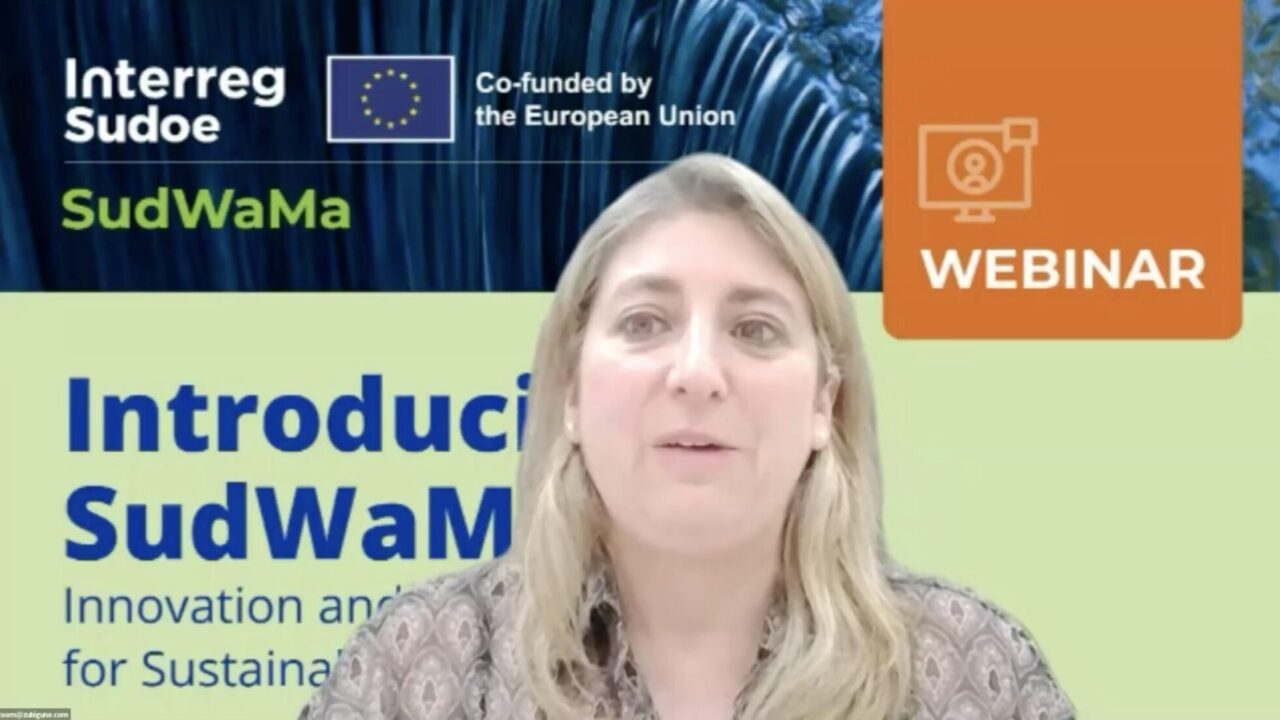
Southern Europe is facing a structural water crisis. With droughts becoming more frequent and urban
pressure rising, the SudWaMa project (Sustainable Water Management) has launched its first
webinar to present a roadmap toward a more resilient and circular future.
The SUDOE territory (Spain, France, and Portugal) is at a turning point. As climate change disrupts
traditional rainfall patterns, the linear «extract-consume-discard» model of water management is no
longer viable. In response, the SudWaMa initiative, co-funded by the Interreg Sudoe Programme, is
leading a transnational effort between 2025 and 2028 to transform institutional buildings into «Living
Laboratories» for sustainable innovation.
The project’s inaugural webinar brought together the partners and stakeholders of the project to highlight
a critical shift in perspective: urban runoff should not be treated as a waste product to be evacuated, but
as a precious resource to be harvested.
During the online event, experts discussed the transition toward Circular Water Management, focusing
on three strategic pillars: policy harmonization, technological innovation (greywater and rainwater reuse),
and citizen engagement.
Turning cities into “sponges”
One of the most compelling topics addressed was the implementation of Sustainable Urban Drainage
Systems (SUDS). By adopting the «Sponge City» concept, urban environments can mimic natural cycles,
allowing water to infiltrate and evaporate rather than overloading sewage systems.
The webinar showcased how green roofs, rain gardens, and permeable pavements—like those used in
major sports stadiums and exhibition centers—can manage water volume, improve quality through
natural filtration, and enhance urban biodiversity.
Another highlight of the session was the introduction of the Water Performance Diagnosis (DPH –
Diagnostic de Performance Hydro). Much like the well-known energy efficiency labels for appliances
and homes, the DPH assigns a rating from A to G to buildings based on five key indices:
- Quantitative: Measuring flows and control processes.
- Qualitative: Evaluating chemical and organic pollutants.
- Equipment & Behavior: Analyzing the efficiency of devices versus user habits.
- Biotope Coefficient: Surface permeability.
- Hydric Stress: Projecting needs for 2030 and 2050.
This framework, currently undergoing AFNOR standardization for 2027, aims to help buildings achieve
up to 40% water savings.
The Portuguese model
The webinar also provided a masterclass in governance through the case of Portugal. Since 1993, the
country has transformed its water sector through a €40 billion investment and structural reforms. Key
takeaways included the importance of independent regulation (ERSAR), the aggregation of services to
gain scale, and long-term strategic planning (30-year visions).
This approach has led Portugal to achieve near-universal drinking water quality and a massive increase
in wastewater treatment coverage (from 28% to 86%).
Join the SudWaMa community
The SudWaMa project demonstrates that sustainable water management is not just a technical
challenge, but a social and political one. By combining «green» and «grey» infrastructures with active
citizen participation, the SUDOE area is positioning itself as a European reference for climate adaptation.
Be part of the solution. To stay updated on future webinars, access expert insights, and explore real-
world project results, you can join the SudWaMa database by leaving your contact details here.
Together, we are building a water-secure future for Southern Europe.
SudWaMa is led by Zubigune Fundazioa and its consortium gathers Universidade de Coimbra,
Universidad Politécnica de Madrid, CEIGRAM-UPM, BREEN AQUAPONIC SYSTEMS SL, ESSEC
Business School, Canal de Isabel II, Águas de Coimbra, E.M., Communauté Pays Basque and
BUILD:INN, Basque Construction Cluster.