
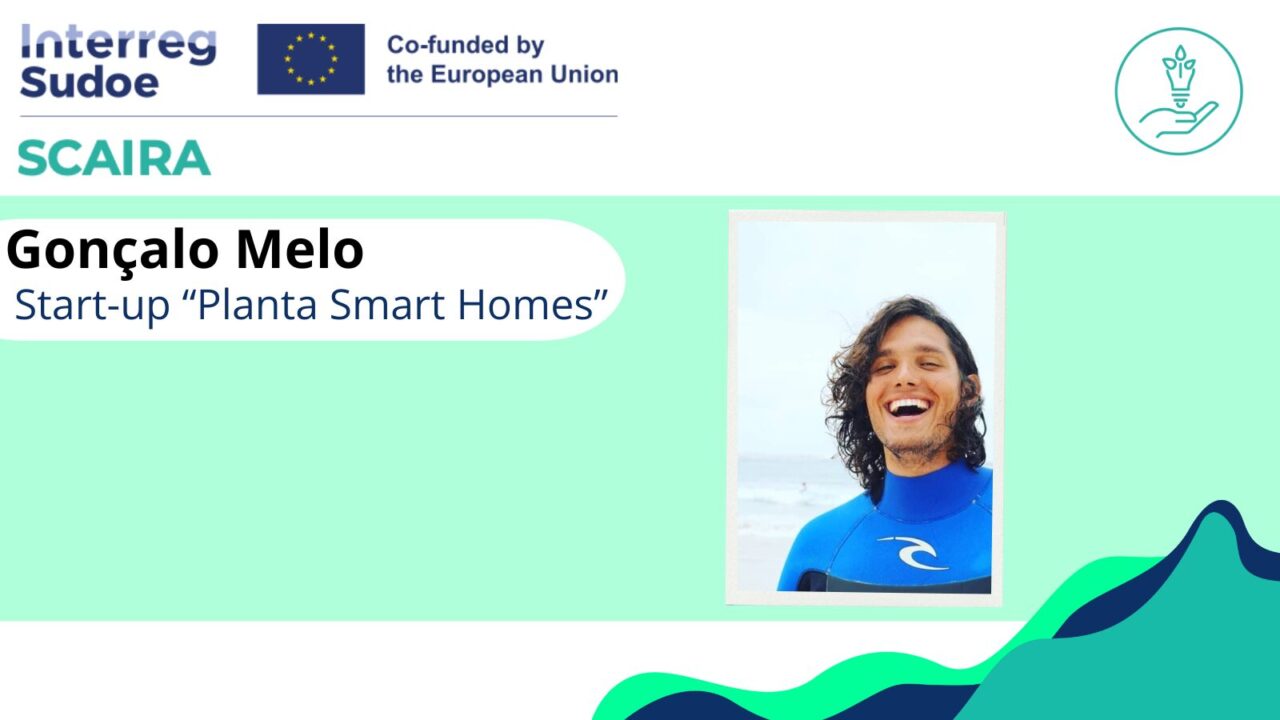
Meet Gonçalo Melo, selected in the second call with his project Planta Smart Homes.
Tell us briefly about yourself and your background!
My name is Gonçalo Melo. I’m Portuguese, and my background lies in Digital Product Design, AI-driven systems, and architectural innovation. I studied and worked for several years in Amsterdam, taking part in large-scale design projects, including the development of visual systems for the Philips Amsterdam headquarters. Throughout my career, I have focused on building products that bring together design, engineering, and intelligence, collaborating with international companies such as Unicage (data engineering, automation, and Python systems).
My passion for systemic design and automation eventually led me to create Planta Smart Homes, where I now serve as CEO.
How did you find out about SCAIRA?
I learned about SCAIRA through Startup Portugal. What immediately caught my attention was the quality of its corporate partners (Renault–HORSE, Airbus Atlantic, Aerospace Valley), the strength of its European sustainability vision, and the opportunity to work on a concrete industrial challenge with real impact. The programme stood out as one of the few European initiatives that genuinely connect startups with major industrial players.

What stage is your start-up currently at?
Planta Smart Homes is currently in an early-traction stage, with its core concept fully developed and the MVP underway (Core OS – an intelligent automation layer). The project has already been selected for three major acceleration programmes: SCAIRA (EU / Renault–HORSE / Airbus), NEXXT Ideas Leiria, and Techstars Startup Week Guimarães. We are now preparing our first industrial pilot integration. The project is growing rapidly on both the technical and business fronts.
What is the nature of your project, and what problem does it aim to solve?
Planta Smart Homes is developing Core OS — now referred to as Planta OS — an operating system for smart housing that brings together AI, architecture, sensors, and energy management. The core problem we aim to solve is that housing remains too expensive, static, inefficient, and not intelligent by default.
Our mission is to:
- Make homes intelligent from the outset, rather than through luxury add-on devices.
- Reduce housing and energy costs through real-time adaptation.
- Bring industrial-level efficiency to residential environments.
- Enable sustainable, modular, and flexible living systems.
In the coming years, I envision the company setting a new global standard for smart, adaptive housing — starting in Europe and expanding worldwide.
Which SCAIRA services have you chosen?
Service 1: Legal and administrative training for start-up creation.
Service 3: National public funding opportunities for start-ups and green innovations.
Service 6 & 7: Proof of concept (POC) and Minimum Viable Product (MVP) development.
Service 8: Industrialisation acculturation – technical and sustainability roadmap.
Service 11: Business plan development and Business Model Canvas.
What are your short-term objectives during the acceleration programme?
During the acceleration programme, our priorities are to develop a clear industrial module that responds directly to the HORSE energy-optimisation challenge, while strengthening our IP strategy and patent protection for software–hardware integration. We also aim to structure a robust business plan and financial model for the next phase, build the first cross-sector proof of concept connecting housing to industrial energy management, and expand the company structure as we prepare for early investment.
Who is your target market and what customer need are you addressing?
Our primary target markets include real estate developers and housing companies, industrial partners working in energy, automation and sustainability, municipalities implementing smart infrastructure, and early adopters of sustainable, modular housing systems. Across these sectors, we address the growing need for affordable, intelligent and efficient housing, as well as energy optimisation solutions that can operate effectively in both residential and industrial contexts.
What are your main challenges right now?
Our main challenges comprise securing funding for large-scale prototypes, protecting the intellectual property of the Core OS system, and recruiting and structuring a strong multidisciplinary team. We also face the technical complexity of integrating AI, sensors and automation into a unified system, while ensuring that development timelines remain aligned across our European partners.
Do you already have a team?
Planta Smart Homes is currently led by myself, overseeing CEO duties as well as design and product strategy, and supported by Unicage for software engineering, data automation and Python infrastructure, Mobinov for industrial mentorship, and external collaborators specialising in electronics, energy and IoT consulting. We are preparing to expand with the addition of a dedicated business developer and robotics or automation engineers. As a whole, we operate as a lean innovation lab focused on intelligence, automation and modular design.