
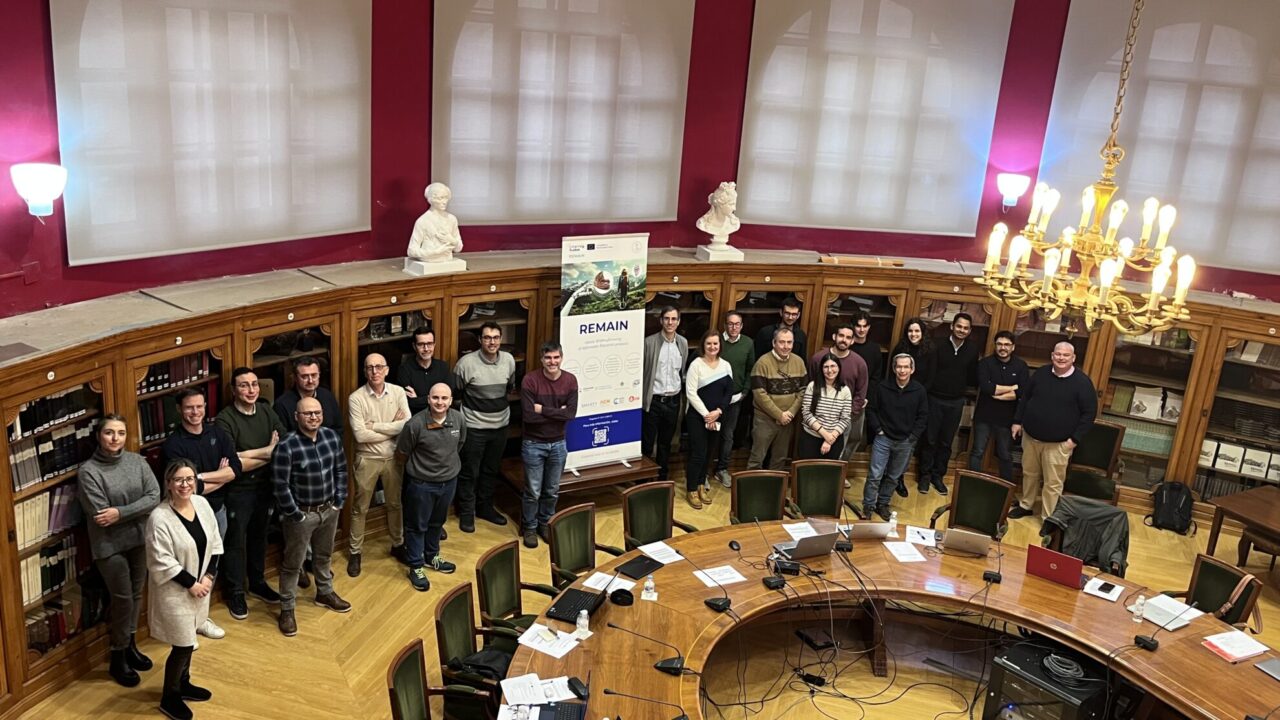
The Interreg SUDOE REMAIN project held its fourth transnational meeting in Spain to review progress on various research areas of an initiative that is making key strides toward the completion of a project combining robotics and sustainability to implement industrial remanufacturing in Europe.
On January 14th, the REMAIN consortium gathered in Zaragoza for its 4th transnational meeting, a pivotal event where partners shared advancements and defined the next steps to successfully complete the project. The meeting took place at the iconic Paraninfo of the University of Zaragoza, which hosted the event. This gathering not only marked a significant advancement in the development of robotic remanufacturing technologies but also occurred at a crucial time, right at the start of the project’s final year, when the development of demonstrators that concretely reflect the progress made becomes especially important.
During the event, key progress was presented in the three REMAIN working groups, each focusing on different aspects of robotic remanufacturing. One of the standout achievements was in the detection and classification of damage in products such as footwear, where significant progress has been made using vision systems, advanced tactile sensors, and machine learning models. These innovations enable the automation of damage identification and evaluation, as a preliminary step for addressing the possible remanufacturing of industrial products.
Another highlight was the development of tools to reintroduce damaged products into the production chain, where successful tests were carried out on the handling of deformable objects using robots supported by innovative technologies such as multispectral vision sensors. These advancements help pave the way for the creation of an efficient robotic system that facilitates the repair, remanufacturing, and reuse of damaged or obsolete products, thereby promoting a circular economy model.
Additionally, the evolution of the Eco-Design Guide was presented. This is a key document focusing on essential principles such as durability, reparability, and modularity of products from the moment of their design, considering both design and materials involved, to facilitate their repair and remanufacturing, thus fostering a more sustainable production model.
The event also provided an opportunity to review the communication and dissemination activities carried out by the REMAIN partners in the past period and present the action plan for 2026. This plan will strengthen the global communication strategy to maximize its reach, both in the industry and among the general public.
Thus, REMAIN continues to make progress in the development of innovative solutions in the field of robotic remanufacturing, promoting sustainability and the circular economy throughout the SUDOE region. These achievements are crucial in reducing the environmental impact of production, offering new opportunities for the industrial sector, and contributing to the creation of a more sustainable and responsible future.
Project partners
The REMAIN project is coordinated by Inescop – Footwear Technology Centre, with the participation of the Universities of Zaragoza, Alicante, Coimbra, and Clermont Auvergne INP; the Federation of Spanish Footwear Industries (FICE); and the companies SMA-RTY, Automática y Control Numérico S.L., and AIDA CCI, with the social association Proyecto Lázaro acting as a collaborating partner.