
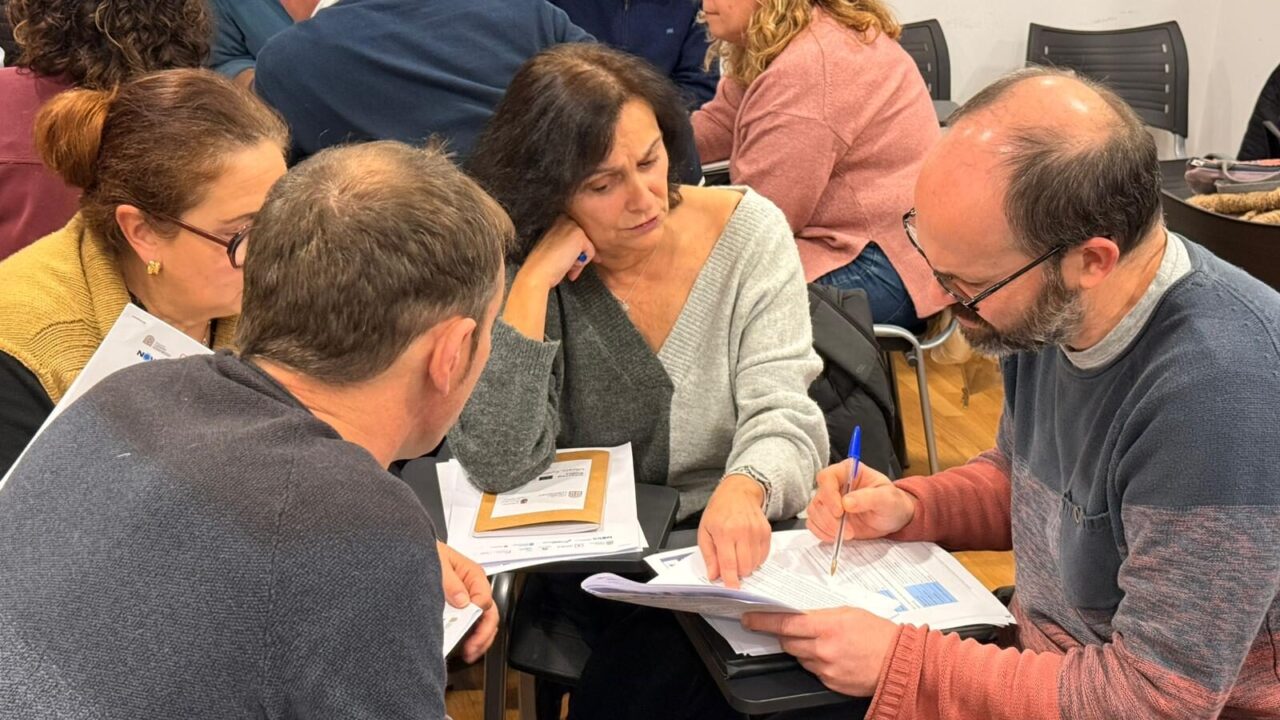
The meeting served to work on the first of the project’s seven strategic lines, the one related to shared governance.
The Camino Lebaniego Foundation held in San Vicente de la Barquera the second meeting of the Hub or working group of the European project ULTREIA-Sudoe, giving continuity to the collaborative governance process initiated several weeks ago, with the aim of promoting the economic and social revitalisation of the Camino Lebaniego territories. The choice of San Vicente de la Barquera as the host location reflects its strategic role as a connection point between the Northern Way of Saint James and the Camino Lebaniego, and reinforces the itinerant nature of the Hub, which will hold a total of five working meetings throughout the year in different locations across the territory.
This second meeting, the first with an operational focus following the initial informational session held in Potes, brought together institutional representatives (among them the mayor of Herrerías, Ramón Cuesta), local stakeholders and professionals connected to the Camino, consolidating a shared working space aimed at defining concrete and consensual actions that contribute to the sustainable development of the region.
During this first session, work was carried out on the strategic lines of the ULTREIA-Sudoe project, particularly that of shared governance. At the end of the meeting, agreements were reached on topics such as the frequency of the sessions, the invitation to other sectors to participate, and the expansion of the group’s communication channels. The following meetings will address the remaining strategic lines, including the enhancement of cultural heritage, local development, improvement of the pilgrim experience, universal accessibility, technological innovation, and adaptation to climate change, all of which are included in the Ultreia Sudoe Action Plan.
Both the director of the Camino Lebaniego Foundation, Pilar G. Bahamonde, and the mayor of San Vicente de la Barquera, Charo Urquiza, highlighted the positive tourism figures for 2025 regarding the arrival of pilgrims on the Camino Lebaniego, as well as the need for joint work involving all actors to ensure the sustainable development of the route—an objective that will be supported by the actions carried out within this project.
In parallel with the launch of the Hubs, the Ultreia Sudoe project is implementing other complementary actions aimed at improving the management of the Camino and the experience of pilgrims and visitors. These include the installation of footfall measurement systems at various points along the route to obtain reliable data on traffic flows, as well as the creation of “Stops along the Camino”, physical and virtual spaces for welcome, rest and information, which also serve as meeting points with local residents and as showcases for local products and services, helping to stimulate the local economy and sustainability.
This process is part of the European ULTREIA-Sudoe project, developed within the Interreg Sudoe Programme, whose goal is to revitalise inland tourism and promote rural development in the territories crossed by the Ways of Saint James, fostering shared strategies among the regions of southwestern Europe.
With the implementation of these working Hubs, the Camino Lebaniego Foundation strengthens its commitment to more coordinated, innovative, and sustainable management of the Camino, promoting public–private collaboration as a key tool to reinforce the local economy and social cohesion.
Ultreia-Sudoe Project
The Ultreia Sudoe project is carried out within the framework of the European Interreg Sudoe Programme, and alongside the Spanish entities (Camino Lebaniego Foundation, Santa María la Real Foundation, Association of Municipalities of the French Way of Saint James, Amica and the S.A. de Xestión do Plan Xacobeo), the Agence Française des Chemins de Compostelle in France, the Portuguese municipality of Vila Pouca de Aguiar, and the Faculty of Science and Technology of the NOVA University of Lisbon are also participating. It should be noted that the Camino Lebaniego Foundation is also an active member of the European Federation of the Ways of St. James.
The initiative aims to revitalise inland tourism and promote rural development in the territories through which the Ways of Saint James pass. The goal is to develop a shared strategy for all the routes within the SUDOE area (Southwestern Europe).
ULTREIA-Sudoe, with a total budget of €1,407,300 distributed among the eight partners and financed 75% by the Interreg Sudoe Programme, will run until 2026.
Through ULTREIA-Sudoe, the Camino Lebaniego Foundation reaffirms its commitment to the revitalisation of rural tourism and the dynamisation of historic territories, thereby strengthening the ties among the communities along the Ways of Saint James in southwestern Europe.