
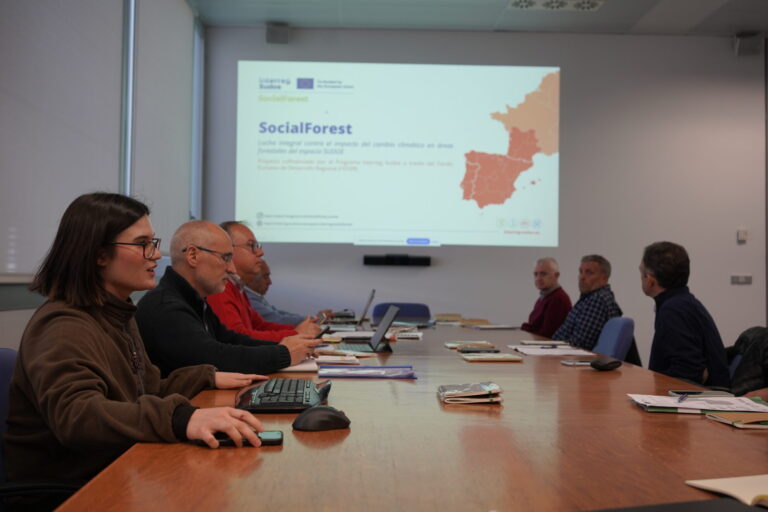
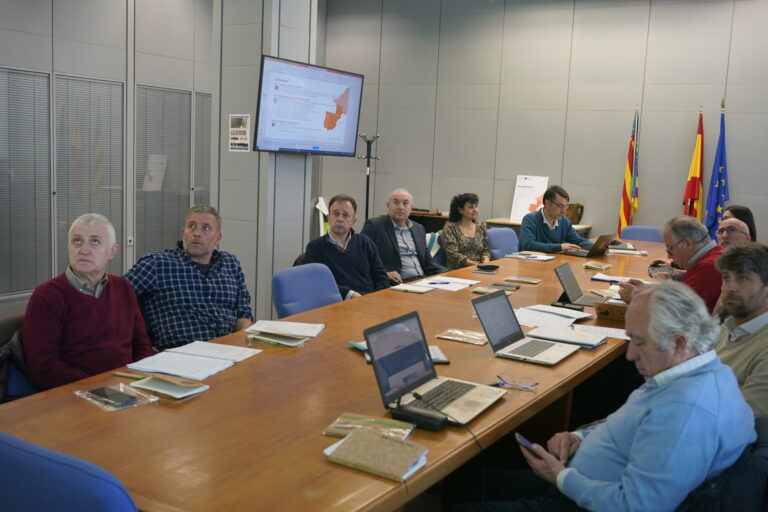
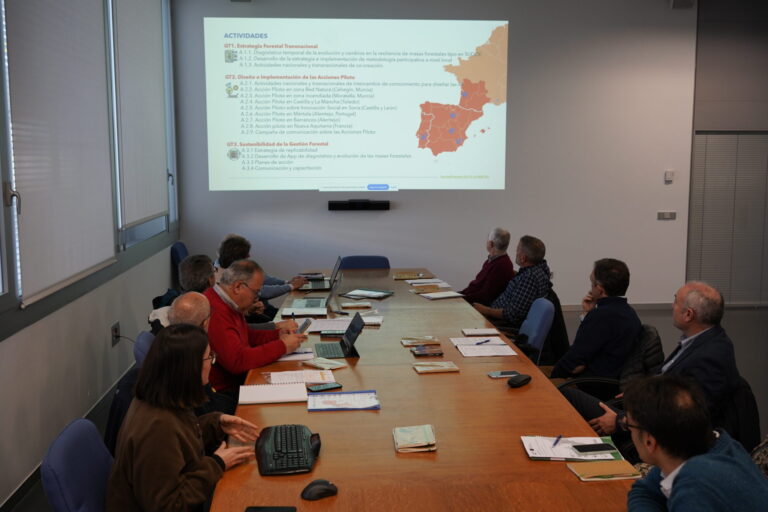
The European SocialForest project has held a series of technical workshops in Spain, France and Portugal, bringing together forest managers, public authorities, researchers and local stakeholders to advance the design of a Transnational Forest Strategy adapted to the challenges of climate change in the SUDOE area.
The meetings focused on representative habitat types: Mediterranean pine forests in the Region of Murcia and Aquitaine, dehesas in Castilla-La Mancha and Alentejo, and endemic juniper forests in the province of Soria. The aim was not to create a new strategy, but to further develop and adapt existing ones to the specific realities of these ecosystems, combining scientific knowledge with territorial experience.
The workshops were based on a prior diagnosis, developed through biophysical analyses and interviews with local stakeholders, which highlighted common problems such as increasing droughts, declining profitability of traditional forest uses, ageing forest stands and rural abandonment. In the pine forests of Murcia, water stress, pests and wildfire risk are the main threats; in dehesas, the lack of tree regeneration and the decline of extensive livestock farming; and in the juniper forests of Soria, management difficulties arising from isolation, low profitability and regulatory constraints.
Based on this diagnosis, participants worked on defining priority management objectives and assessing how different forest measures influence ecosystem services, such as water regulation, biodiversity, fire prevention and local socioeconomic development. New proposals were also discussed to improve the adaptation of these systems to climate change, ranging from silvicultural treatments and grazing management to diversification of uses, ecotourism and payments for ecosystem services.
The conclusions of these workshops provide the basis for classifying measures according to national strategies and orienting them towards resistance, resilience or transition approaches, depending on the level of vulnerability of each territory. In this way, SocialForest moves forward towards a practical tool that will enable local managers to make coherent decisions, aligned with public policies and adapted to the climatic and social challenges facing forests in southwestern Europe.