
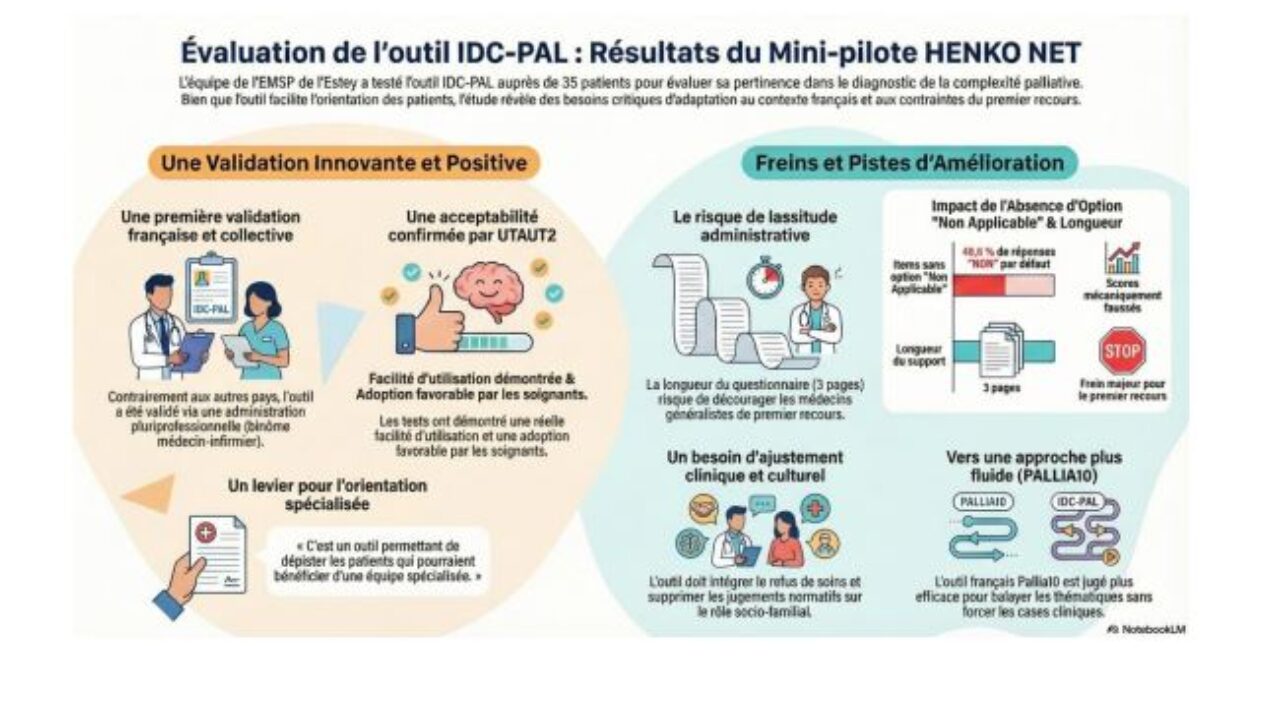
The Équipe Mobile de Soins Palliatifs (EMSP) team at Estey, part of the Pavillon de la Mutualité in Bordeaux and a partner in the European HENKO NET project, has completed the mini-pilot of the IDC-PAL tool, an instrument designed to identify the complexity of palliative situations in patients with advanced or terminal illnesses.
Between November 2025 and January 2026, seven professionals—three doctors, three nurses and a psychologist—evaluated the tool with 35 patients aged between 48 and 96.
A focus group was held with the professionals involved, and their main contributions emphasise that the main usefulness of the tool is clear: ‘It allows the detection of patients who could benefit from a specialised team’ and would also improve ‘initial guidance towards palliative care resources’.
In turn, the study reveals that the actual target audience for the tool is not experts and professionals specialising in palliative care. They believe that the IDC-PAL could be more aimed at general practitioners or teams who need initial support to identify complexities. ‘It is more for those who have no experience in palliative care.’
The mini-pilot methodology included home visits in pairs, joint completion of the questionnaire, multidisciplinary discussions and qualitative analysis using a focus group, as well as evaluation using the UTAUT2 questionnaire, which confirmed its acceptability and ease of use.
Even so, the discussion group expressed one major concern: the length of the questionnaire—three pages—could discourage already overworked general practitioners. ‘There is a risk that there will be no notifications simply because it is three pages long,’ warned the team’s psychologist.
The study also generated several suggestions for improvement, such as including the option “Not applicable” in all items, adapting the content to the French context—especially the socio-family dimension—and integrating essential aspects of palliative care that are not currently reflected, such as refusal of care, proportionality of treatments, and palliative sedation.
The professionals also recommended comparing IDC-PAL with the French tool PALLIA10, which is considered more flexible and capable of covering situations that IDC-PAL fragments or does not contemplate, including conflict management within the team or requests for early death.
Finally, the team highlighted the potential of IDC-PAL as a research tool for measuring the impact of palliative care interventions. ‘It would be interesting to see if complexity levels decrease over time,’ explained the psychologist.
The study is a first step towards the adaptation and validation of IDC-PAL in France, contributing to HENKO NET’s objective of improving the management of palliative situations through shared solutions between France, Spain and Portugal.