
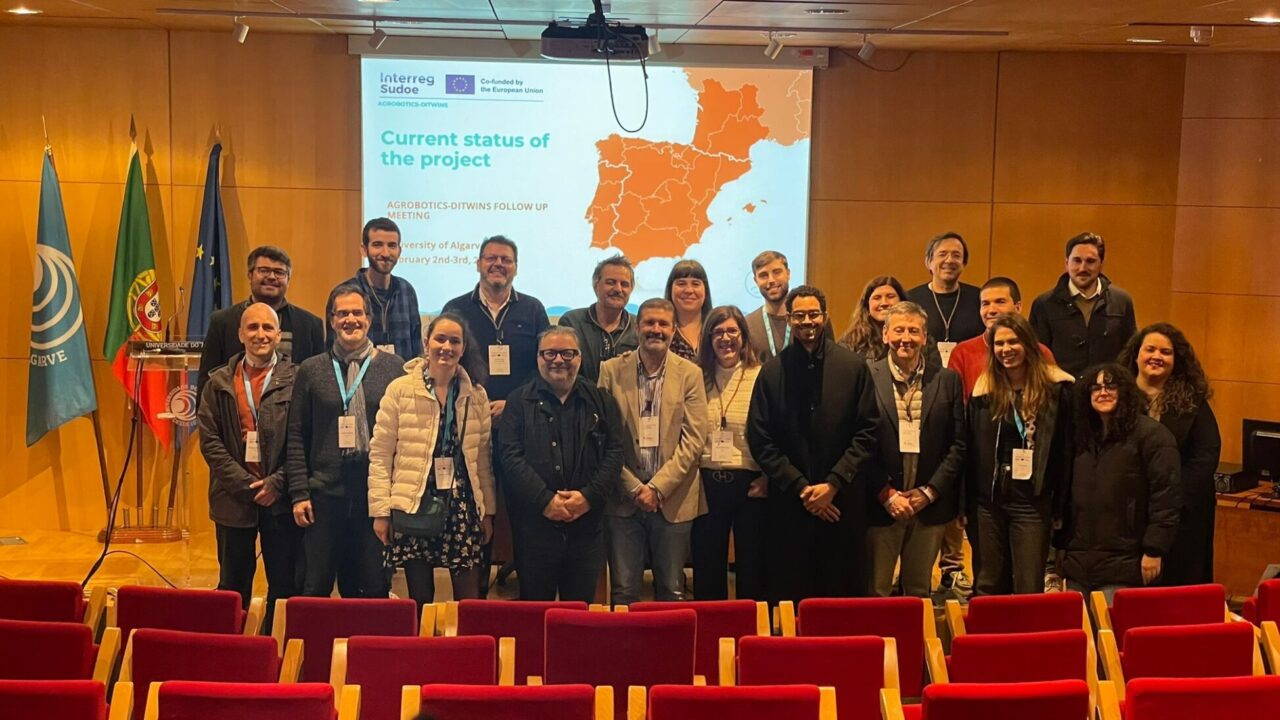
The European project Agrobotics Di-Twins, co-financed by the Interreg Sudoe programme, held its second in-person meeting on 2 and 3 February at the Instituto Superior de Engenharia of the University of Algarve, in Faro (Portugal).
The meeting once again brought together consortium partners from Spain, France and Portugal, with the aim of advancing the project’s technical development, coordinating upcoming actions, and strengthening joint work towards the creation of innovative solutions in agro-robotics.
Supporting Agricultural Companies Towards Agriculture 5.0
Agrobotics Di-Twins aims to support agricultural companies in the integration of robotic technologies to improve efficiency and productivity, while simultaneously reducing the environmental impact of farming operations.
The project provides a working environment based on Living Labs and Digital Twins, enabling companies to analyse and simulate robotic solutions before making major investments. In addition, participants benefit from training and technical support throughout the entire process. This approach facilitates the transition of agricultural SMEs towards the Agriculture 5.0 model, combining technological innovation, sustainability and economic viability.
Technical Coordination, Living Labs and Upcoming Milestones
During the meeting, the consortium reviewed the project’s progress, analysing the activities carried out to date and aligning criteria for the preparation of upcoming technical deliverables. Progress was also made in defining a common approach for the design and implementation of the Living Labs, which will serve as one of the main spaces for experimentation and validation of agro-robotic solutions within the project.
The meeting also addressed key cross-cutting topics, such as the communication strategy, quality and monitoring procedures, and the planning of future pilot actions with companies. These pilot activities will focus on testing robotic solutions under real operating conditions through the use of digital twins.
These working sessions helped strengthen coordination among partners and consolidate a shared roadmap for the coming months, ensuring consistent implementation aligned with the project’s objectives.
A Strong Partnership Driving Agro-Robotic Innovation
Agrobotics Di-Twins is supported by a consortium of 13 beneficiary partners and 3 associated partners from Spain, France and Portugal, bringing together universities, technology centres, business associations, technology parks and innovative companies.
The partnership is led by the University of Málaga as the coordinating entity, together with the University of the Basque Country (EHU/UPV), Miguel Hernández University of Elche, University of Huelva, University of Algarve, Université de Limoges, Málaga TechPark, Data CoLab, NERA – Associação Empresarial da Região do Algarve, Aquitaine Robotics, OSFARM, FI Group and ELATEC.
In addition, the project includes three associated partners: Cluster Machinisme, ASAJA Málaga – Asociación Agraria de Jóvenes Agricultores, and AlgarOrange – Associação de Operadores de Citrinos do Algarve.
Next Steps
Following this second in-person meeting, Agrobotics Di-Twins will continue advancing its technical and coordination activities, with a strong focus on defining and launching the Living Labs and preparing the first pilot actions based on digital twins.
In this context, the project has launched a questionnaire aimed at agricultural companies, cooperatives and other organisations in the sector interested in participating. The goal is to identify real needs, operational conditions and opportunities for the implementation of robotic solutions. Based on the results, selected entities will be invited to take part in future project activities, including pilot experiences, technical support and assistance in identifying funding opportunities.
Interested organisations can access the questionnaire via the following link.
Through these actions, Agrobotics Di-Twins reinforces its commitment to direct collaboration with the agricultural business ecosystem in the SUDOE region, facilitating the progressive adoption of advanced technologies in a safe environment and supporting companies in their transition towards Agriculture 5.0.