
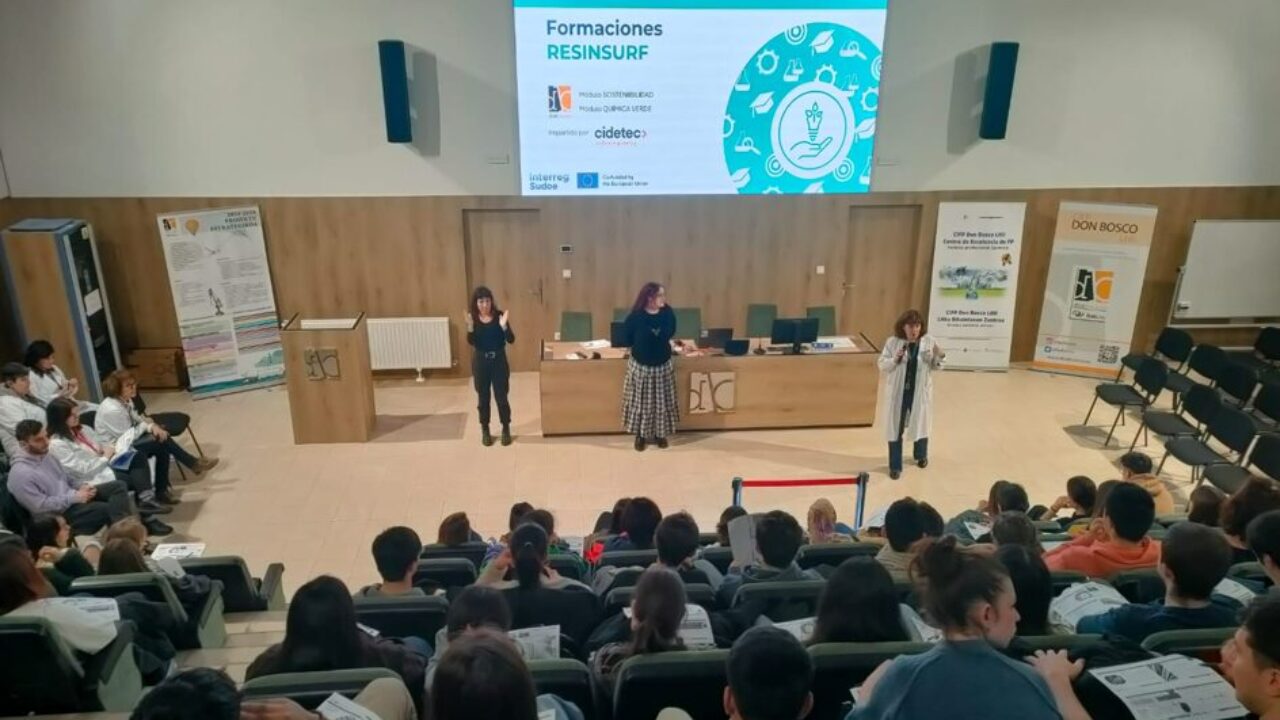
 Within the framework of the RESINSURF project, staff from CIDETEC Surface Engineering, as the consortium leader, delivered a training session at the Don Bosco centre, an associated entity of the project. The activity brought together over ninety teachers and vocational training students from the Sustainability and Green Chemistry modules, strengthening cooperation between the educational field and applied research in the industrial sector.
The session addressed key topics related to European regulation and critical substances — such as those managed by ECHA and the REACH regulation — as well as the role of hexavalent chromium (Cr(VI)) in coating processes. The advances of the pilots developed within RESINSURF were also presented, showing how science and technology contribute to replacing hazardous compounds with safer and more sustainable alternatives. The session further highlighted the relevance of industrial scale-up and demonstration pilots in validating innovative solutions and their potential impact on transforming the surface coating sector towards more responsible and competitive models.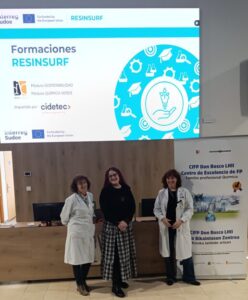
To foster active and inclusive participation, the activity featured sign language interpretation, ensuring full accessibility for all attendees. It also integrated digital teaching methodologies, such as the interactive tool Mentimeter, which enabled students to participate in real time through their mobile devices, creating a dynamic learning environment and encouraging the exchange of ideas.
The training also provided an opportunity to reflect on the challenges of transitioning towards a more sustainable industry, both from a business perspective and that of European public policies.
Don Bosco, a leading centre in technical and industrial vocational training, actively collaborates with RESINSURF in disseminating knowledge and linking technical education with applied innovation. Meanwhile, CIDETEC Surface Engineering, based in San Sebastián, leads the RESINSURF project, which seeks to develop innovative solutions to replace hexavalent-chromium-based coatings with safer and more sustainable alternatives.
Activities such as this one reinforce RESINSURF‘s commitment to training new generations of professionals — essential for driving a more responsible, innovative, and inclusive European industry.
The RESINSURF project is part of the Interreg Sudoe program, which promotes cooperation among regions in southwestern Europe to foster innovation, sustainability, and competitiveness. Through this initiative, transnational collaboration between research centres, companies, and educational institutions is encouraged, developing joint solutions to environmental and industrial challenges in the Sudoe area.