
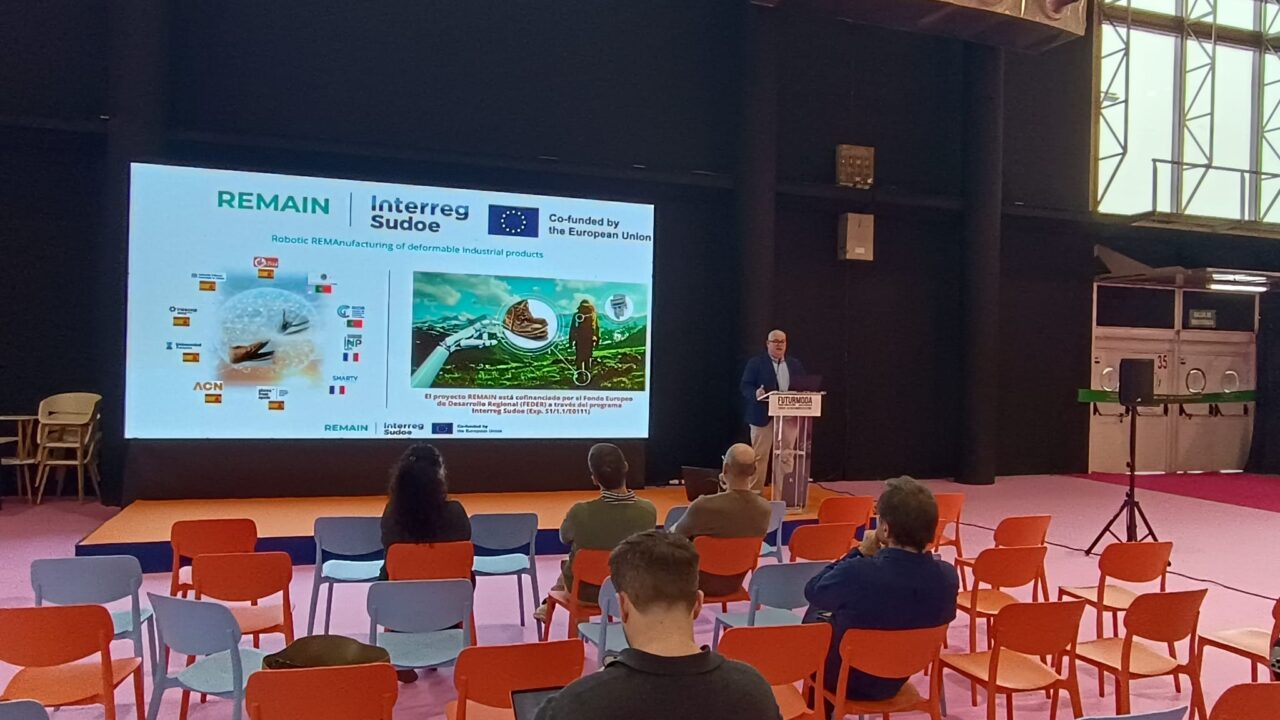
On March 4, within the framework of the international trade fair FUTURMODA, held at IFA – Fira Alacant (Elche, Alicante), a joint session organized by the European project REMAIN took place, featuring the Fashion Forward project as a guest. During the session, it was highlighted how technological innovation and the adoption of new circular models can boost companies’ competitiveness and open up new development opportunities.
The session opened with José Francisco Gómez, Head of the Advanced Manufacturing Unit at Inescop, who presented the context and objectives of the European REMAIN project, focused on the development of technological solutions aimed at enabling the industrial remanufacturing of footwear. In his presentation, he explained what remanufacturing applied to industry entails: a process that allows products at the end of their life cycle to be recovered, reconditioned, and returned to the market with performance equivalent to that of a new product.
During his presentation, José Francisco introduced the demonstrators being developed within the framework of the project, including automatic damage detection systems for footwear, a multi-robot cell for remanufacturing operations, an eco-design guideline aimed at facilitating repair and remanufacturing from the product design stage, and strategies to promote the transfer of these technologies to the industrial sector.
He also highlighted the impact these solutions may have on the industry, as they make it possible to transform what is currently considered waste into a valuable asset. This opens up new opportunities such as business lines based on remanufacturing, advanced after-sales services, market differentiation, and higher value-added products.
For her part, Lídia Morcillo, Innovation Manager at Modacc, presented the Fashion Forward project, an initiative aimed at promoting the transition toward circularity in the textile and fashion sector in Spain, southern France, and Portugal. During her presentation, she outlined the main advances and results of the project, highlighting the development of tools and methodologies designed to help companies adopt circular models and practices. She also emphasized how the integration of these approaches can become a strategic factor in improving the sector’s competitiveness, especially in a context marked by increasingly demanding environmental regulations.
The session held at Futurmoda highlights the key role of innovation, technology, and collaboration between European initiatives as drivers for advancing toward more sustainable production models. This approach enables the industry to generate new value-added opportunities while reducing its environmental impact and moving toward a circular economy.
Project partners
The REMAIN project is coordinated by Inescop – Footwear Technology Centre, with the participation of the Universities of Zaragoza, Alicante, Coimbra, and Clermont Auvergne INP; the Federation of Spanish Footwear Industries (FICE); and the companies SMA-RTY, Automática y Control Numérico S.L., and AIDA CCI, with the social association Proyecto Lázaro acting as a collaborating partner.