
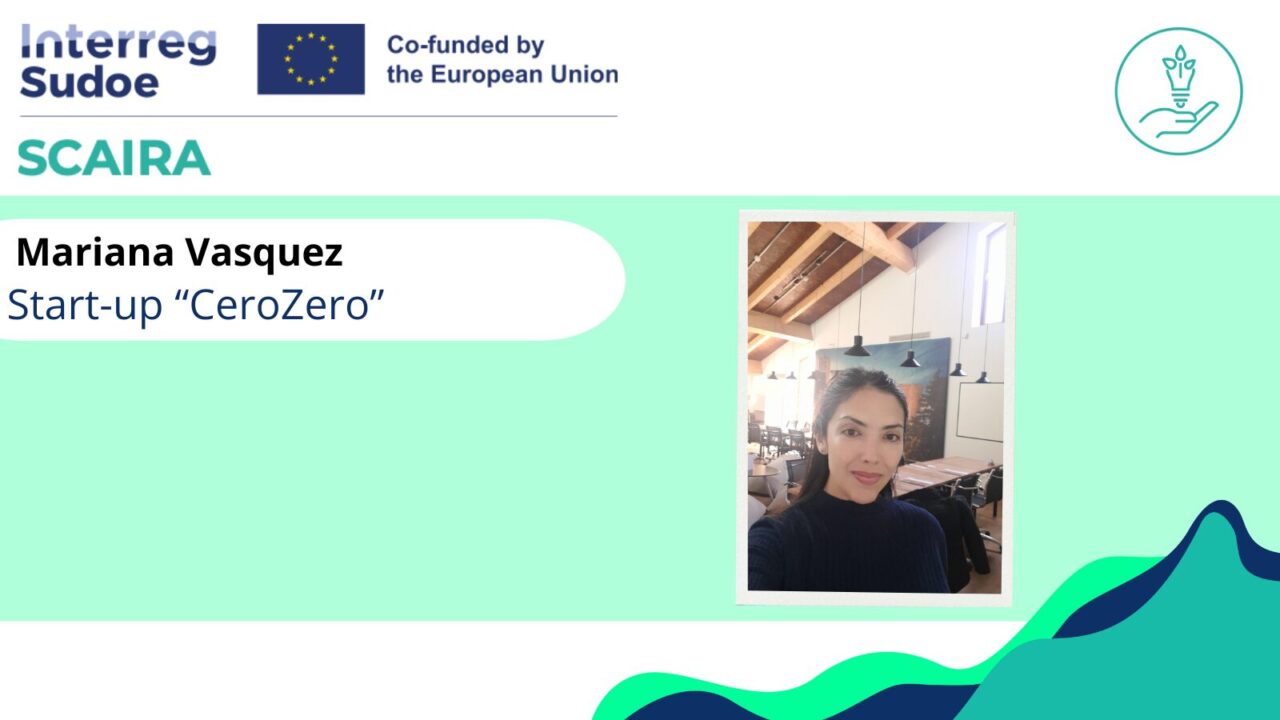
Meet Melo Mariana Vasquez, selected in the second call with his project CeroZero.
Tell us briefly about yourself and your background!
I am a psychologist and applied researcher with an MSc in Consumer Psychology, with professional experience in market research and innovation projects focused on real user needs and behavioral risk reduction.
During a trends observatory project, I identified alcohol and drug consumption as major and persistent contributors to road fatalities—accounting for around 25% of traffic deaths in Europe, with an even higher impact in specific segments. Despite this, I observed a lack of scalable preventive solutions capable of acting before driving takes place.
This insight led me to launch project CeroZero, combining behavioral science, speech-based neuromotor assessment, and digital technology to contribute to safer mobility ecosystems.

How did you find out about SCAIRA?
I learned about SCAIRA through LinkedIn and was immediately interested due to its strong alignment with European mobility priorities, particularly the EU Vision Zero roadmap.
What appealed most to me was SCAIRA’s positioning as a bridge between innovation, industry, and deployment—especially its close connection to the automotive and mobility ecosystem, where safety, prevention, and intelligent mobility are strategic priorities.
What stage is your start-up currently at?
The project is in an advanced MVP refinement phase. In parallel, we are working on regulatory, legal, and go-to-market aspects, as well as customer discovery and early use-case validation.
The solution operates at the intersection of scientific research (speech-based neuromotor coordination assessment), digital technology, and mobility risk management, which requires a structured approach to validation and industrial readiness.
What is the nature of your project, and what problem does it aim to solve?
The project focuses on detecting impaired neuromotor coordination—commonly associated with alcohol or drug consumption—at the critical moment when a user attempts to activate or access a vehicle (car, motorcycle, or shared mobility vehicle).
The solution is designed as a short, scalable digital test deployable on mobile devices and integrable into vehicle access systems or fleet management platforms. When a high risk is detected, access to the vehicle can be temporarily denied.
The objective is to shift road safety from reactive to preventive, reducing accidents before they occur. This approach has a direct impact on accident severity and frequency, human harm reduction, and cost volatility for fleet operators and insurers, while supporting safer and more affordable mobility services.
Which SCAIRA services have you chosen?
Service 1: Legal and administrative training for start-up creation.
Service 2: Training in intellectual property.
Service 3 & 4: National public funding opportunities for start-ups and green innovations.
Service 6 & 7: Proof of concept (POC) and Minimum Viable Product (MVP) development.
Service 8: Industrialisation acculturation – technical and sustainability roadmap.
Service 10: Marketing and business communication.
Service 11: Business plan development and Business Model Canvas.
Service 13: Project preparation for its presentation to industry and investors, including registration on LOOM.
Service 14: B2B meetings between startups and industrial companies, and B2F meetings between startups and investors.
What are your short-term objectives during the acceleration programme?
During the programme, my goal is to work with SCAIRA mentors and European experts to:
• validate the solution from a technical, regulatory, and industrial perspective;
• refine priority use cases within automotive, shared mobility, and fleet contexts;
• strengthen the project’s readiness for pilot deployment and partnerships.
Ultimately, I aim to increase the project’s maturity, credibility, and alignment with industry requirements in order to prepare for real-world implementation.
Who is your target market and what customer need are you addressing?
What are your main challenges right now?
The main challenge is to advance a pioneering preventive safety solution in a domain with limited existing benchmarks, while simultaneously addressing validation, regulatory acceptance, and industry integration requirements.
Do you already have a team?
I collaborate with experts in natural language processing and speech analysis, as well as software developers responsible for the technical implementation of the MVP.