
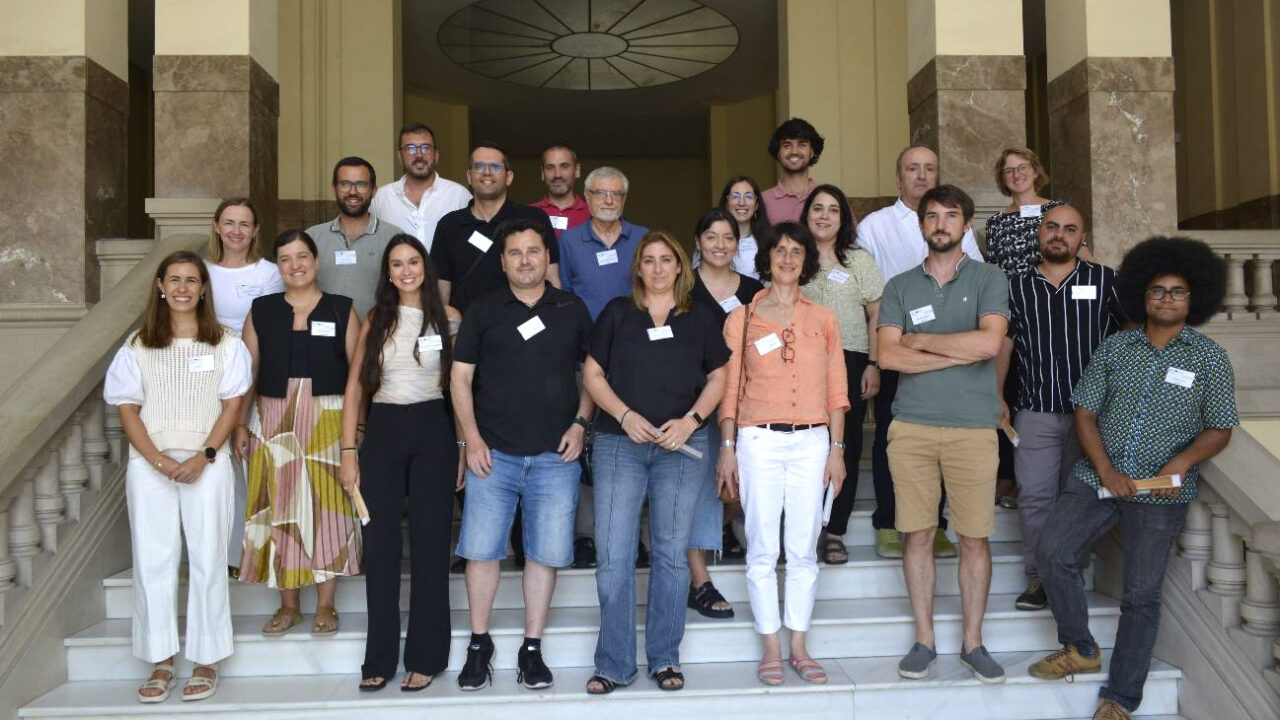
The SudWaMa project (SUDOE Sustainable Water Management), recently approved under the Interreg Sudoe programme, has officially begun with its Kick-Off Meeting held on 9 and 10 July 2025. The event, organised by the Universidad Politécnica de Madrid (UPM) in collaboration with Canal de Isabel II and Zubigune Fundazioa, took place at the School of Agricultural, Food and Biosystems Engineering (ETSIAAB) at UPM in Madrid.
SudWaMa is a 36-month transnational initiative (June 2025 – May 2028) led by Zubigune Fundazioa, with a total budget of €1.699.936,16 (75% ERDF co-funding). Its main goal is to address challenges related to water efficiency and water quality in institutional buildings across the SUDOE area (Spain, Portugal, Southern France). The Project involves 20 Associated Partners from academia, public institutions, NGOs, and SMEs.
The project involves nine main beneficiaries from the three countries of the SUDOE region: Spain, Portugal and France. It is structured around three key Work Packages (WPs), aligned with the project’s main objectives:
- To design a sustainable strategy for circular water management in institutional buildings, promoting water efficiency, water reuse, quality assurance, and behavioural change among users.
- To demonstrate the feasibility of circular water solutions (greywater, rainwater and wastewater) in various demonstration settings.
- To raise awareness and engage users through participatory activities, water labs and educational modules on sustainable water management.
Given the diversity of the project partners, these objectives will be approached with a comprehensive and multidisciplinary vision.
The SUDOE region faces a range of water-related challenges: frequent and prolonged droughts, pollution, and pressure on water resources due to climate change and excessive consumption. Transnational cooperation is crucial because:
- It enables faster experimentation: The diversity of the pilot sites (different water types: grey, rain, wastewater; various climates and uses) facilitates the testing and scaling-up of treatment processes and monitoring tools.
- It helps overcome regulatory and cultural barriers: The project will compare regulatory frameworks and address cultural barriers to adopting the circular water economy, learning from the experiences of each region.
- It promotes policy alignment: Cooperation allows for the alignment of policies, regulations and standards among regions and stakeholders, fostering sustainable water management and climate adaptation solutions.
- It builds sustainable networks: The project will establish networks that support cross-border communication, cooperation, and knowledge exchange.
SudWaMa will implement innovative solutions across four pilot sites located in different parts of the three SUDOE countries. At the ESTIA Campus (France), a campus-scale “Water Smart Grid” will be implemented to collect, store and manage rainwater for toilet flushing, irrigation and cleaning, using sensors equipped with IoT and AI technologies. The pilot will also explore the use of dry urinals to transform urine into fertiliser, and the creation of wetlands to store and mitigate the impact of heavy rainfall.
At the University of Coimbra and Águas de Coimbra (Portugal), the focus will be on greywater reuse for secondary uses (such as garden irrigation and toilet flushing), monitoring water consumption, and implementing water efficiency measures such as flow reducers and dry urinals.
In Spain, there will be two pilot sites. In Madrid, Canal de Isabel II will implement Sustainable Urban Drainage Systems (SUDS) to collect rainwater at source, improve its quality and increase infiltration, thereby enhancing urban resilience to extreme rainfall events. Greywater will also be reused in an institutional building for non-potable purposes. In the Basque Country, BREEN and Zubigune will be responsible for the fourth pilot site, which will simulate sustainable wastewater management through biological processes. The treated water, rich in nutrients, will be used for rooftop hydroponic farming, powered by photovoltaic pumping and monitored using IoT technologies.
The expected impacts of the project include:
- Reduction in potable water consumption and improved water quality
- Increased urban resilience to extreme weather events
- Promotion of the circular economy and behavioural change among users
- Redirecting infrastructure investment to urban areas
SudWaMa begins with momentum, driving a much-needed and urgent shift in how we conceive and manage water in our cities. The commitment of all partners and the wide range of approaches involved promise transformative results that could extend well beyond the SUDOE region. As the project progresses, we will continue to share updates and insights that contribute to a fairer, more efficient, and more resilient approach to water management.