
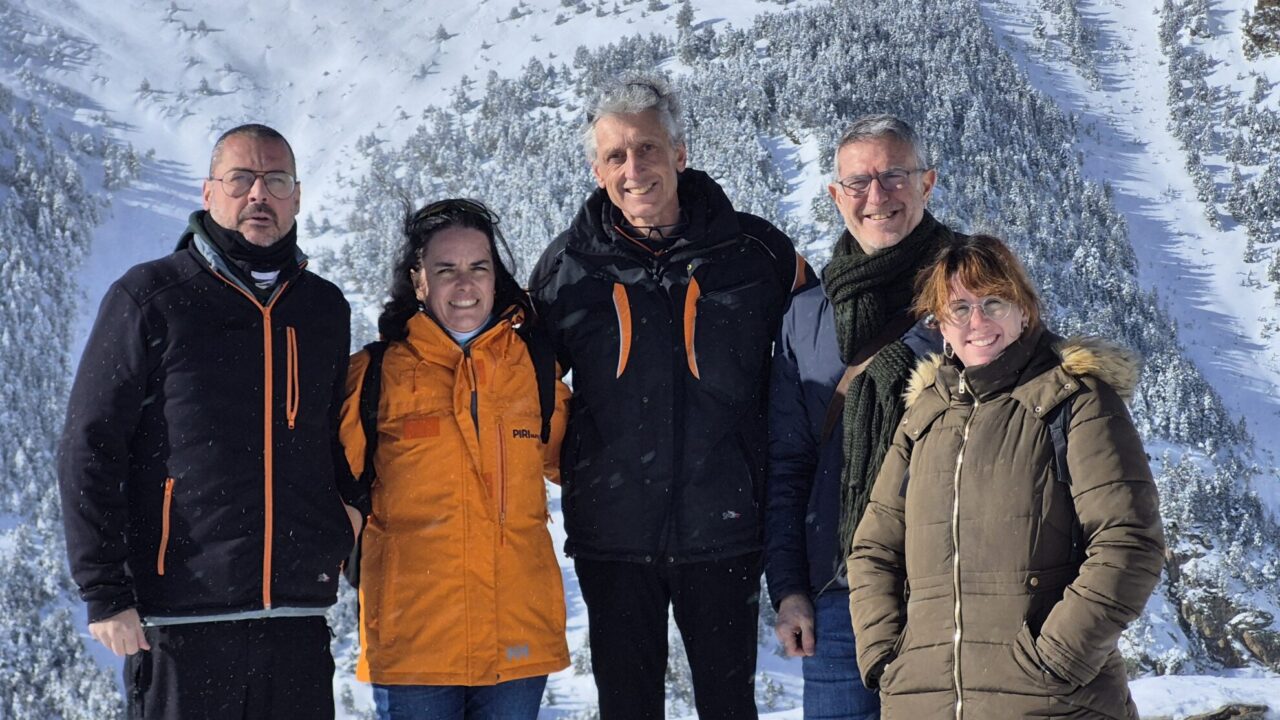
The first on-site meeting lays the groundwork for updating Núria’s heritage assets, which will integrate new social, environmental, and historical perspectives.
The European project RESPIRA has begun its fieldwork this week in the Vall de Núria with an initial in-person meeting with representatives of FGC Turisme i Muntanya, marking the official start of collaboration in the area.
The meeting, held on Wednesday 21 January, brought together representatives of FGC Turisme i Muntanya —including the European projects coordinator, Laura Eduardo, the director of Vall de Núria, Toni Casals, and Miquel Pous, head of administration— alongside ICRPC researchers for the RESPIRA project, Íngrid Castañé and Carles Gorini. The day combined a visit to the main heritage assets with a working session aimed at defining realistic, actionable, and locally useful lines of action.
One of the central points of the meeting was a shared reflection on the need to update existing heritage narratives, especially those related to the rack railway and exhibition spaces, by incorporating a cross-cutting perspective. In this regard, participants emphasized the importance of embedding railway heritage within its social, historical, symbolic, and environmental context, reinforcing the connection between infrastructure, mountain, and community.
Within the framework of the RESPIRA project, the potential of the Vall de Núria was also highlighted as a space to address contemporary challenges such as sustainability, collective mobility, health, and the social use of the mountain, in line with current European Union priorities. The Núria rack railway was identified as a key asset in narratives promoting public transport and reducing private vehicle pressure in sensitive natural environments.
Above all, the meeting helped “break the ice” and consolidate a strategic relationship between the ICRPC and FGC Turisme i Muntanya, which will be essential for the success of the RESPIRA project. The session established a framework of trust and collaboration that will facilitate the implementation of the planned actions through 2027.
The Interreg Sudoe “RESPIRA” project (Sustainable and Professional Revitalization of Interconnected Rural Heritage) is a transnational initiative funded by the Interreg Sudoe 2021–2027 programme. It seeks to promote the revitalization of rural areas in southwest Europe by enhancing territorial heritage —natural, cultural, and memorial— as a resource to strengthen territorial attractiveness, local development, population retention, social cohesion, and innovation. This will be achieved through the creation of valorization strategies, a transnational action plan, heritage schemes, training activities, and pilot projects implemented in the participating territories.
The project consortium includes, alongside the Institut Català de Recerca en Patrimoni Cultural (ICRPC), the Pôle Métropolitain du Pays de Béarn (lead partner), the Communauté de Communes Pyrénées Haut Garonnaises (France), the Provincial Council of Teruel (Spain), the Agrupamento Europeu de Cooperação Territorial do Rio Minho (Portugal), the Municipality of Barcelos (Portugal), the Public University of Navarra – Department of Human Sciences and Education (Spain), the CIRDOC – Institut occitan de cultura (France), and the Asociación Ibérica de Municipios Ribereños del Duero (Spain).