
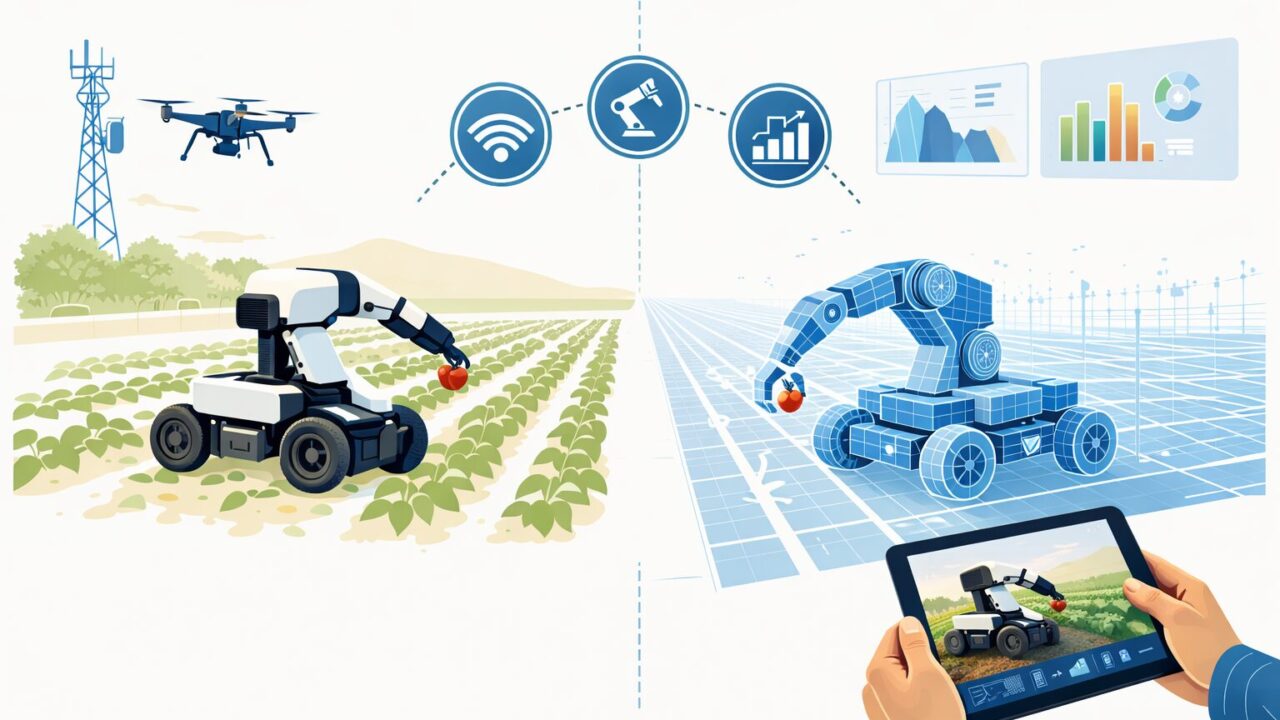
Today, numerous technological developments have already been validated for application in agricultural holdings: IoT-based sensor systems, monitoring mechanisms, remote activation and infrastructure management tools, intelligent image analysis systems, among others. However, these technologies have yet to be implemented systematically and at large scale.
Several factors may explain this situation, including uncertainty about the modifications required within the plantation, the associated costs, and the actual positive impact that adopting specific technologies may bring. All of this often discourages farmers when it comes to making a clear investment decision in favour of digital solutions.
In this context, the emergence of digital twins in agriculture may represent a qualitative turning point in encouraging farm managers to take the step towards digitalisation.
Indeed, the possibility of accurately recreating a plantation and its infrastructure, predicting its behaviour and simulating—at a reduced cost—the implementation of a wide range of technological systems can be decisive in verifying the applicability, efficiency and added value of the solutions currently available on the market. In this way, “twinification” can support the agricultural sector in confidently embracing emerging technologies that foster innovation in farm operations.
Similarly, the robotisation of plantations can particularly benefit from the development of agricultural digital twins, as the high investment costs associated with deploying robots for autonomous tasks currently represent a barrier to widespread adoption.
By enabling the virtual testing of different types of robots adapted to the specific characteristics of each plantation, assessing the feasibility of robotic applications and more accurately forecasting implementation costs, digital twins become a key enabler for the effective integration of robotics into agricultural operations.
This is precisely the vision underpinning the Agrobotics-DiTwins project, which aims to combine digital twins, robotics and deployments within Living Labs to address the automation needs of agricultural tasks—something that has not yet been fully achieved.
By bringing together stakeholders from different regions of southwestern Europe (Andalusia, the Basque Country, the Valencian Community, Algarve, Alto Minho and Nouvelle-Aquitaine), and fostering collaboration between researchers and business representatives, the project seeks to develop real use cases integrating digital twins and agricultural robotic applications. In doing so, it aims to analyse specific needs and propose solutions that represent a significant step forward in this field, combining the academic and technical expertise of the project partners with the direct involvement of agricultural entrepreneurs in these regions.
Projects such as Agrobotics-DiTwins represent a decisive step towards the digitalisation of the agricultural sector, promoting the use of digital twins as a tool for the virtual validation of innovative technologies, with a particular emphasis on agricultural robotics applications.