
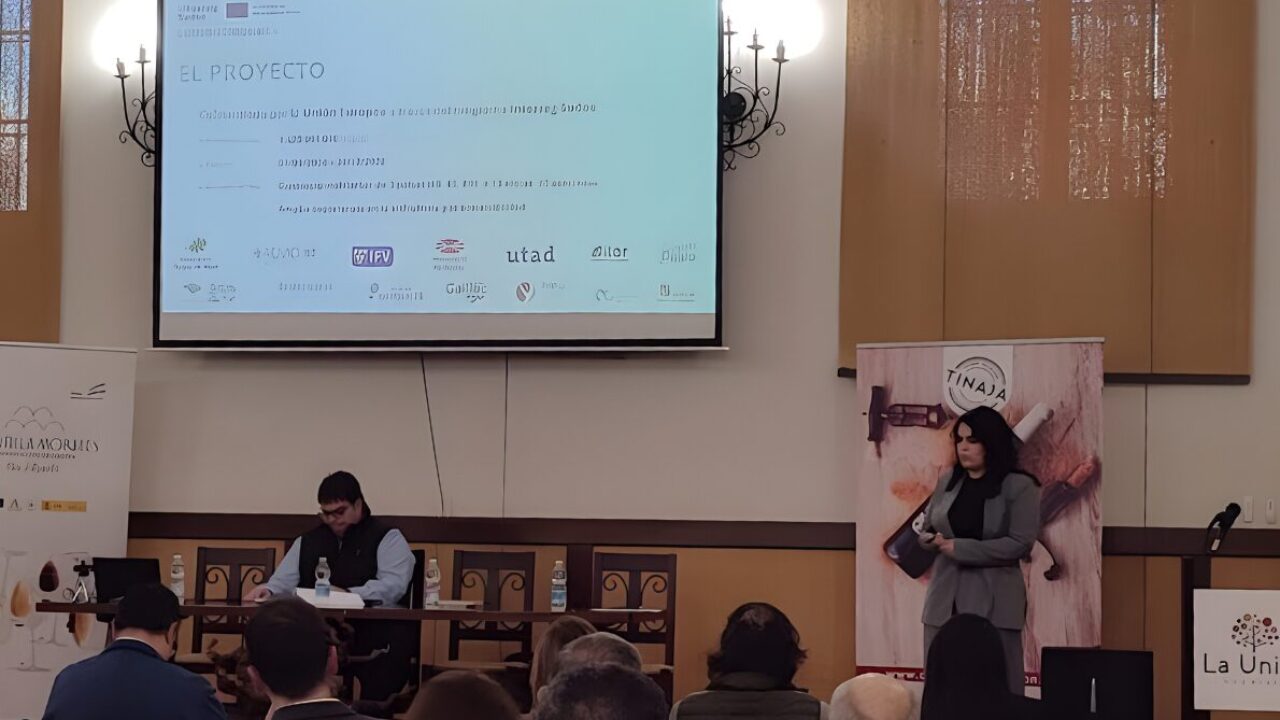
The consortium of the European project ECOSPHEREWINES presented today, during the Technical Conference of the Viticulture Classroom of the DOP Montilla-Moriles (Córdoba), the first results of this applied research carried out in Spain, France, and Portugal. The project aims to enhance the ecosystem services of vineyard landscapes with high ecological value and to implement a large network of green infrastructure.
Previous contacts with the managing director of the DOP Montilla-Moriles, Enrique José Garrido, highlighted the strong potential for transferring ECOSPHEREWINES results to the Andalusian wine region, especially in relation to key and contrasting challenges in the current changing climate scenario. The first is tackling the periodic occurrence of downy mildew every 20 to 30 years, and the second is adapting to prolonged drought scenarios.
In this regard, during her presentation, Anabel Alba, technician from the Research and Innovation Area of the Juana de Vega Foundation, the coordinating entity of ECOSPHEREWINES, outlined the potential benefits of the main technical advances achieved after two years of work in the four high natural value experimental areas: Gaillac-Tarn (France), Alto Douro (Portugal), DOP Arribes and IXP Betanzos (Galicia, Spain). During her speech, she thanked the management of the DOP Montilla-Moriles for their support in this research.
Specifically, the results are:
– Gaillac-Tarn (Occitania region, southern France): Research has validated that soil management using green manure would allow more carbon sequestration compared to conventional chemical weed control. Additionally, sensors have quantified how green infrastructure (hedgerows and trees) regulates the microclimate of the plot, reducing daytime light incidence and retaining nighttime heat.
– Alto Douro (Northern region of Portugal): The project has demonstrated the effectiveness of biocontrol against the “green leafhopper” (Empoasca vitis) using entomopathogenic fungi, achieving nymph mortality rates of between 80% and 90% at laboratory scale. Furthermore, it has been confirmed that the use of sown and incorporated cover crops significantly improves the number and weight of grape clusters per vine compared to natural vegetation.
– DOP Arribes (Zamora and Salamanca, Spain): The traditional restoration of terraces on steep slopes has been completed, using them as Nature-Based Solutions (NBS) to conserve soil and locally adapted varieties. The work has included continuous monitoring of humidity and temperature to optimize water management under different soil management practices.
– IXP Betanzos (Galicia, Spain): The actions have achieved a significant improvement in plant vigor (NDVI) and chlorophyll through the use of gorse mulching and mustard cover crops. Techniques for applying two types of biochar have been validated to increase nutrients, with both cases showing an increase in the amount of enzymes involved in the carbon cycle and in soil nutrient content 15 days after application. Additionally, in this experimental area, dry stone walls and riparian forests have been restored, and edible forests and flower strips have been planted to enhance functional biodiversity.
During the conference, two strategic tools for the sector were also presented: an Implementation Strategy for the SUDOE area and a Practical Guide designed to facilitate the effective transfer of knowledge to winegrowers and local stakeholders.
Prelude to an international event in Andalusia
The DOP Montilla-Moriles conference represents the starting point for a major international event that ECOSPHEREWINES is organizing for the beginning of the second half of 2026 in Andalusia. This event will bring together key actors from the wine sector, research, and territorial management to present in depth the Strategy developed by the project and its final results.
Beyond a technical exchange, the event aims to become a reference forum where key elements for the transformation of vineyard landscapes in the SUDOE area will be defined. Innovative, replicable, and nature-based solutions will be addressed to strengthen the competitiveness of the sector, improve the sustainability of farms, and increase their resilience to climate change.