
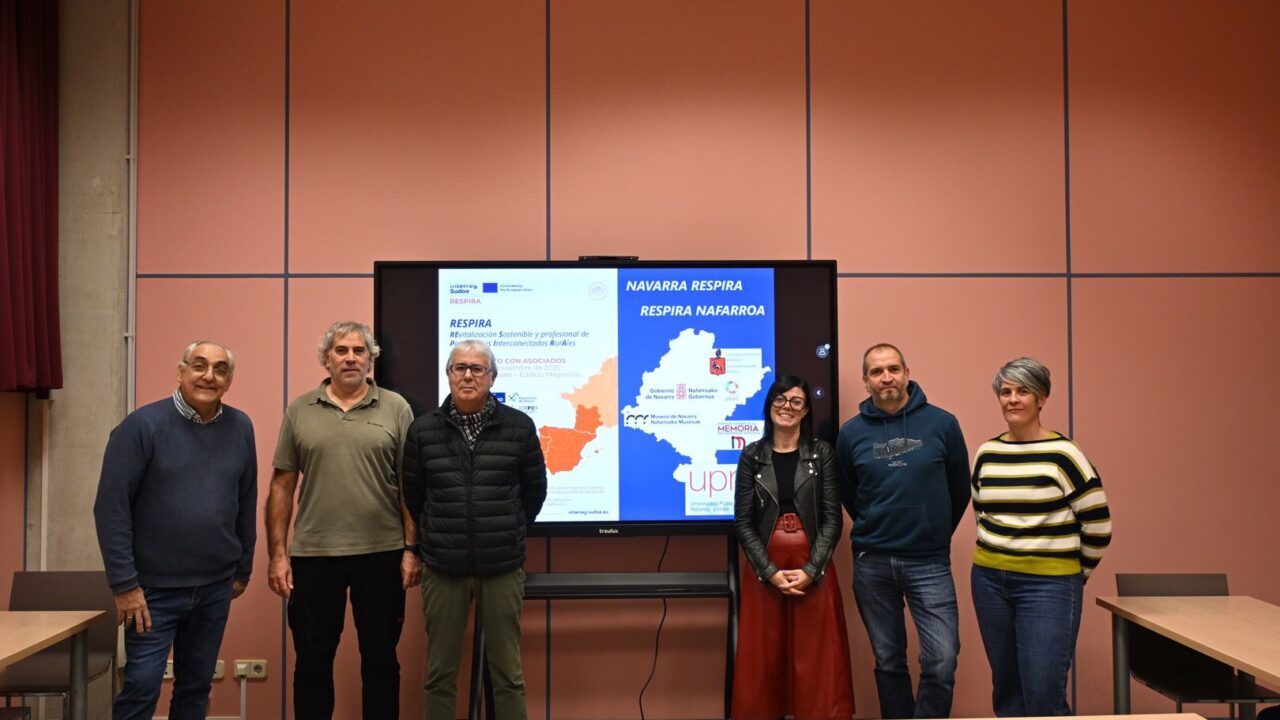
The Public University of Navarre (UPNA) recently hosted the official presentation of the European project RESPIRA, aimed at promoting the revitalization of rural areas through the enhancement of their natural, cultural, and memorial heritage. The project, which will run from 2025 to May 2028 with UPNA participating as a partner, has a total budget of 1.7 million euros, of which 1.3 million are co-financed by ERDF funds. Part of the Interreg SUDOE Programme, it is led by the Pôle Métropolitain du Pays de Béarn (France) and brings together nine partners from France, Spain, and Portugal, along with eighteen associated entities.
The project will implement a Strategy for the Valorization of Heritage Identity and a Transnational Action Plan, as well as heritage frameworks, training and awareness activities, and a pilot action in several rural territories. “These tools will equip public authorities and local stakeholders with methodologies and capacities to strengthen heritage transmission and harness its potential as a strategic resource,” the project team explains.
UPNA participates in RESPIRA with a budget of €245,700 (€184,275 ERDF funds) and the collaboration of the Government of Navarre, the Navarre Institute of Memory, and the Council of the Salazar Valley. Specifically, in Navarre, several lines of action will be developed: adaptation of tools to the territory, production of educational and outreach materials, territorial workshops, and development of technological and educational resources, in addition to a pilot project in the Salazar Valley.
This pilot project includes two heritage routes enhanced with augmented and virtual reality to showcase different forms of migration — economic, labor-related, political, traditional, and natural — that have shaped the valley’s identity. One of them incorporates democratic memory and values related to human rights, while the other focuses on sustainability, local identity, intergenerational perspective, and intercultural dialogue.
The presentation event at UPNA featured Professor Alfredo Asiáin Ansorena, principal investigator of the project at UPNA; Professor Isabel Merino González, project communication manager (both from the Department of Human Sciences and Education and the I-COMMUNITAS Institute); Mikel Ozkoidi Pérez, head of the Section for Ethnological and Intangible Heritage of the Government of Navarre; José Miguel Gastón Aguas, director of the Navarre Institute of Memory; and two representatives from the Council of the Salazar Valley, Maitane Eslava and Gustavo Goiena.
The main UPNA research group involved in the project is “Research in Linguistics and Intangible Heritage”, led by Professor of Basque Philology Patxi Salaberri Zaratiegi. The project will be carried out through collaboration among various multidisciplinary working groups.
Depopulation, aging, and loss of dynamism
As highlighted, RESPIRA was created to address the challenges faced by rural territories in the SUDOE area (Southwest Europe), affected by depopulation, aging, and economic decline. Its objective is to strengthen territorial identity and to turn heritage — natural, cultural, and memorial — into a driver of sustainable development, social cohesion, and innovation.
RESPIRA seeks to revitalize participating territories and build a transnational cooperation network that facilitates knowledge transfer, fosters new opportunities, and consolidates a sustainable model for heritage management and transmission.
The project will conclude with an international dissemination seminar, accompanied by thematic webinars, territorial meetings, and scientific publications. “With the presentation held at UPNA, RESPIRA officially begins its journey to strengthen the link between community, heritage, and innovation, and to contribute to the sustainable and balanced future of rural areas in the SUDOE space,” noted the project’s research team.
Photo: Official presentation of the RESPIRA project at UPNA. From left to right: Alfredo Asiáin, Mikel Ozkoidi, José Miguel Gastón, Isabel Merino, Gustavo Goiena, and Maitane Eslava.
