
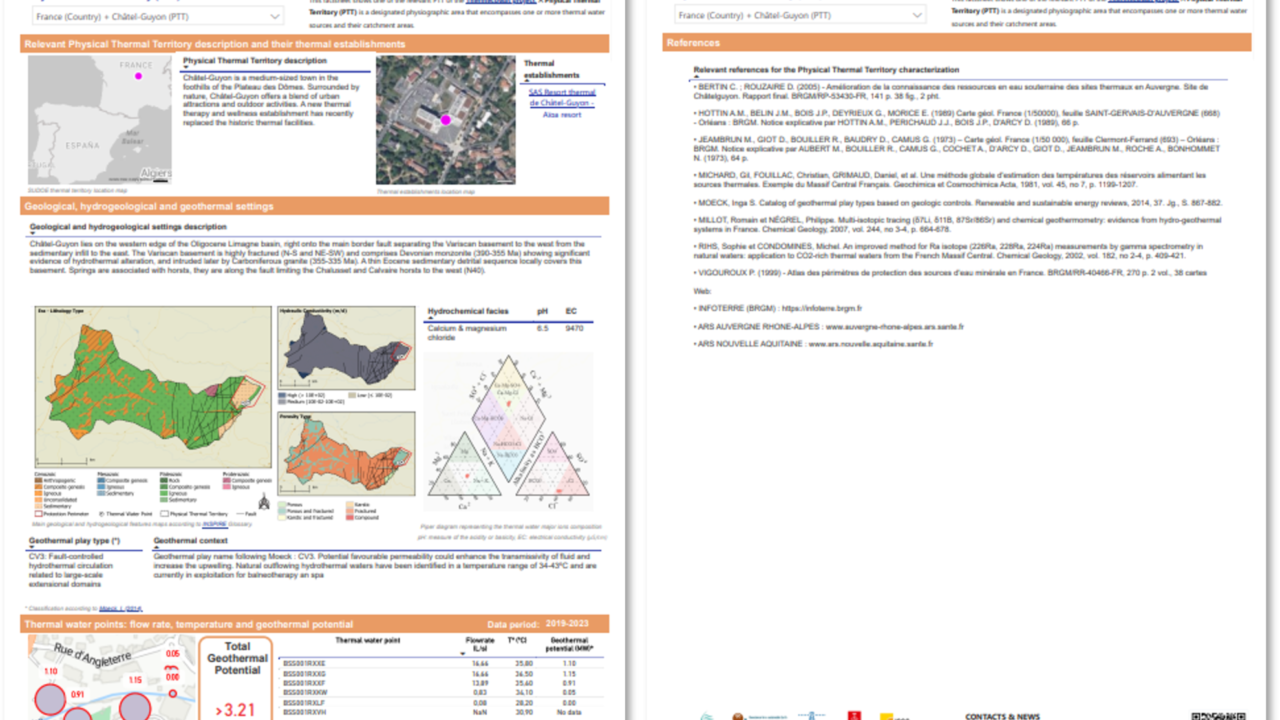
Caption for the photo above: Technical factsheet on geothermal resources of Chatel Guyon (France), one of the thermal territories relevant for the project.
ThermEcoWat “Technical factsheets on geothermal resources” compile a series of concise, harmonised sheets that characterise thermal water resources and their geothermal potential of the most relevant territories for the project.

One of the aims of the ThermEcoWat (TEW) project is to characterize the thermal water resources from the quantity and quality points of view, to approximate their geoenergy potential and to evaluate the climate change (CC) impacts at different pilot sites.
Understanding the nature and behaviour of thermal waters is the foundation for evaluating their future and their possibilities for diversification. Therefore, the assessment of how to exploit the energy vector of these thermal waters is essential to build more resilient territories whose current economies rely mainly on exploiting them as a source of health and well-being.
Within this context, the “Technical factsheets on geothermal resources”, provided by the GT1 team of TEW, integrate an inventory of relevant thermal springs and provide a synthetic but comprehensive overview of their geological, hydrogeological and geothermal settings, including information on thermal water uses, temperatures, flow rates and an indicative geothermal potential.
The factsheets cover several relevant thermal territories for the project located in the SUDOE region; 11 thermal towns in the Massif Central (France), 8 towns
in Central Portugal and 7 towns in Catalonia (NE of Spain). Each factsheet focuses on a physical thermal territory, understood as a physiographic area that includes thermal water sources and their catchments areas. They feature geological and hydrogeological maps highlighting the superficial lithology, main faults, hydraulic conductivity and porosity types of the catchment areas. Thermal establishment locations and protection perimeters are overlaid on regional contexts. Piper diagrams illustrate major ion hydrochemical facies of the thermal water for the most relevant hot water points.

To make these territories comparable, the work required targeted data collection from diverse national and local sources, followed by careful standardisation and homogenisation with special care on agreed definitions among the three countries. This task has been done by the Geological Surveys of France (BRGM), Portugal (LNEG) and Catalonia (ICGC). Common definitions, indicators and cartographic representations were adopted so that all pilot sites could be described using the same structure and parameters.
The added value of these factsheets lies in offering a shared technical baseline on geothermal resources for the ThermEcoWat partners and stakeholders. By aligning data and concepts across borders, the factsheets support the assessment of geoenergy potential and facilitate the design of adaptation strategies for thermal water ecosystems at the SUDOE scale with possible replications in the future to other thermal territories, already beyond the TEW scope.
To consult all the “Technical factsheets on geothermal resources”, please, click on the link below:
Author and sources:
Georgina Arnó (1), Elsa Ramalho (2), Rosi Moreno (1), Christian Iasio (3), Cyril Aumar (3)