
The impact of forest fires on ecosystems in south-western Europe can last for more than a decade. This is one of the main conclusions of the research carried out by the University of Toulouse within the framework of the SocialForest Interreg Sudoe project. Scientists examined how climate crises affect forest areas in south-western Europe, focusing on the impact of fires and their long-term effects on the entire ecosystem. To this end, they combined geochemical analysis of soils and associated vegetation with remote sensing monitoring, comparing burned areas with others that remained intact.
Researchers were thus able to examine how forest fires alter ecosystem functioning, from the geochemical composition of soils to vegetation regeneration. The combination of geochemical analyses and remote sensing provided a comprehensive view of fire effects, from invisible processes at soil and plant level to structural changes in the landscape. These findings contributed to the design of the Transnational Forest Strategy developed within the SocialForest project.

Biogeochemistry of pine forest ecosystems
The scientific team studied the evolution of soil biogeochemistry in two representative forests of southern Europe: the maritime pine forest of the Landes (Nouvelle-Aquitaine, France) and the Aleppo pine forest of Moratalla (Region of Murcia, Spain). The results show that fires not only cause immediate changes but also durably modify the distribution of chemical elements along the soil–plant continuum.
Initial findings indicate an increase in elemental concentrations, even several months or years after the fire. Regarding vegetation, an increase in elemental contents in litter was observed eight months after the fire at the Landes pilot site, driven by the input of ash and enriched pine needles. An increase in the proportion of elements associated with the residual soil fraction was also recorded at both sites, indicating a decrease in element bioavailability several months after the fire.
This study therefore demonstrated that changes in element distribution remain visible in the soil–plant continuum up to 12 years after the fire, opening up new research perspectives.
Remote sensing
The research also relied on remote sensing tools to monitor fire effects in different contexts. In Moratalla, two areas (one burned in 2012 and one unaffected by fire) were compared using a Digital Surface Model (DSM) and a Digital Terrain Model (DTM) to calculate biomass and tree canopy density. The data reveal that forest regeneration remains uneven 12 years after the fire, particularly in areas with the most degraded soils.
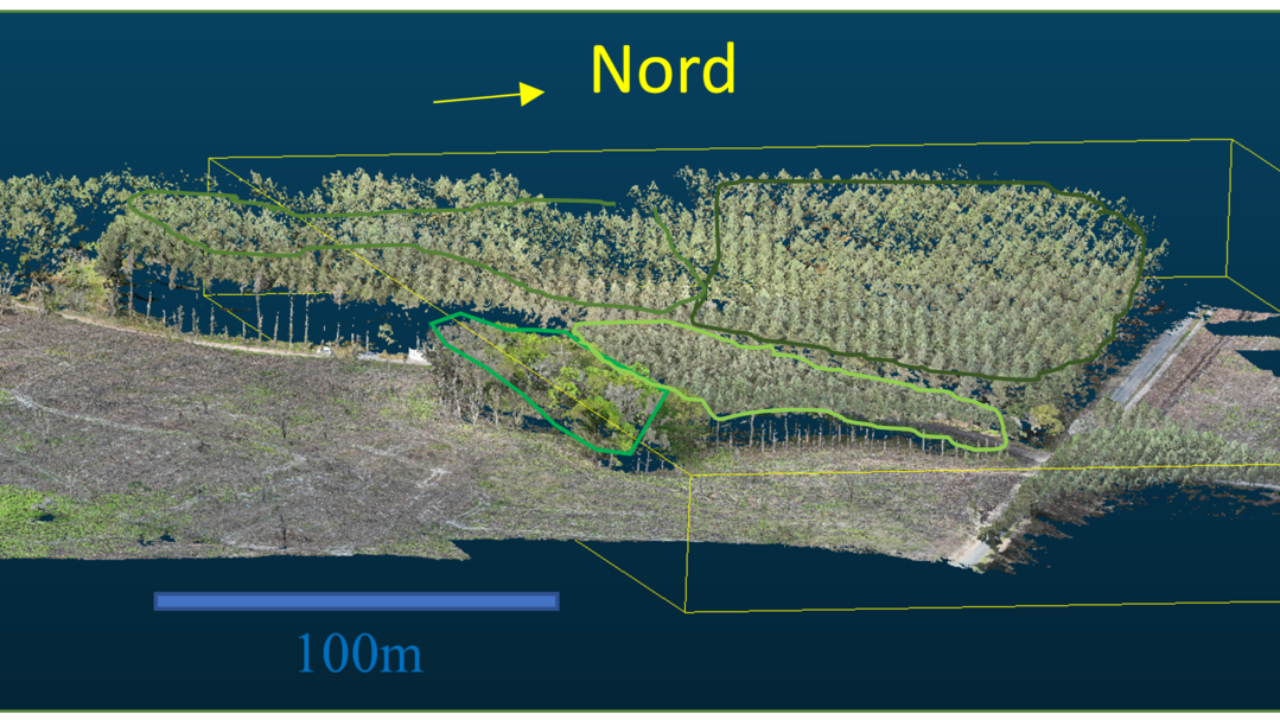
In the Landes forest, near Barbaste, two areas were monitored using a LiDAR drone and multispectral sensors: one area burned in August 2024 and an older maritime pine stand under controlled management. This made it possible to distinguish completely destroyed areas from sectors where vegetation was preserved.
Monitoring was extended to the French region of Aude, affected by numerous wildfire outbreaks during the summer of 2025. Given the scale of the area, data from the European Copernicus programme (Sentinel-2 mission) were used. This made it possible to assess vegetation resilience over the following months. The data also show significant soil degradation in areas where vegetation disappeared.
Finally, work was carried out in Barrancos (Alentejo, Portugal), focusing on areas affected by forest pests. Thanks to multispectral drone acquisitions, initial results enabled degraded tree crowns to be identified and the density of dead trees to be estimated.
Instagram (@socialforest_sudoe)