
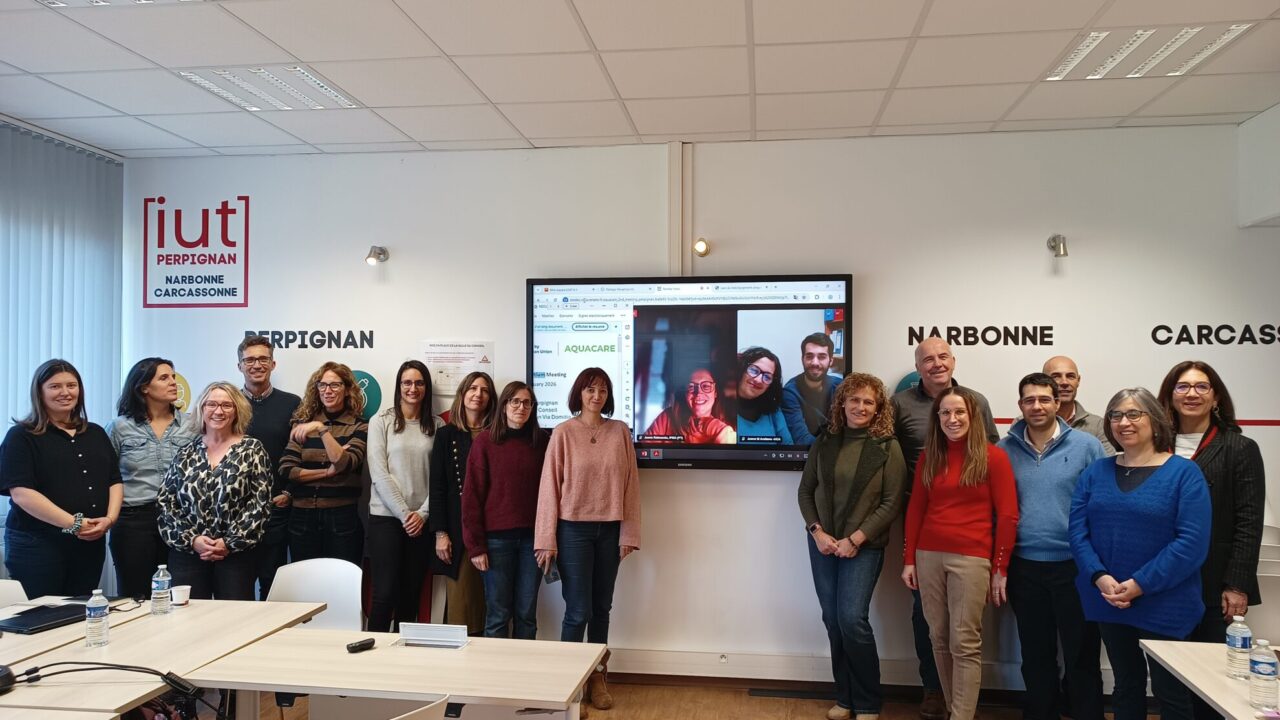
The AQUACARE consortium met on 22 January 2026 at the University of Perpignan Via Domitia (Perpignan, France) for an in-person workshop (Meeting 2, M2) focused on harmonising and finalising key decisions for the sampling and analysis phase of emerging contaminants in the SUDOE area. The meeting enabled the consolidation of technical agreements on methodology, sampling points and sample shipment logistics, while strengthening internal coordination and project visibility.
The session was opened by Thierry Noguer (UPVD), who welcomed participants and introduced Guillaume Cano, an associated partner (PMM). In his presentation, Guillaume Cano shared a practical overview of water control and sanitation management, supported by an explanatory video on the urban water cycle and the local management system.
Next, Juana María Arellano (UCA), joining online, provided a general project progress update, thanked the hosts, and recalled recent milestones, including the availability of the first deliverable, which compiles relevant European directives and criteria for selecting sampling points in the rivers under study. The need to clarify the definition of potential “hotspots” and how these fit within the agreed planning was also highlighted.
Technical work: two groups, one shared goal
The core of the meeting was organised into two thematic working groups (microplastics and pharmaceuticals) to advance the harmonisation of protocols and ensure that all partners apply comparable criteria across Spain, France and Portugal. Miguel Santos (UPORTO) proposed a joint review of the sampling process and facilitated the division into working groups, using a previous protocol as a reference.
Microplastics Working Group (Activity 1.2). Key discussions covered campaign planning and operational aspects such as upstream/downstream points, water volumes and sample types. The group agreed to move forward with a dedicated workshop (ultimately proposed in Lisbon) and to carry out an intercalibration between laboratories to ensure analytical consistency.
Pharmaceuticals Working Group (Activity 1.2). The group addressed methodological questions following the roadmap and agreed to build on previously evaluated protocols, incorporating decisions on the sampling scheme, minimum volumes and sample preservation, with particular attention to cross-border logistics.
Consolidated agreements to launch the sampling campaign
In the plenary wrap-up, the consortium confirmed a set of operational decisions enabling the next project phase:
- Sampling dates: 1st campaign in May–June and 2nd in November–December.
- River sampling points: reference distance of 25 m upstream and 25 m downstream of the WWTP discharge for environmental sampling.
- Pharmaceutical analysis: decision to use passive samplers.
- Ecotoxicological tests: agreed volume of 500 mL to be collected and analysed.
- Shipment and preservation: samples to be shipped frozen and in a plastic bottle.
- Protocol drafting (responsibilities): organic pollutants protocol by Romeu Avo (CMPEAE); WWTP microplastics protocol by Juana María Arellano (UCA); environmental microplastics protocol by Joana Raimundo (IPMA).
- Optimisation of sampling points: reduction of river sampling points due to processing capacity and transport constraints, resulting in: Guadalete (2 WWTPs to be defined), Nivelle (1), Adour (1), Têt (1) and Duero (2).
- Internal review deadlines: revised protocols to be uploaded to Teams by 30/01/2026, with a one-week window until 06/02/2026 for comments.
Communication and compliance: visibility and internal coordination
During the communication session, (AITIIP) presented the project’s communication strategy and showcased key assets already produced: the brochure, promotional video, LinkedIn profile, and project website. The meeting also highlighted the need to complete the Excel file with the communication contact persons for each organisation, and reiterated the importance of installing posters and leaflets, documenting these actions with photographs to support project visibility.
Next consortium meeting
The meeting concluded with remarks by Juana María Arellano (UCA), confirming that the next consortium meeting will take place in Porto (Portugal) and has been proposed for July, as the sampling calendar makes the initial May date unfeasible.
With this second transnational meeting, AQUACARE strengthens scientific and technical cooperation to protect river and community health in Southwest Europe, advancing toward practical solutions aligned with the project’s overarching messages and objectives.