
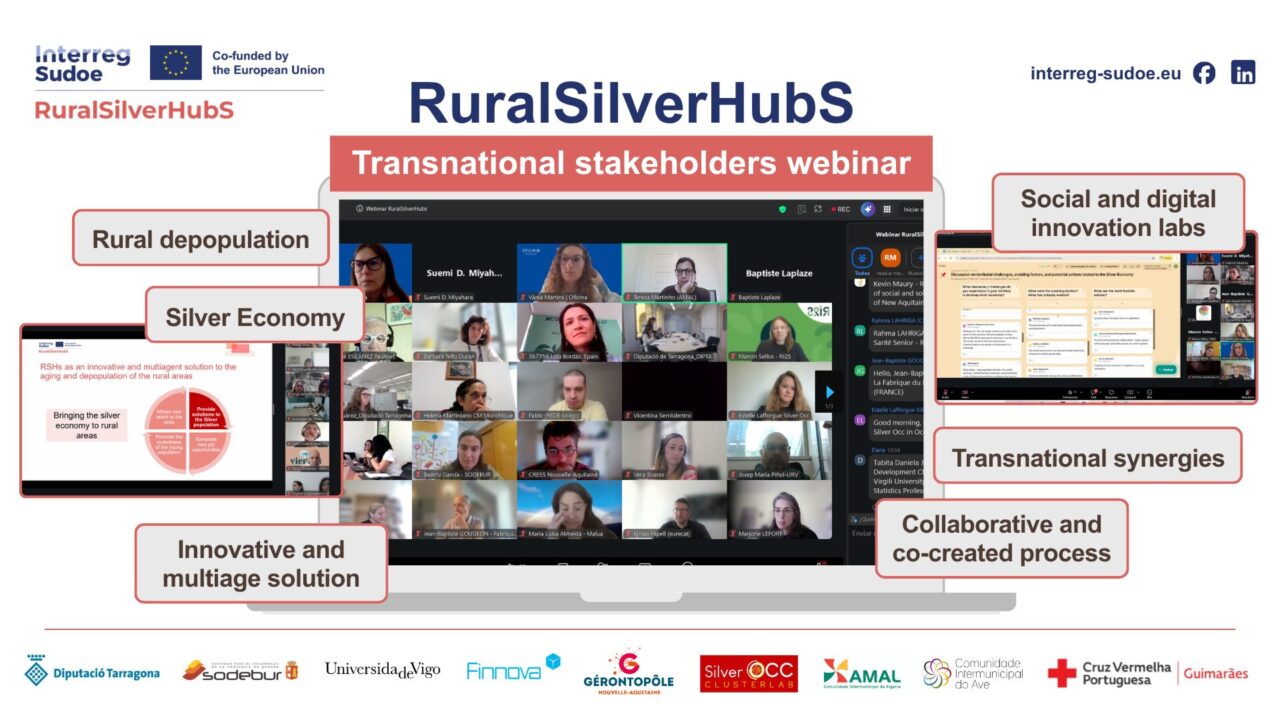
The international webinar, organized by AMAL (Algarve Intermunicipal Community) and broadcast from Portugal, highlights results, best practices, and challenges of aging in the Sudoe space
“Future,” “opportunity,” “innovation,” and “well-being”: this is how participants define the silver economy in the rural sphere
On April 27, the international webinar of the European project Interreg Sudoe RuralSilverHubS was held, an initiative that brings together partners from Spain, France, and Portugal to address the challenges of aging, depopulation, and access to services in rural areas. The event, organized by AMAL and broadcast online from Portugal, featured the participation of 80 people, including stakeholders, experts, and institutional representatives, with the aim of sharing results, best practices, and innovative solutions regarding the development of the silver economy in the Sudoe space.
The session was led by Simone Julio (AMAL) and began with an institutional welcome from Marta Farrero, Head of the Transversal Projects Service at the Diputació de Tarragona, the project’s lead entity. In the first block, dedicated to territory snapshots, the main characteristics and challenges of the participating territories were presented by Carla Aguilar (Diputació de Tarragona), Beatriz García (SODEBUR), Isabelle Lesterpt (Gérontopôle Nouvelle-Aquitaine), Estelle Lafforgue (SilverOcc Clusterlab), Teresa Martinho (AMAL), and Vera Soares (Ave Intermunicipal Community). These interventions offered a comparative view of the rural contexts in the three countries.
Next, the results of the analysis of the silver economy in France, Spain, and Portugal were presented, providing a global perspective on trends, challenges, and opportunities in these territories. In this context, an interactive live survey allowed for the identification of the attendees’ profiles—mostly individuals between 45 and 55 years old, primarily from the public sector and civil society, with a presence also from the academic field and the private sector. As a result, participants defined the silver economy with four key concepts: future, opportunity, innovation, and well-being.
The seminar also included a block for presenting best practices, featuring initiatives from Iratxe Herrero (Y-logica, Burgos), Jean-Baptiste Gougeon (La Fabrique à Initiative, Nouvelle-Aquitaine), Catarina Pereira (Portuguese Red Cross, Ave region), Bárbara Telo and Jordi Escuder (Eurecat), and Paula Cid Serradentro (Algarve), among others. These experiences highlighted the potential of social and technological innovation to improve the quality of life for people over 55 in rural environments.
Following this, an interactive roundtable discussion focused on territorial challenges, enabling factors, and priority actions to boost the silver economy was moderated by Vania Martins. During the debate, issues such as the main obstacles in each territory, initiatives that have proven effective, and the most viable actions in the short and medium term were addressed. The session concluded with an open Q&A space that allowed for the collection of concerns and encouraged the exchange of ideas among participants.
The closing of the event was handled by the Diputació de Tarragona, with an intervention by Marta Farrero, who stressed the importance of transnational cooperation and the exchange of knowledge to move toward rural territories that are more inclusive, resilient, and sustainable.
The RuralSilverHubS project, with a duration of 30 months and a budget of nearly 1.3 million euros, aims to improve the quality of life for people over 55 in rural areas by promoting the silver economy, social innovation, and territorial cooperation.
The project consortium consists of nine partners: the Diputación de Tarragona (lead partner), the Society for the Development of the Province of Burgos (SODEBUR), the University of Vigo, the Finnova Foundation, the Gérontopôle Nouvelle-Aquitaine, SilverOcc Clusterlab, the Algarve Intermunicipal Community (AMAL), the Ave Intermunicipal Community, and the Portuguese Red Cross.