
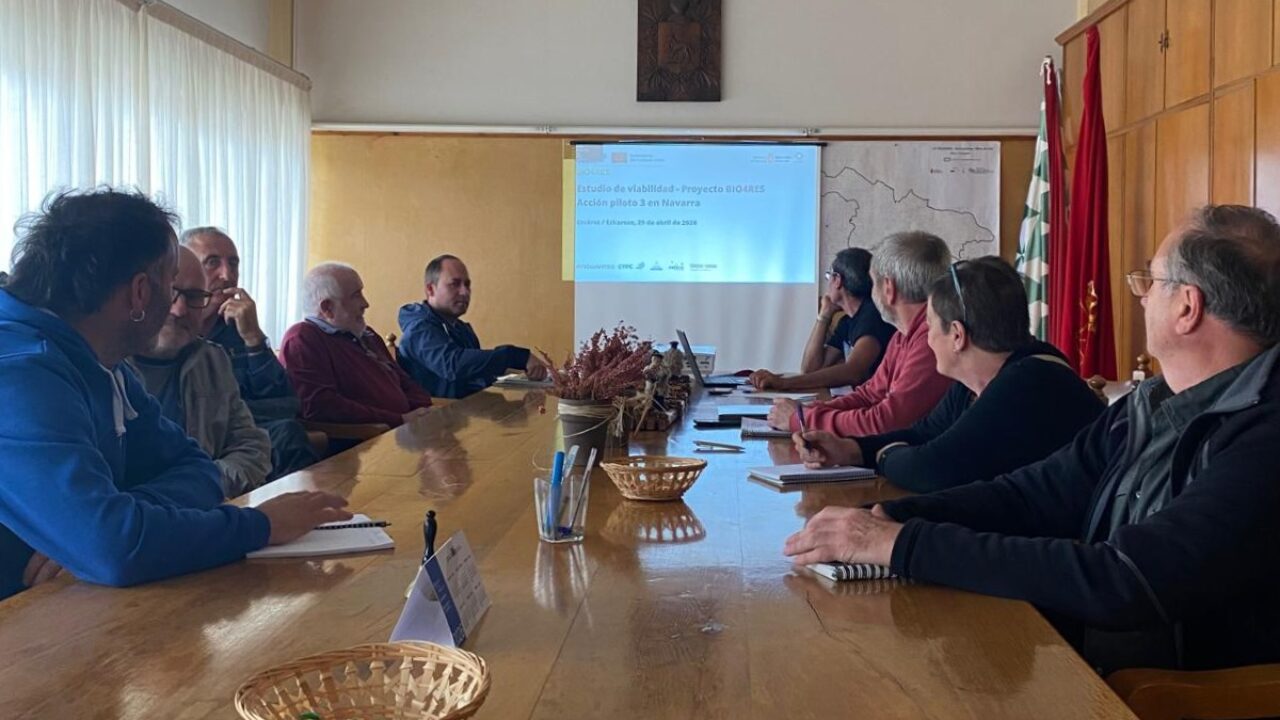
The European BIO4RES project has launched work in Ezcároz to draw up a feasibility study aimed at analysing the establishment of a regional hub for the integrated management of biomass in the Navarran Pyrenees, specifically in the Salazar and Roncal valleys.
The meeting, held on 29 April at the Casa del Valle de Salazar, served to present the scope of the work and establish the starting point for a participatory process aimed at promoting models for the sustainable use of forest biomass in a region with significant forestry potential.
The session was attended by representatives from eight local organisations: NASUVINSA, AGRESTA S. COOP., the town councils of Ochagavía, Sarriés, Ezcároz and Jaurrieta, as well as the General Assembly of the Salazar Valley and the General Assembly of the Roncal Valley. In total, ten people linked to local authorities and regional stakeholders involved in forest management and rural development attended.
NASUVINSA, the main beneficiary of the European BIO4RES project, is driving this initiative as part of the project’s Pilot 3, which focuses on developing local forest biomass management models. The overall objective of BIO4RES is to improve the prevention and management of forest fire risk through the utilisation of harvested biomass, whilst simultaneously strengthening the resilience of forests and the sustainable development of rural areas.
The contract to carry out the feasibility study has been awarded to AGRESTA S. COOP., which will be responsible for developing the plan for the commissioning and management of the future Salazar-Roncal regional biomass hub. The study will analyse aspects such as current and potential energy demand, available forest resources, management models, logistical requirements and possible governance arrangements.
The proposed model involves the collection, processing, storage and utilisation of forest biomass in the Navarran Pyrenees, with the aim of creating a local value chain linked to renewable energy and sustainable forest management. Key challenges addressed include fire prevention, decarbonisation, the creation of rural jobs and improving the resilience of forests to climate change.
The meeting also addressed the current status of the future biomass drying and storage plant planned for the Iciz industrial estate, a strategic infrastructure for the project’s development in the region.
The feasibility study will run until October 2026 and will be carried out through a participatory process involving local authorities and stakeholders in the region, with the aim of defining a model tailored to the needs and capabilities of the Navarran Pyrenees.