
SenForFire strengthens ties with Chile: international meeting at ICIFOR-INIA, CSIC to advance early forest fire detection
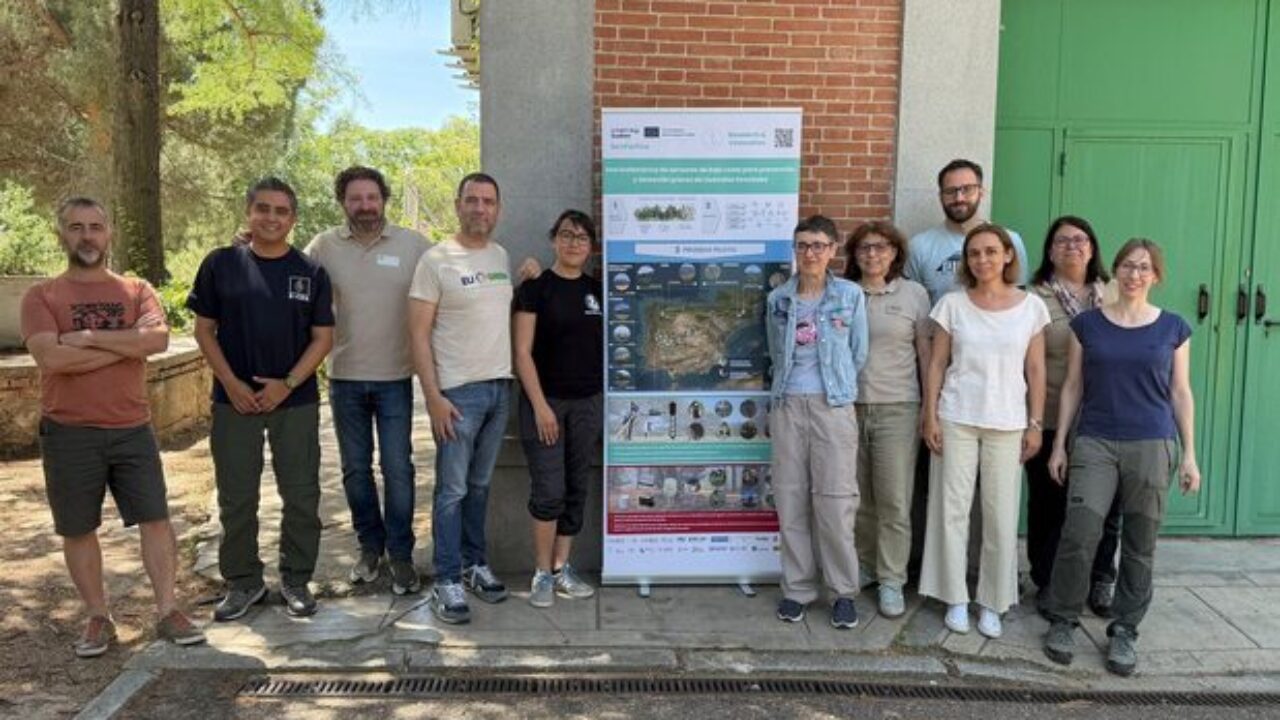
The European SenForFire project (Interreg Sudoe) held an international collaboration event at the ICIFOR-INIA, CSIC facilities in Madrid, attended by Fabián Guerrero, coordinator of the AIRIS (Intelligent Air Quality Alert for Fires) project at the Federico Santa María Technical University (Valparaíso, Chile). This collaboration strengthens scientific cooperation between Spain and Chile in the field of forest fires.

The meeting, organised by the SenForFire team, aimed to share progress, methodologies and technologies between the two projects, which share a common approach: the use of low-cost wireless sensor networks for environmental monitoring and early fire detection. The AIRIS project, funded by the Regional Government of Valparaíso, will deploy a network of air quality monitoring devices in an urban-rural interface area in Chile, aimed at both detecting fires and monitoring air quality before, during and after them.
As part of this event, the SenForFire team carried out experimental vegetation burns in the ICIFOR-INIA, CSIC wind tunnel, monitoring emissions using new microsensors developed by the IMB-CSIC as part of the project, as well as modules developed by the University of Extremadura (UEX), RAY Ingeniería Electrónica (RAY IE) and ITEFI-CSIC.


Six experimental burns were carried out throughout the day, involving different species of Mediterranean vegetation representative of the Iberian forest environment: strawberry tree (Arbutus unedo), Pyrenean oak (Quercus pyrenaica), stone pine (Pinus pinea), maritime pine (Pinus pinaster), holm oak (Quercus ilex) and cork oak (Quercus suber). In the burns carried out on recently collected vegetation and in high humidity, the fire manifested itself mainly as smoke, with few flames, whilst the combustion of drier fuel, collected earlier and conditioned for testing, produced higher and longer-lasting flames.


One of the most notable findings of the day was obtained during the fifth burn, carried out using dry needles of stone pine (see upper figure). In this case, the Next-PM particle sensor barely registered a response, whilst the gas microsensors and volatile organic compound (VOC) sensors developed by the University of Extremadura detected a very marked increase in the signal, as can be seen in the following graphs. This finding suggests that, in burns with low particle production, these microsensors can provide a complementary and early warning that systems based solely on particles might fail to detect — a relevant finding for the design of future monitoring networks such as the AIRIS project in Chile. The remaining data from all sensors during the six burns are included in the technical annex to this document.


Among the aspects explored is the possibility of incorporating modules developed within SenForFire into the AIRIS project network, which would open up a concrete avenue for technology transfer between Europe and Latin America.
“This initiative represents an excellent opportunity to strengthen scientific collaboration between Spain and Chile in the field of forest fires. Bringing together expertise in early detection, atmospheric monitoring and experimental fire assessment will enable progress in the development of innovative solutions for the prevention and management of forest fires,” said Fabián Guerrero Castro, coordinator of the AIRIS project.

SenForFire is a project co-funded by the European Regional Development Fund (ERDF) through the Interreg Sudoe programme, and involves thirteen partners from Spain, Portugal, France and Andorra.
Further information: https://interreg-sudoe.eu/proyecto-interreg/senforfire/
Further information about AIRIS: https://usm.cl/noticias/usm-lanza-innovador-sistema-de-alerta-temprana-para-incendios-forestales-basado-en-monitoreo-de-calidad-del-aire/