
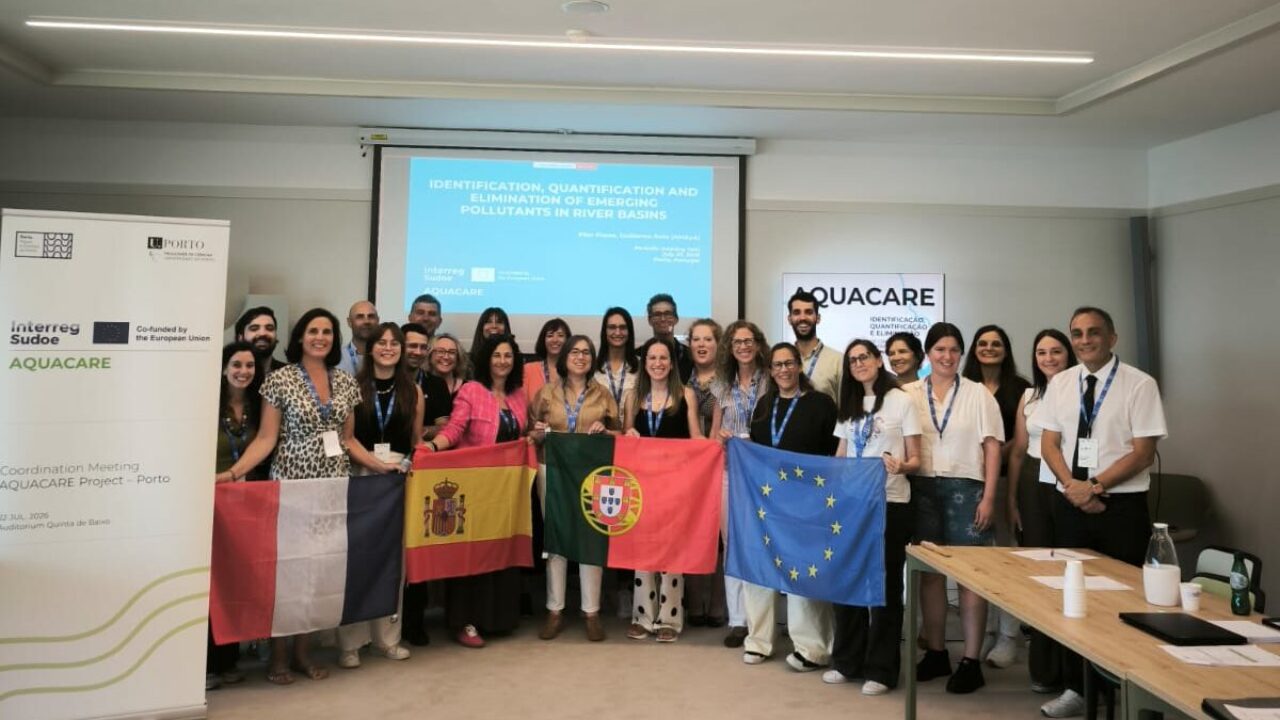
The AQUACARE consortium met on 22 July 2026 in Porto (Portugal) for a technical working session focused on presenting the first analytical results from environmental sampling campaigns and coordinating the next steps in the evaluation of advanced water treatment technologies. Hosted by Águas e Energia do Porto (AEdP) and the Faculty of Sciences of the University of Porto (FCUP), the meeting strengthened collaboration across the Guadalete, Douro, Têt, Adour and Nivelle pilot river basins and the wastewater treatment plants selected within each territory.
First findings on pharmaceuticals and emerging pollutants
One of the highlights of the meeting was the presentation of preliminary analytical results by the Université de Perpignan (UPVD). HPLC-MS/MS analyses carried out on wastewater and river samples suggest that the wastewater treatment plants analysed show limitations in completely removing certain organic microcontaminants, including commonly used pharmaceuticals such as irbesartan, diclofenac, carbamazepine and hydrochlorothiazide, as well as some anti-corrosive compounds. The results indicate a possible contribution of treated discharges to the presence of these substances downstream in some of the monitored river systems.
At the same time, project partners working on microplastics monitoring presented progress in particle quantification and in the harmonisation of filtration, sample preparation and spectroscopic analysis protocols using techniques such as microFTIR and ATR. Discussions also focused on the technical challenges associated with processing and characterising complex environmental samples.
Assessment of advanced treatment technologies
CIEMAT-PSA presented preparatory work for the assessment of advanced treatment technologies aimed at removing microcontaminants and microplastics from urban wastewater. These activities are being developed in response to the new requirements established under the revised EU Urban Wastewater Treatment Directive (Directive EU 2024/3019).
Over the coming months, pilot-scale comparison of Advanced Oxidation Processes (AOPs), solar photo-Fenton, ozonation and nanofiltration-based solutions will continue, assessing removal efficiency, energy consumption, techno-economic feasibility and transferability across different SUDOE territories.
First-year review and transition to the “Architects of the Water Future” phase
The University of Cádiz (UCA), project coordinator, presented the main achievements of AQUACARE’s first year, including the identification of discharge points within the pilot basins, the launch of field sampling campaigns and the establishment of common methodologies for monitoring microcontaminants and microplastics.
Following the first-year monitoring review with the Interreg SUDOE Joint Secretariat, the project now enters its second year, moving from the “Water Detectives” phase to the “Architects of the Water Future” phase, focused on technological innovation, risk assessment and the development of regional strategies to strengthen water resilience across Southwest Europe.