
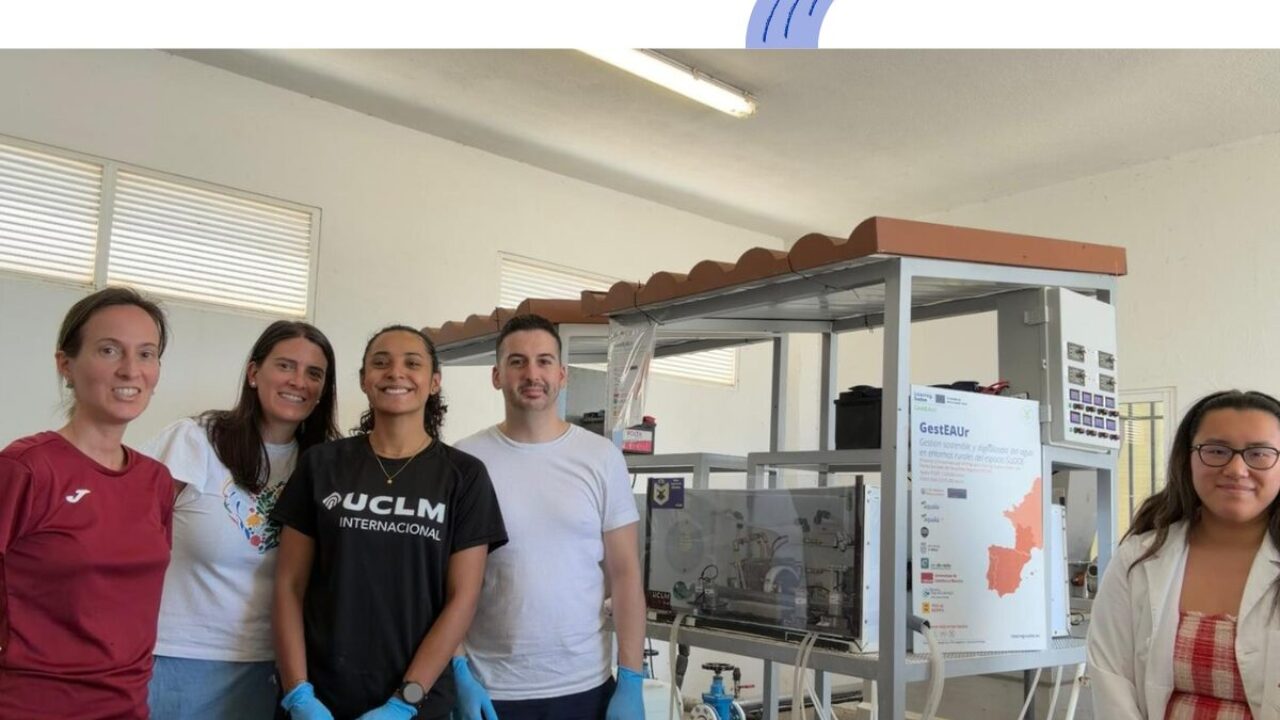
The European GestEAUr project, funded by the Interreg Sudoe programme, has taken another step forward in developing innovative solutions for sustainable water management with the installation of a modular pilot system at the Fontiveros Wastewater Treatment Plant in Ávila, Spain. Developed by the University of Castilla-La Mancha (UCLM), the pilot system will make it possible to assess, under real operating conditions, an electrochemical technology designed to improve wastewater reclamation and reuse.
The system has been designed to generate oxidants in situ, directly at the treatment facility, thereby eliminating the need to transport and store chemical products. Through an electrochemical process, it can produce gaseous ozone and hydrogen peroxide, two compounds widely used in water treatment due to their ability to remove pollutants and enhance disinfection. One of the main advantages of this technology is that the two oxidants can be used separately or combined to generate other oxidising agents, such as peroxone, which increases the removal of hard-to-treat contaminants and improves the quality of water intended for reuse.
The system has also been designed to operate using photovoltaic solar energy, helping to reduce energy consumption and making it suitable for facilities located in areas without access to the electricity grid. Its modular and transportable design allows the technology to be adapted to different needs and locations.
The pilot system was transported to the Fontiveros wastewater treatment plant, operated by Aqualia, on 21 July. The first test results are expected in the coming weeks. These results will make it possible to analyse the technology’s performance and assess its potential to support more efficient and sustainable water reuse tailored to the needs of rural municipalities across the SUDOE region.