
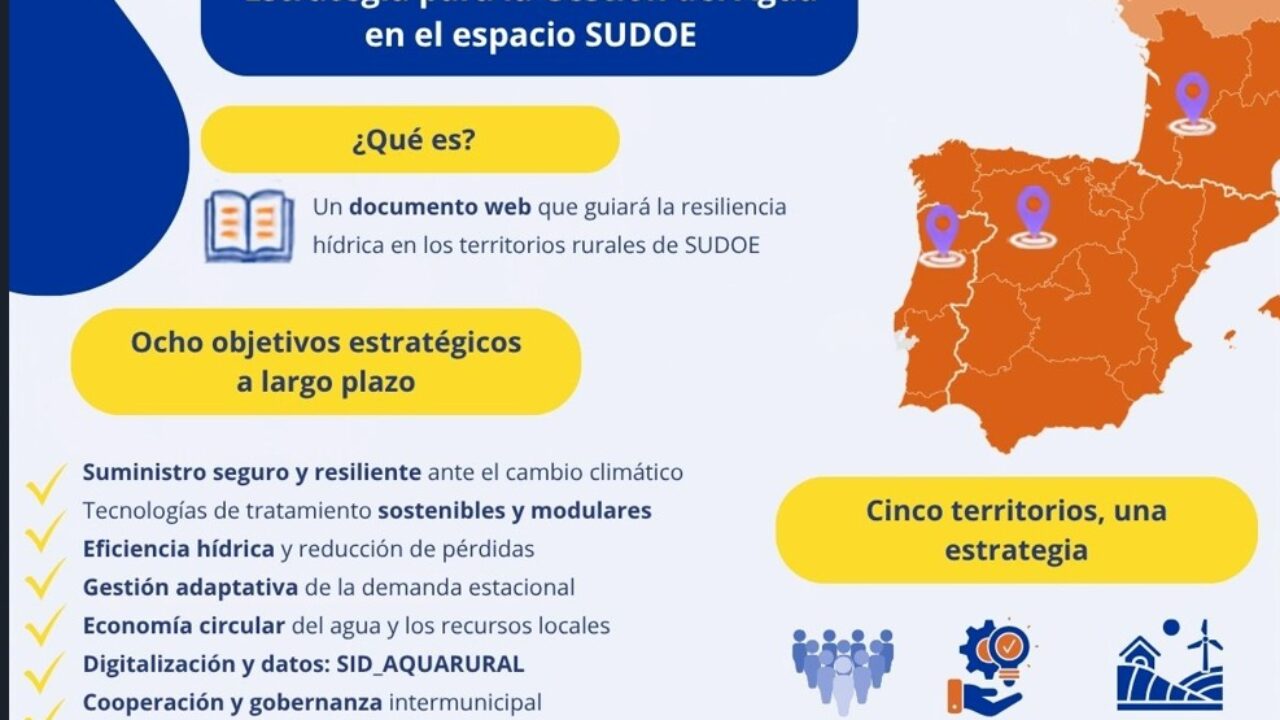
The European project GestEAUr (Sustainable and Digitalised Water Management in Rural Areas of the SUDOE Region), funded by the Interreg Sudoe programme, has published on its website its Strategy to improve water management and strengthen resilience to climate change.
The document brings together the assessment carried out in the project’s five pilot areas (La Moraña, the Guadiana basin, Alto Minho, Oeste Portugal–Torres Vedras and Béarn) and summarises the main lessons learned in the fields of water treatment, circular economy and digitalisation. Based on this analysis, the strategy is structured around eight long-term strategic objectives. These include ensuring a safe and climate-resilient water supply, deploying treatment technologies adapted to rural areas, improving efficiency and reducing water losses, advancing towards a circular water economy, and strengthening data knowledge and digital tools, such as the SID_AQUARURAL application, a lightweight digital twin designed to support decision-making by rural water operators.
The strategy also includes a review of the main funding opportunities available for rural water systems, including European funds, territorial cooperation programmes, national instruments and blended finance mechanisms, with the aim of facilitating the implementation of the proposed solutions. Its adoption horizon is set for before January 2028, by which time at least one organisation in each participating country (Spain, Portugal and France) is expected to have formally endorsed the strategic framework.
With this publication, GestEAUr translates the scientific and technological results achieved during the project into a practical and adaptable framework that will serve as a roadmap for rural territories across the SUDOE area to move towards safer, more efficient, circular and digitally supported water management.
Follow us and get involved X and LinkedIn.