
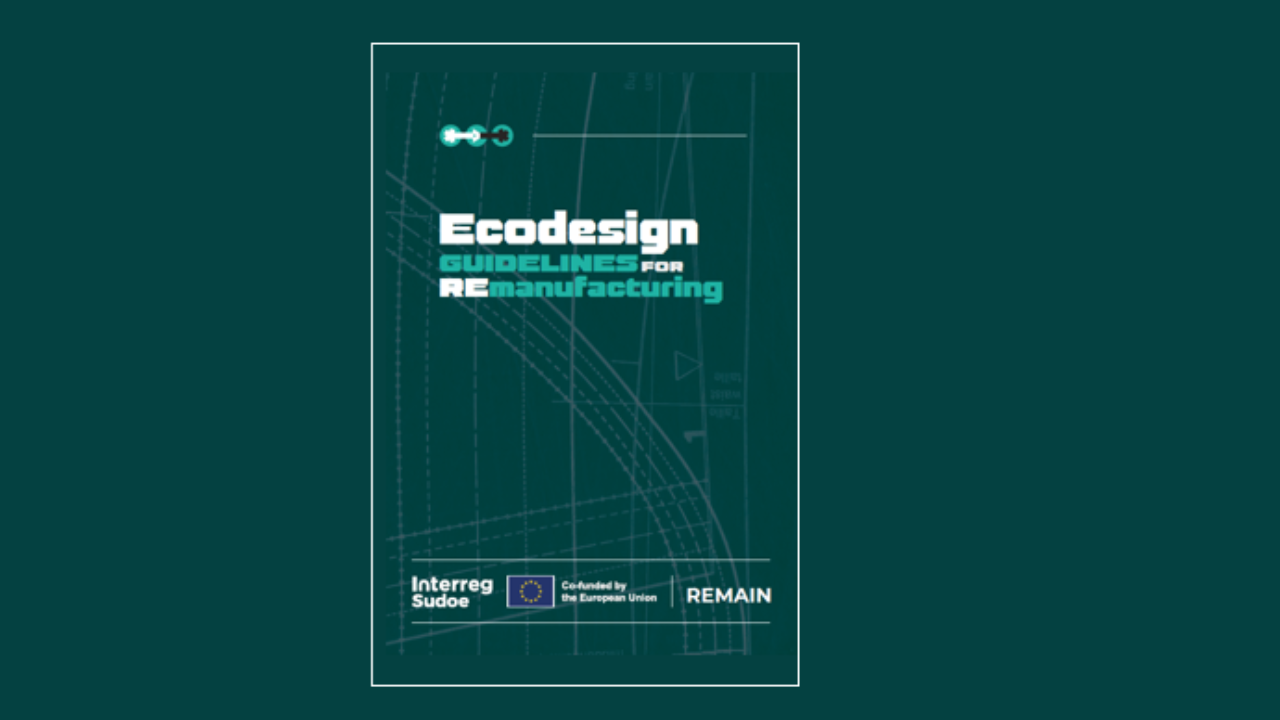
REMAIN project releases guide dedicated to ecodesign applied to footwear and textile remanufacturing.
How can we design products that last longer, are easier to repair, and can experience multiple lifecycles?
It is precisely this question that the ecodesign for remanufacturing guide seeks to answer. Developed under the REMAIN project and co-financed by the European Regional Development Fund (ERDF) through the Interreg Sudoe Programme, it delivers practical guidelines to embed circular economy principles from the earliest product design phase, in line with the European Union’s sustainability regulations.
The guide stems from a central premise: extending the lifecycle of products begins the moment they are conceived. In footwear and textiles, ecodesign helps prevent waste generation, facilitates repair, reconditioning, and remanufacturing, and consequently preserves product value over time.
Seven themes to rethink product design: ecodesign for remanufacturing
The full version of the guide is structured into seven sections, addressing diverse dimensions of ecodesign and remanufacturing:
- Introduction to the project and guide purpose, presenting REMAIN and the role of ecodesign in extending footwear and textile durability;
- The product lifecycle, focusing on the shift from a linear model to a circular framework based on prevention, repair, and remanufacturing;
- Restoration processes, distinguishing between repair, reconditioning, and remanufacturing;
- Regulatory framework, including ecodesign standards, the Digital Product Passport (DPP), and emerging sustainability reporting requirements;
- Building the future of remanufacturing, identifying existing market barriers and the imperative of designing with disassembly, recovery, and reuse in mind;
- The six principles of ecodesign for remanufacturing, offering technical guidelines on durability, disassembly, modularity, materials, accessibility, and traceability;
- From repair to ecodesign, drawing on real case studies to transform recurring design flaws into proactive prevention strategies.
From problem to solution: ecodesign in practice
One case study detailed in the summary version demonstrates how a design flaw can drastically curtail an article’s operational lifespan.
This is evident in polyurethane (PU) soles which, owing to chemical material degradation over time, can cause premature disposal of otherwise high-quality footwear. The solution requires rethinking material selection and physical construction, prioritising durable compounds and modular assemblies that allow soles to be replaced straightforwardly.
This approach captures the guide’s foundational aim: shifting from reactive troubleshooting to systemic design-led prevention.
REMAIN project
The guide was developed under the REMAIN project and is co-financed by the European Regional Development Fund (ERDF) through the Interreg Sudoe Programme.
The summary version provides an overview of the core principles, while the comprehensive guide can be requested free of charge.
👉🏼 View the summary version:
👉🏼 Request the Ecodesign Guide for Remanufacturing free of charge:
Application form for the full guide
An exceptional opportunity to explore ecodesign fundamentals and determine how initial design choices can deliver multiple lifecycles for industrial products.