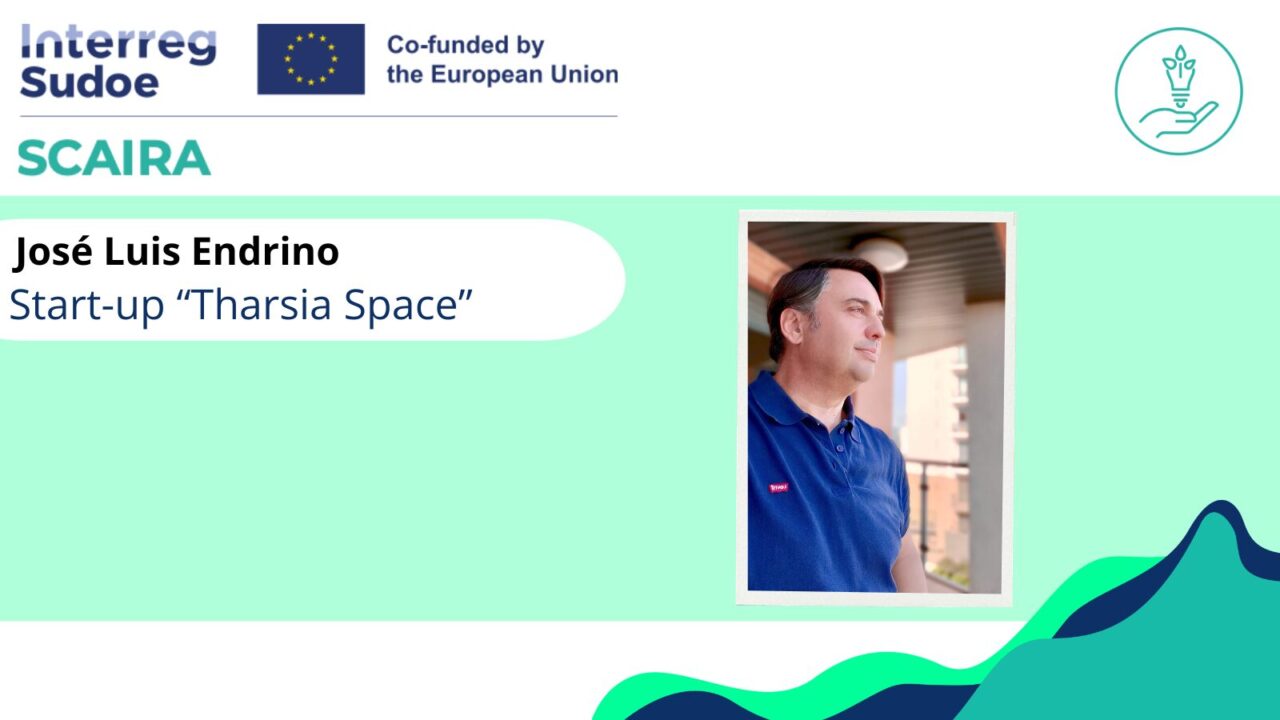
We are at an early stage, between concept and MVP, currently focusing on validating simulation of orbital mechanics, AI-surrogate models, and their potential applications.
What is the nature of your project, and what problem does it aim to solve?
Tharsia Space aims to develop AI-based onboard control solutions for satellites and high-altitude platforms to improve efficiency, safety, and lifetime. The goal is to reduce failures, improve precision in positioning maneuvers, extend mission duration, and contribute to more sustainable space operations by minimizing waste and improving end-of-life management .
Which SCAIRA services have you chosen?
Services 3 and 4: Financial strategy focused on innovation and sustainable manufacturing, as well as public and private funding opportunities for start-ups and green innovations.
Services 6 and 7: Proof of Concept (PoC) and MVP.
Service 11: Development of the business plan and the Business Model Canvas.
Service 14: B2B meetings between start-ups and industrial companies, and B2F meetings between start-ups and investors.
What are your short-term objectives during the acceleration programme?
To validate the technology, refine the value proposition, and develop a solid MVP, while also building initial partnerships and preparing for early market entry.
Who is your target market and what customer need are you addressing?
Our main targets are satellite propulsion system manufacturers, small satellite manufacturers and integrators, universities with satellites projects and new space operators. We address the need for smarter, more autonomous systems that improve performance, reduce operational risks, and support sustainability goals.
What challenges do you identify today?
The key challenges are technology validation, access to early adopters, and transitioning from a research-driven idea to a market-ready product.
Do you already have a team?
Yes, the team also comes from academia, but also with a corporate background, and focuses on aerospace engineering, Validation & Verification, AI, and control systems. It brings strong research and modelling capabilities, supporting the development of advanced onboard control solutions.