
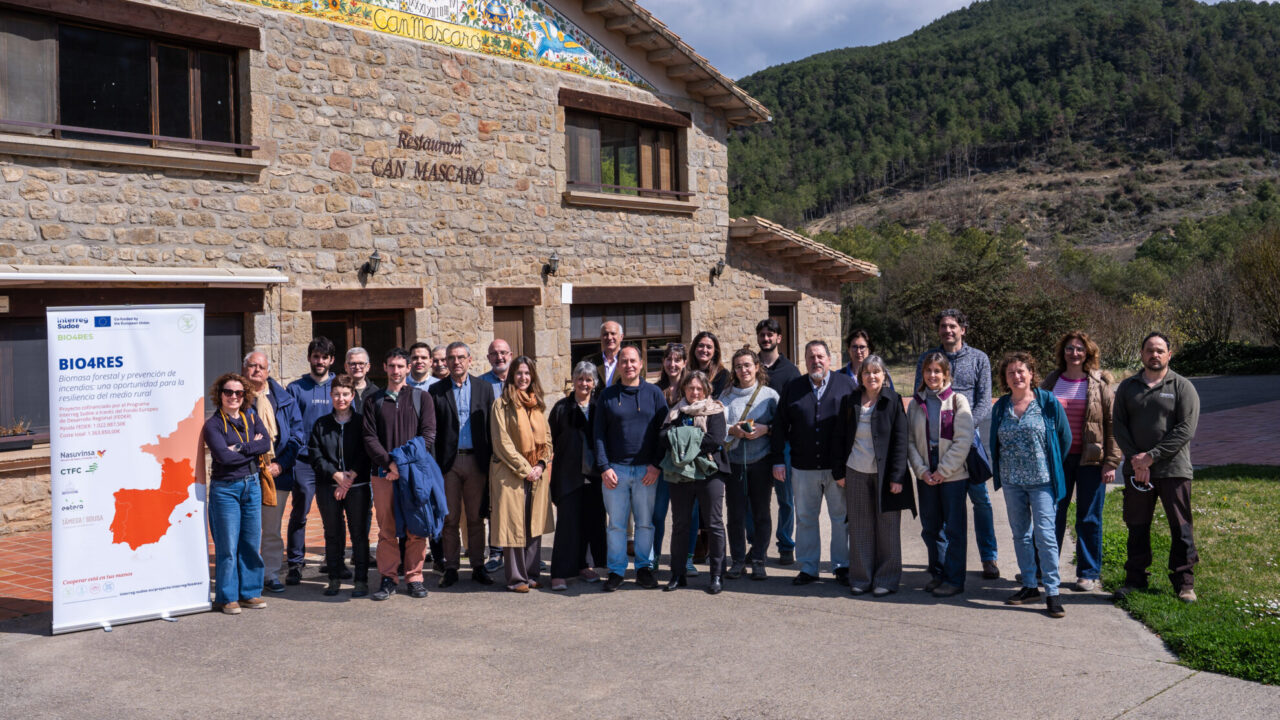
On 24 and 25 March, the Centre for Forest Science and Technology of Catalonia (CTFC) hosted the transnational seminar and knowledge transfer workshop for the Interreg SUDOE BIO4RES project, a European initiative aimed at improving the prevention and management of forest fire risk through the utilisation of biomass.
The event brought together around 30 participants, including experts, technical staff and institutional representatives from Spain, France and Portugal, who shared results, experiences and innovative approaches to move towards more efficient, sustainable forest management adapted to the current climate context.
The event was opened by Adriano Raddi, head of the Bioeconomy and Governance Programme and head of the Timber Utilisation and Biomass Group at the CTFC, who highlighted the centre’s role as a public research and technology transfer institution in sustainable forest management. With over 25 years of experience, the CTFC is affiliated with the Government of Catalonia and forms part of the CERCA network.
During his presentation, the main lines of the BIO4RES project were outlined. The project aims to improve fire risk prevention and management in the forests of the SUDOE region through the utilisation of forest biomass, thereby helping to strengthen the resilience of ecosystems without compromising their environmental, social and economic services.
The project is led by Nasuvinsa (Navarre) and involves the CTFC (Catalonia), the Union des Communes Forestières du Grand Sud (France), Estera Innovation (France) and the Comunidade Intermunicipal do Tâmega e Sousa (Portugal), consolidating a key territorial cooperation network to jointly address forestry challenges in southern Europe.
On the technical side, researcher Gianni Picchi (CNR-IBE) highlighted the need to address biomass accumulation “as a central focus of fire prevention”, in a context marked by drought, rising temperatures and a lack of forest management. Picchi advocated an approach tailored to each territory, combining tools such as grazing, prescribed burning and preventive silviculture, and emphasised “the role of mechanisation in improving efficiency and facilitating biomass recovery”.
The seminar also served to highlight innovative regional models such as the “Bosques del Vallès” project, presented by Laura Oliver, Councillor for Climate Emergency, and Natàlia Tierno, Head of Technical Services in the Regional Development Department of the Vallès Occidental Regional Council. This initiative promotes the use of biomass as a local energy resource, “promoting renewable energy, reducing emissions and strengthening local development through new forms of public governance”.
Ignasi Castelló, former head of the Technical Office for Municipal Forest Fire Prevention at Barcelona Provincial Council, also offered his thoughts on the main structural challenges in forest fire management, highlighting land fragmentation, the sector’s lack of profitability and institutional lack of coordination as some of the key challenges. Castelló argued for “the need to prioritise technical management, long-term planning and active prevention based on forest fuel management”.
The meeting highlighted the importance of European cooperation and knowledge transfer as key tools for tackling the growing risk of forest fires in the context of climate change.