
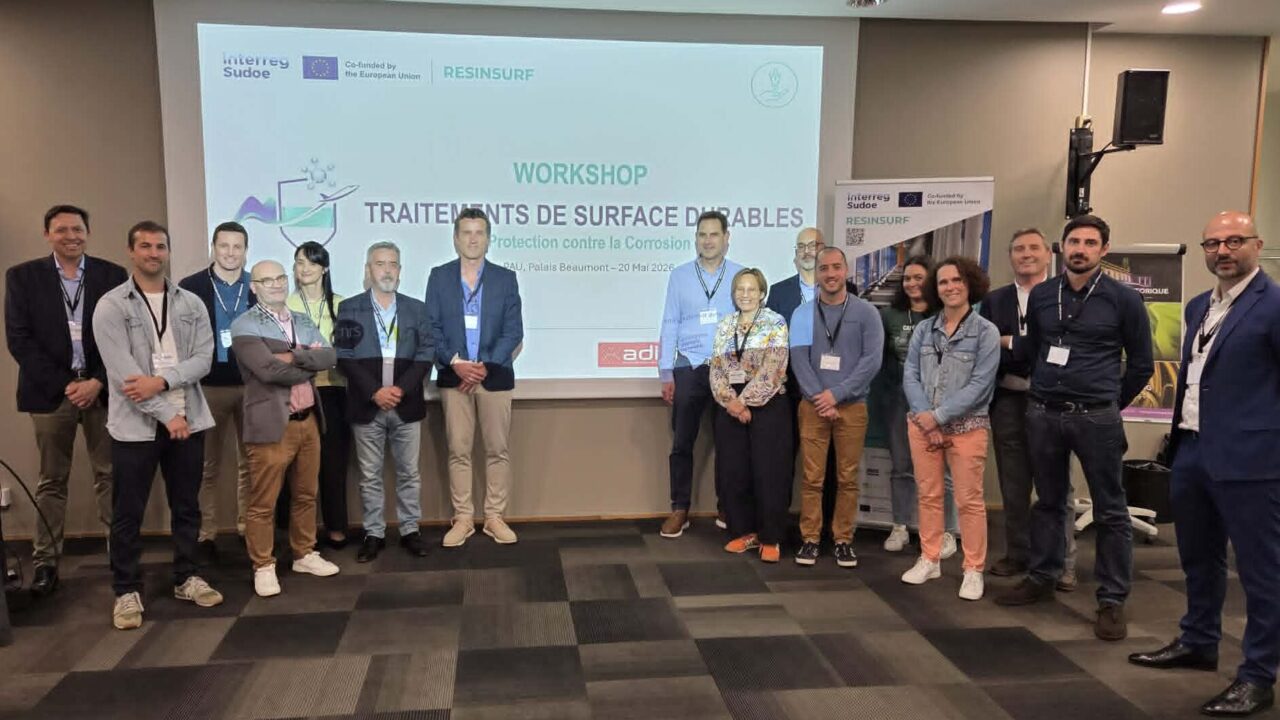

The advancement of more sustainable surface treatment technologies in Europe was one of the main focuses of the workshop “Traitement de Surface Durables – Protection contre la Corrosion”, recently held in Pau (France). The event gathered key stakeholders from the scientific and industrial sectors to discuss the challenges and opportunities associated with replacing critical substances in coating processes.
In this context, the European project RESINSURF played a prominent role as an initiative aimed at developing sustainable alternatives to hexavalent chromium (Cr(VI)), a substance widely used in industry but subject to strict restrictions due to its environmental and health impacts.

The project presentation showcased progress in new solutions designed to maintain the high technical performance required by sectors such as aeronautics and automotive, while aligning with European regulatory and sustainability objectives.
Throughout the workshop, different technological approaches to corrosion protection were discussed, along with the challenges related to the industrial implementation of these alternatives. Among the key points highlighted was the need to ensure reliability, durability, and competitiveness of new processes, which are essential for large-scale adoption.
The workshop also emphasized the importance of collaboration between research centers, universities, and industry to accelerate the transition towards safer solutions. In this regard, initiatives such as RESINSURF illustrate the role of collaborative projects in generating applied knowledge and validating emerging technologies in environments close to industrial reality.


The event was co-funded by the Interreg Sudoe programme and organized by the Université de Pau et des Pays de l’Adour (UPPA) and UT2A (both associated members of the RESINSURF Project), reinforcing the regional commitment to innovation in sustainable surface treatments.