
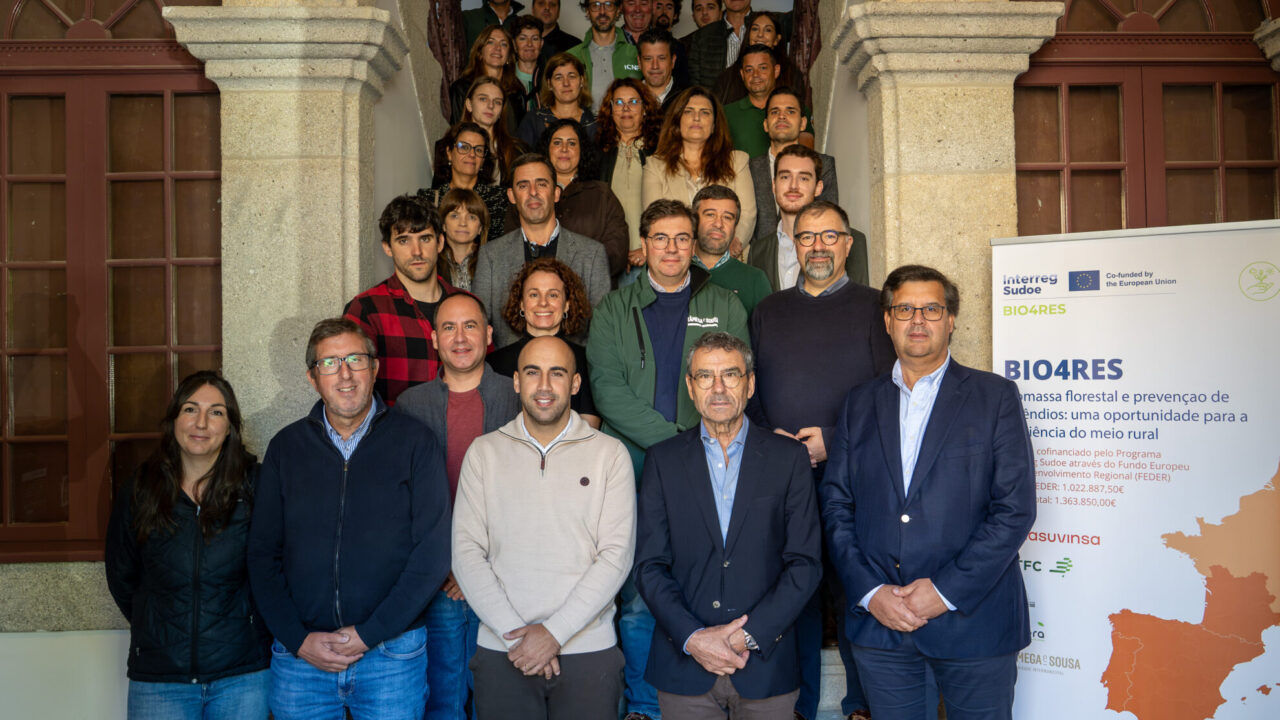
Sustainable forest management, the prevention of forest fires and the use of biomass as an energy and economic resource were the focus of the final seminar of the European BIO4RES project, held on 28 October at the Casa de Chavães in Baião (Portugal).
The event brought together institutional representatives, forestry specialists and organisations from Spain, France and Portugal to share the main findings of this transnational cooperation initiative, which aims to improve the resilience of regions to climate change through the sustainable use of forest resources.
The event took place as part of the Transnational Meeting on Biomass, Forests and Territorial Resilience, held from 27 to 29 October in the Portuguese region of Douro, Tâmega and Sousa, and provided an opportunity to pool experiences, tools and solutions developed during the project.
The official opening was attended by Nuno Fonseca, president of the Intermunicipal Council of the CIM do Tâmega e Sousa, and Ana Raquel Coelho Azevedo, mayor of Baião.
A SHARED STRATEGY FOR UTILISING FOREST BIOMASS
One of the key outcomes presented during the seminar was the Integrated Strategy for Biomass Utilisation and Fire Prevention, outlined by Adriano Radi, head of the Forest Utilisation and Biomass Group at the Catalan Centre for Forest Science and Technology (CTFC).
This strategy addresses some of the challenges shared by regions in south-western Europe, such as the accumulation of plant fuel, the costs of preventative work, the difficulties in mobilising forestry resources and the need to preserve biodiversity.
Its approach aims to turn active forest management into an opportunity to generate economic and social value, by promoting local supply chains, technological innovation and greater coordination between stakeholders.
FOUR PILOT PROJECTS TO TRANSFORM KNOWLEDGE INTO SOLUTIONS
A key part of the seminar was devoted to presenting the results of four pilot projects carried out in France, Spain and Portugal, which enable the objectives of BIO4RES to be translated into concrete actions on the ground.
The first, presented by Lea Pradines of the Union Grand Sud des Communes Forestières, focused on analysing the impact of biomass harvesting on forest biodiversity. The study combines ecological data and fire risk mapping to identify practices that reduce plant fuel without compromising habitats and species.
The second case study, presented by Gerard Alcoverro, technical manager for mechanisation and forest biomass at the CTFC, addressed technological innovation in biomass harvesting operations. Trials carried out in the French and Catalan versions of La Cerdanya have enabled a comparison of different machinery systems and an exploration of the potential of technologies such as LiDAR to improve forest inventories.
For its part, Portugal presented a model for local energy utilisation developed in Baião. Manuela Alves and Mário Júlio, coordinators of BIO4RES at the CIM do Tâmega e Sousa, explained an initiative aimed at collecting, processing and using residual forest biomass as fuel for a heating and hot water system located next to the Gove forest fire station.
These initiatives highlight the importance of tailoring solutions to the specific characteristics of each region, combining environmental criteria, technical feasibility and the use of local resources.
NAVARRE PRESENTS ITS PROGRESS IN TRAINING AND AWARENESS-RAISING
The fourth pilot project focused on Navarre, which presented the work carried out in the fields of education, vocational training and public awareness-raising.
David Candel, project manager at Nasuvinsa-Lursarea, outlined the main initiatives launched to improve knowledge of sustainable forest management, fire prevention and the responsible use of biomass.
Notable results include the production of training materials and a transnational guide on forest biomass management, designed as a training tool for professionals, local authorities and other stakeholders linked to the region.
Furthermore, Nasuvinsa has carried out various awareness-raising initiatives aimed at the general public and the education sector, with the aim of introducing younger generations to the environmental, social and economic benefits of active forest management.
Another resource presented was a series of four educational videos produced as part of the project: ‘A well-managed forest is a sustainable forest’, ‘Forest biomass: energy from the forest’, ‘Many hands, one forest’ and ‘Forests prepared for climate change’.
These audiovisual pieces aim to convey, in a simple and accessible way, the importance of looking after our forests, using their resources responsibly and fostering collaboration amongst the various stakeholders in the forestry sector.
PREVENTION, CO-OPERATION AND RURAL DEVELOPMENT
The seminar also provided an opportunity to learn about various European strategies for fire prevention and biomass management, with presentations by Paulo Bessa, from the Portuguese Institute for Nature Conservation and Forests (ICNF), and Denis Martin, president of the Union Grand Sud des Communes Forestières.
The experiences shared highlighted the importance of maintaining preventive measures throughout the year, strengthening the involvement of local authorities and promoting management models that help to reduce the risk of fires and boost rural economies.
The event also featured presentations on the training of local authority representatives and the work of forest fire brigades in the field.
Olatz Esparza, director of the Navarre Timber Industry Association (ADEMAN), took part in this session via video link, offering a business perspective on the need to raise public awareness of sustainable forest management and the responsible use of forest resources.
EUROPEAN CO-OPERATION FOR THE FUTURE OF OUR FORESTS
The final BIO4RES seminar highlighted that forest fire prevention requires a comprehensive approach, capable of combining active land management, biodiversity conservation, technological innovation, professional training and institutional co-operation.
Experiences in Spain, France and Portugal demonstrate that the sustainable use of biomass can help improve the resilience of forest ecosystems whilst, at the same time, generating economic and social opportunities in rural areas.
With the presentation of these results, BIO4RES is making progress in knowledge transfer and in consolidating a shared strategy to tackle the environmental challenges facing south-western Europe.
The BIO4RES project, ‘Forest biomass and fire prevention: an opportunity for rural resilience’, is co-funded by the European Union through the Interreg Sudoe programme and involves the participation of Nasuvinsa (Navarre), the Centre for Forestry Science and Technology of Catalonia (CTFC), the Union Grand Sud des Communes Forestières and Estera Innovation (France), and the Comunidade Intermunicipal do Tâmega e Sousa (Portugal).