
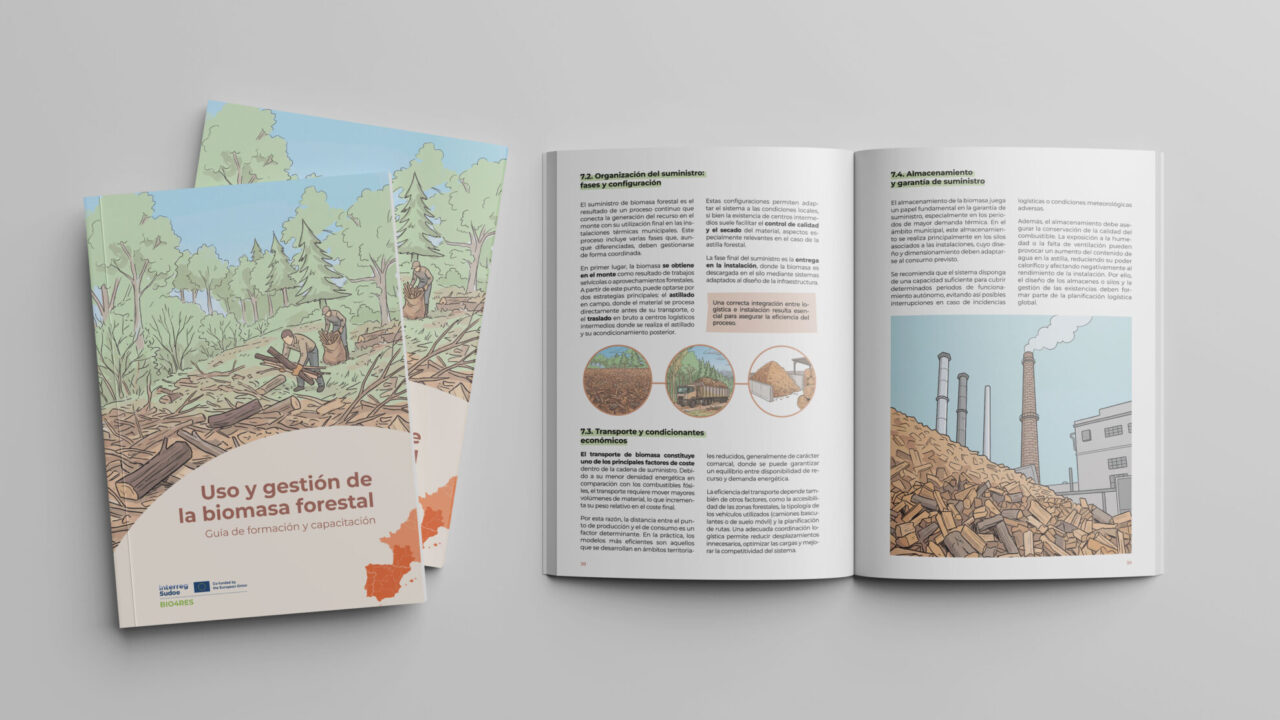
The European BIO4RES project has produced the guide ‘Use and Management of Forest Biomass: A Training and Capacity-Building Guide’, a new tool designed to facilitate understanding, planning and the sustainable use of forest resources, particularly at local authority level.
The 72-page document offers a comprehensive overview of the opportunities presented by forest biomass to advance the energy transition, improve forest management, prevent fires and generate economic activity in rural areas.
Developed as part of the Interreg Sudoe programme, the publication addresses one of BIO4RES’s main objectives: to promote solutions that enable the responsible use of forest resources, strengthening the resilience of forests to climate change and contributing to the sustainability of local areas.
The guide is based on a fundamental idea: forest biomass should not be viewed solely as a source of renewable energy, but as a strategic resource capable of linking forest management, fire prevention, economic activity and local development.
A PRACTICAL TOOL FOR LOCAL AUTHORITIES AND PROFESSIONALS
The publication is specifically aimed at local authorities, which play a key role in land management, energy planning and the promotion of initiatives linked to the use of forest resources.
Spanning twelve chapters, the guide covers the key aspects required to develop biomass projects, from initial planning through to the commissioning and maintenance of energy facilities.
Key topics include forest fire prevention, the organisation of the biomass value chain, the operation of municipal facilities, the quality of wood chips, logistics and supply, as well as procurement procedures and different management models.
The document also includes recommendations to ensure the technical, economic and environmental viability of these initiatives, paying particular attention to the proximity of resources, coordination between stakeholders and the professionalisation of the sector.
TRAINING FOR MORE SUSTAINABLE FOREST MANAGEMENT
One of the central themes of the guide is the importance of training and capacity-building for individuals and organisations involved in the management of forest biomass.
BIO4RES is committed to improving the technical knowledge of professionals, facilitating the transfer of best practice and promoting organisational models that enable the available forest resources to be transformed into real opportunities for the region.
In this regard, the publication devotes particular attention to wood chips as a biofuel, explaining the quality, storage, transport and supply requirements necessary to ensure the efficient operation of facilities.
It also highlights the potential of biomass to help prevent fires through active forest management measures, such as thinning, clearing and the utilisation of forest residues, always in accordance with sustainability and planning criteria.
BIOMASS, ENERGY AND RURAL DEVELOPMENT
The guide also highlights the economic and social opportunities associated with the creation of local supply chains, which can generate specialised employment, boost forestry businesses and retain the added value of resources within the local area itself.
From this perspective, local authorities can play a decisive role, both through the use of biomass in public buildings and facilities and through procurement, spatial planning and collaboration with various stakeholders in the sector.
By producing this guide, BIO4RES reinforces its commitment to knowledge transfer and training as key tools for moving towards more sustainable forest management and more resilient rural areas.
The document thus provides a new resource to support local authorities and professionals in developing initiatives that harness the energy potential of our forests without compromising their conservation.
The BIO4RES project, ‘Forest biomass and fire prevention: an opportunity for rural resilience’, is co-funded by the Interreg Sudoe programme through the European Regional Development Fund (ERDF) and by the Government of Navarre.