
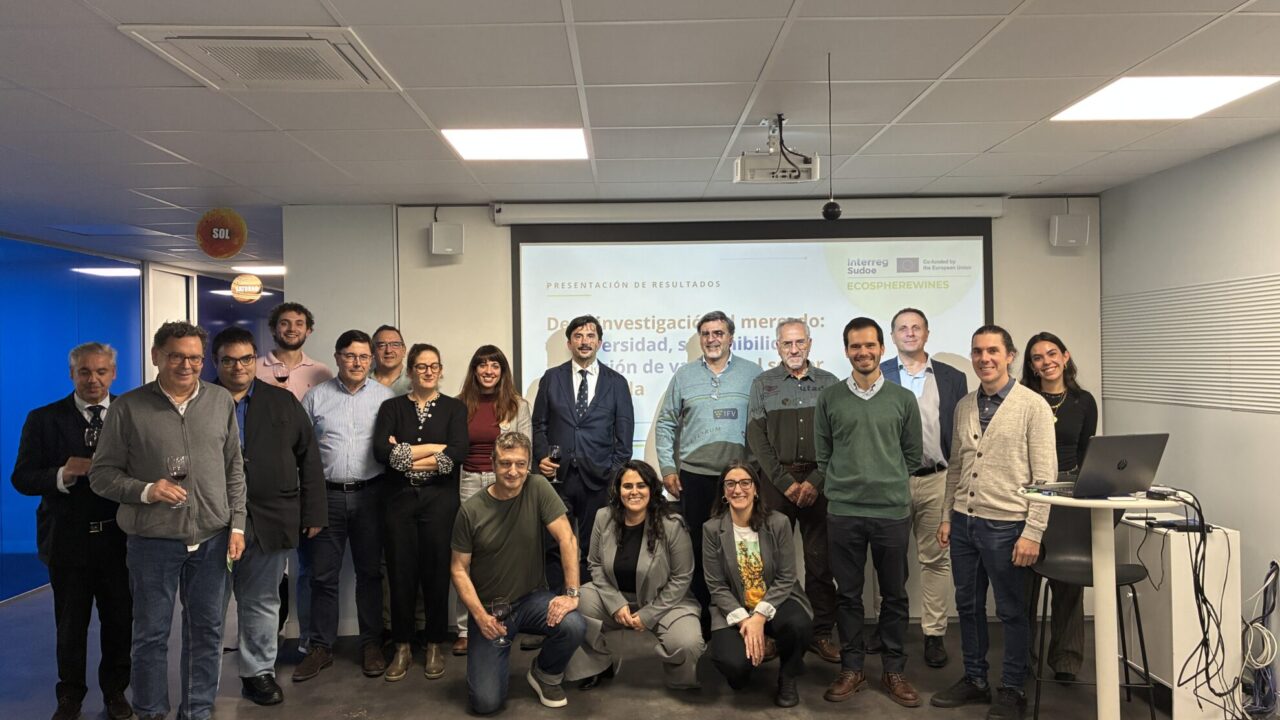
On 17 November, MOA Institute (Madrid) hosted the final event of the ECOSPHEREWINES project, an initiative funded by the Interreg Sudoe programme and co-financed by the European Union. Under the title “From research to market: biodiversity, sustainability and value creation in the wine sector”, the event focused on how to turn scientific results into practical tools and added value for winegrowers, wineries and territories.
The session presented the main results from the four ECOSPHEREWINES pilot areas: Gaillac-Tarn (France), Alto Douro Vinhateiro (Portugal) and, in Spain, Paderne (Galicia) and Arribes del Duero. Measures tested there include cover crops, legume sowing, conservation of trees and shrubs, management of mowing residues, biocontrol and restoration of heritage features.
Results in the Spanish areas
In Paderne, within the Betanzos PGI, the project combined soil monitoring with the recovery of traditional vineyards and ecological and heritage restoration. At the A Picha plot, biochar was applied to the surface at 40 tonnes per hectare, following the manufacturer’s recommendations. The report makes clear that this rate applies to the experimental plot and cannot be generalised, as application rates are not yet standardised. In Arribes del Duero, actions focused on enhancing biodiversity, conserving minority grape varieties and restoring traditional terraces. The Galician and Arribes areas also showed the most notable improvements in estimated erosion reduction.
Experiences from Portugal and France
In Portugal, the project set up a green manure trial of around six hectares in Vila Nova de Foz Côa, within the Alto Douro Vinhateiro, using a mix of five legumes. Two biomass management methods, incorporated into the soil or left on the surface, were compared with an area of natural vegetation. There were no significant differences in pruning wood weight. There were, however, differences in the Ravaz index, which was lower under natural vegetation than under either green manure method. Stem water potential showed no significant effect of the cover crops either, although water stress was moderated at the end of ripening in the covered inter-rows. The initial soil analysis also detected low potassium levels, highlighting the importance of a prior diagnosis before deciding on cover crops.
In Gaillac-Tarn (France), work focused on characterising vineyard microclimate and vigour by combining Sentinel-2 satellite imagery, nine temperature and humidity sensors, a drone flight and LiDAR-based solar radiation models. After the August 2025 heatwave, vegetation indices dropped sharply. The central plot, partly surrounded by trees and buildings, received up to 55% less solar radiation and yet maintained its water status better. Shade and possibly higher soil moisture are the likely explanations, although these still need to be confirmed with further measurements. The main methodological conclusion was that combining drone, satellite and LiDAR data makes it possible to distinguish a plot’s structural limitations from its short-term responses to a heat event.
Green infrastructure under discussion
After Anabel Alba, project officer at Fundación Juana de Vega, presented the ECOSPHEREWINES Green Infrastructure Strategy, one of the key moments of the day followed: the round table “From knowledge to action: challenges and opportunities for integrating green infrastructure into the wine sector”.
Moderated by Alfonso Ribas, Director of Research and Innovation at Fundación Juana de Vega, it featured Mario de la Fuente, President of the Viticulture Commission of the International Organisation of Vine and Wine (OIV); Tania López-Piñeiro, Deputy Assistant Director for Terrestrial and Marine Biodiversity at the Spanish Ministry for the Ecological Transition and the Demographic Challenge (MITECO); Elena Vicente, Head of Area at the Sub-Directorate General for Fruit, Vegetables and Wine of the Spanish Ministry of Agriculture, Fisheries and Food (MAPA); and Mireia Torres, Director of Innovation at Familia Torres.
The debate thus brought together international, institutional and industry perspectives on the role of biodiversity in the future of viticulture.
Alfonso Ribas, as coordinator of ECOSPHEREWINES, closed the event and introduced a tasting of wines from the project’s different experimental areas.