
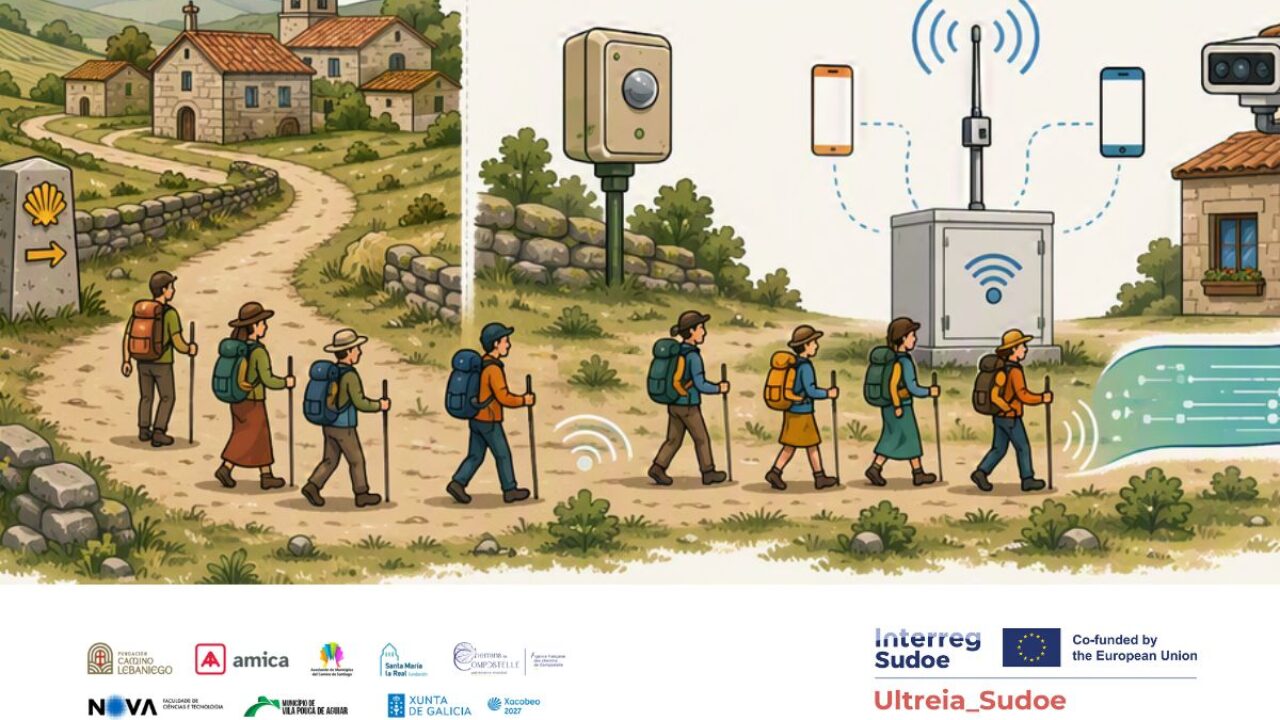
A new study proposes the use of sensors, data analytics, and digital tools to improve sustainability, service management, and the pilgrim experience along the Camino de Santiago. The Camino de Santiago, one of Europe’s most important pilgrimage routes, faces the challenge of managing a growing number of visitors without compromising its cultural, heritage, and spiritual value. To address this challenge, researchers and partners of the European ULTREIA SUDOE project have developed an innovative smart management framework based on people-flow monitoring technologies and decision-support systems.
The study, published in the scientific journal Multimodal Technologies and Interaction, proposes the integration of people-counting sensors, mobile signal detection systems, and real-time data analytics to help municipalities and managing authorities anticipate needs and improve resource planning along the Camino de Santiago.
Technology Serving a Historic Heritage Route
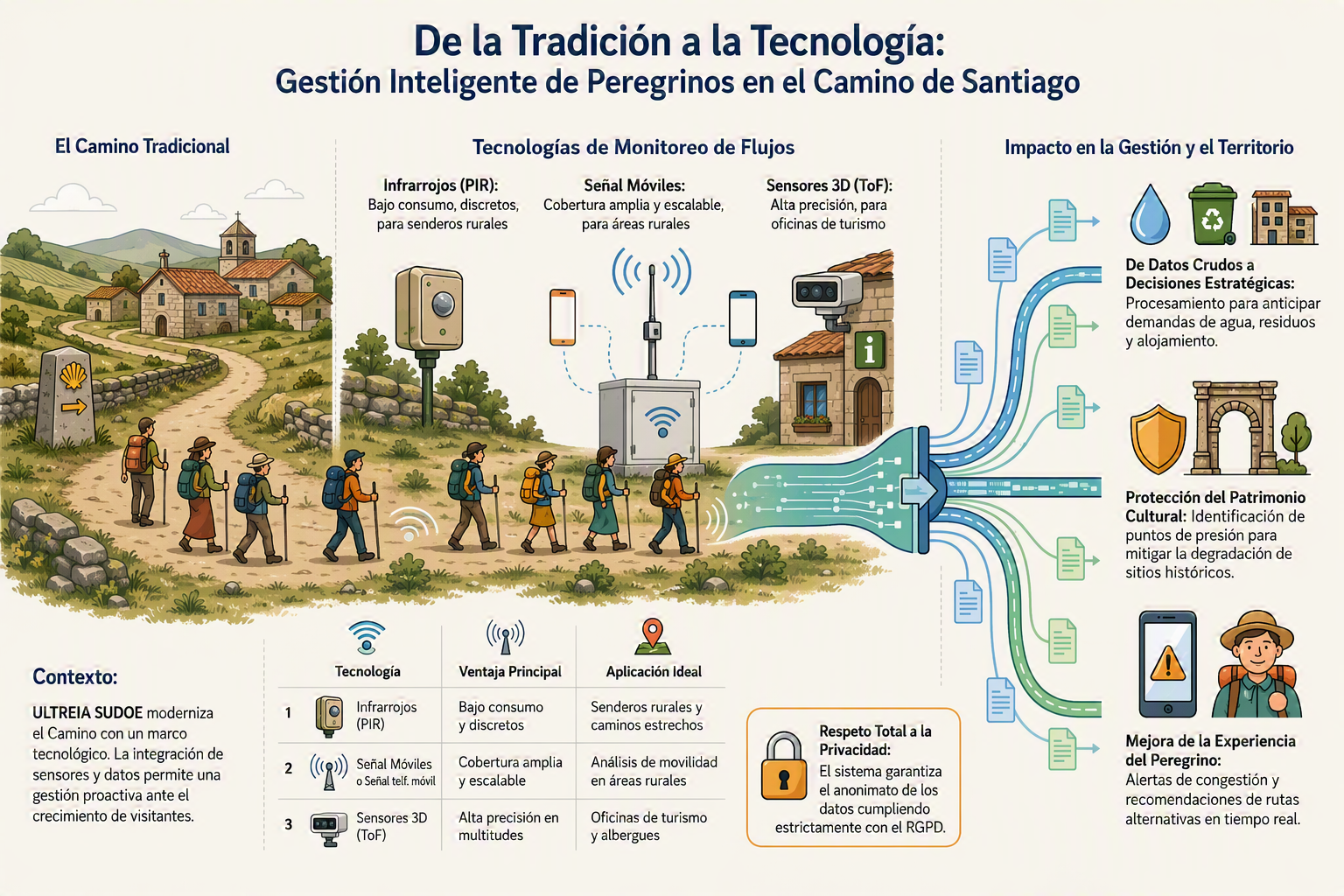
The authors highlight that the steady increase in the number of pilgrims is placing growing pressure on infrastructure and services, particularly in small rural communities. The lack of real-time information makes it difficult to plan essential aspects such as accommodation, sanitation, safety, healthcare services, and waste management. To address these challenges, the research examines various people-counting technologies, including infrared sensors, radar systems, thermal cameras, LiDAR systems, and Wi-Fi and Bluetooth signal detectors. Each of these solutions offers different advantages depending on the characteristics of the monitored environments, ranging from rural trails to tourist information offices and pilgrim hostels.
Five Pilot Territories in Spain, Portugal, and France
The technological proposal is being developed within the framework of the ULTREIA SUDOE project, an initiative co-funded by the European Union’s Interreg Sudoe Programme that aims to promote the sustainable development of territories associated with the Camino de Santiago. The system will be tested in five pilot areas:
- Belorado (Burgos, Spain).
- Camino Lebaniego (Cantabria, Spain).
- O Cebreiro (Galicia, Spain).
- Eauze (France).
- Vila Pouca de Aguiar (Portugal).
In these locations, different devices will be installed to collect information on pilgrim traffic, movements between points of interest, and occupancy patterns in specific spaces.
A Dashboard to Improve Decision-Making
All collected information will be integrated into a digital platform developed specifically for the project. The system will process data anonymously, ensuring compliance with data protection regulations, and will generate key indicators to support territorial management. Planned functionalities include:
- Identification of congestion hotspots.
- Monitoring of pilgrim flows.
- Visitor flow prediction.
- Optimization of services and infrastructure.
- Support for the conservation of cultural and natural heritage.
- Generation of alerts and information for managers and users.
Towards a More Sustainable and Smarter Camino
Researchers believe that the combination of digital technologies and contextual data will enable a shift from reactive to predictive management of the Camino de Santiago. This will facilitate a better distribution of visitor flows, reduce pressure on sensitive areas, and contribute to improving the pilgrim experience. Furthermore, the model developed by ULTREIA SUDOE could serve as a reference for other European cultural and pilgrimage routes facing similar challenges related to sustainability, heritage conservation, and the management of large visitor flows. The project demonstrates that technological innovation and heritage preservation can move forward hand in hand, creating new opportunities for a more efficient, sustainable, and respectful management of the essence of the Camino de Santiago. Download the report in English here.
Download here: From Tradition to Technology ULTREIA SUDOE
Ultreia Sudoe es un proyecto europeo de cooperación transfronteriza (España, Francia y Portugal) dotado con 1,4 millones de euros. Su objetivo es dinamizar las zonas rurales del interior a través de los Caminos de Santiago, impulsando la artesanía, los productos agroalimentarios y el turismo sostenible de cara al Xacobeo 2027