
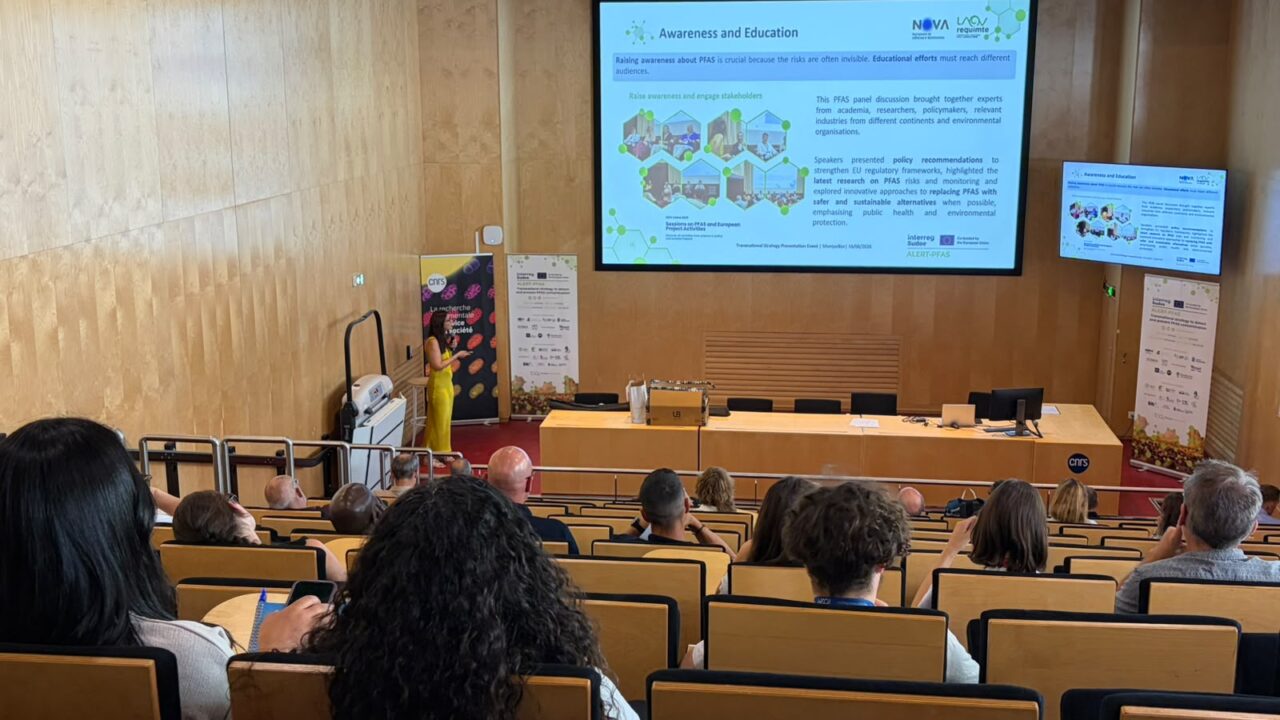
On 16 and 17 June 2026, partners of the European ALERT-PFAS project gathered in Montpellier and Gignac (France) for two days dedicated to knowledge exchange, transnational cooperation and the advancement of innovative solutions to tackle PFAS pollution. The programme combined a public event organised as part of EU Green Week 2026 with a Steering Committee meeting and a technical visit to the facilities of SDIS 34.
EU Green Week highlights the PFAS challenge
The first day took place in Montpellier on 16 June under the title “Addressing the PFAS Challenge: Science, Cooperation and Environmental Solutions”, an EU Green Week partner event that brought together more than 40 participants, including researchers, public authorities, water sector professionals, emergency services, industry representatives and members of the public.

The event was opened by representatives of NOVA School of Science and Technology (NOVA FCT), coordinator of the ALERT-PFAS project, who presented the project’s objectives and progress in developing a transnational strategy to detect, prevent and mitigate PFAS contamination across the SUDOE area.
Throughout the afternoon, leading experts explored the PFAS issue from a range of perspectives. Julie Mendret from the University of Montpellier presented awareness-raising initiatives and innovative educational tools, while Vincent Cavaillès examined the potential impacts of PFAS on human health, with particular attention to their links with certain types of cancer.
The programme also featured presentations on water quality and available treatment solutions, as well as a session focusing on firefighters’ exposure to PFAS and other contaminants present in fire smoke. Participants also learned about ongoing CNRS research activities related to PFAS before taking part in an open discussion on the scientific, health, environmental and industrial challenges posed by these persistent pollutants.
Technical progress and strengthened partner coordination
The second day was dedicated to the ALERT-PFAS Steering Committee meeting, held at the Pôle de Préparation à l’Engagement aux Situations d’Urgence (P.P.E.S.U.) in Gignac. Partners reviewed the progress of research, technological development, communication and knowledge-transfer activities being carried out across the project.
Key discussions focused on advances in optical sensor development, artificial intelligence-based tools for PFAS monitoring, technologies for PFAS separation and degradation, pilot actions across participating territories, and studies assessing the environmental, economic and social impacts of the solutions being developed. Partners also reviewed awareness-raising, training and results-transfer activities implemented throughout the project.
Technical visit to SDIS 34 and firefighting foam demonstrations
One of the highlights of the second day was a technical visit to the facilities of SDIS 34, where participants gained first-hand insight into the operational reality of emergency services and attended demonstrations of different types of firefighting foams.

During the visit, several foam products used in different intervention scenarios were presented, together with explanations of their characteristics, operational applications and effectiveness. The demonstrations also provided an opportunity to better understand the historical role of PFAS-containing firefighting foams and the ongoing challenges involved in identifying safer alternatives for both human health and the environment.
The visit offered a valuable opportunity to connect the scientific research undertaken within ALERT-PFAS with the practical needs of emergency responders, strengthening collaboration between researchers, environmental managers and firefighting professionals

Strengthening cooperation to address a common challenge
These two days highlighted the importance of combining scientific research, technological innovation, awareness-raising and operational expertise in order to address PFAS contamination effectively.

Through initiatives such as this, ALERT-PFAS continues to strengthen cooperation between research organisations, public authorities, emergency services and socio-economic stakeholders, advancing innovative solutions that help protect natural ecosystems, public health and the resilience of territories across the SUDOE region.