
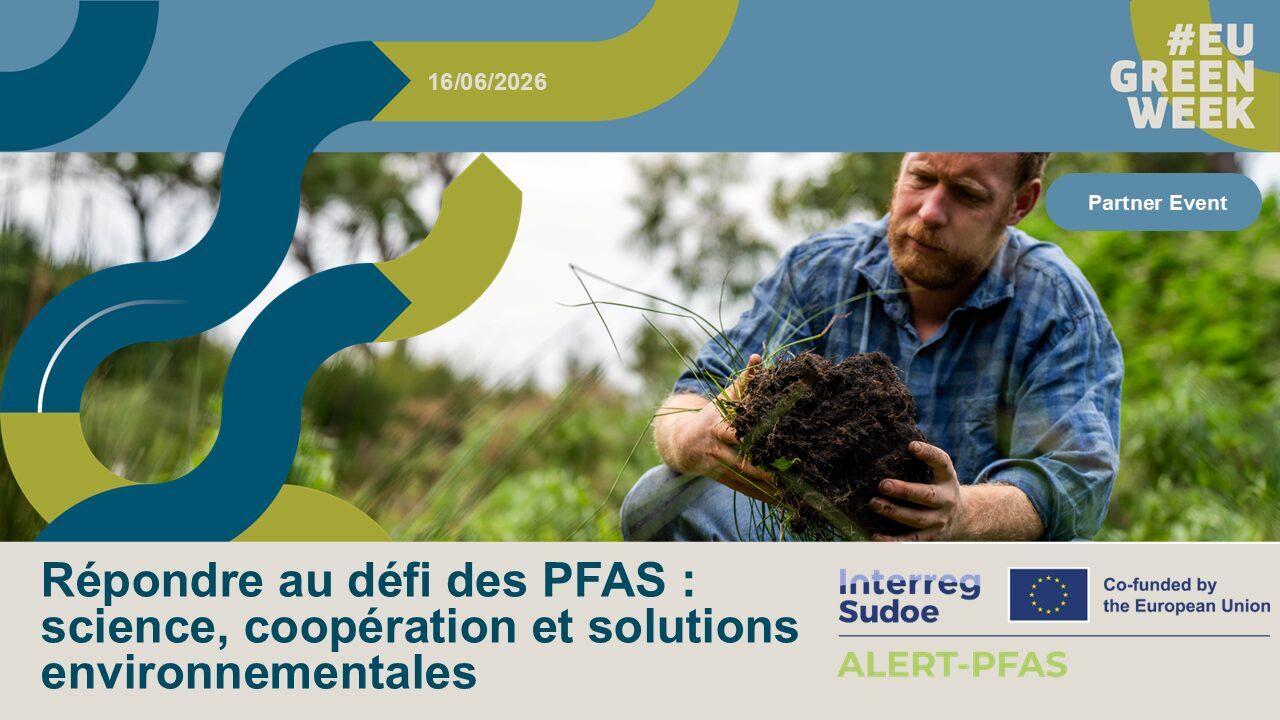
The European project ALERT-PFAS will host the event “Addressing the PFAS Challenge: Science, Cooperation and Environmental Solutions” on 16 June 2026 in Montpellier (France), as part of the official programme of EU Green Week 2026.
The event will bring together researchers, public authorities, water sector professionals, emergency services, industry representatives and citizens to discuss one of Europe’s most pressing emerging environmental challenges: the detection, prevention and mitigation of PFAS (per- and polyfluoroalkyl substances), commonly known as “forever chemicals” due to their extreme persistence in the environment.
Held at the CNRS Amphitheatre in Montpellier, the event will highlight the importance of cooperation between the scientific community, public institutions and the private sector in addressing growing concerns surrounding these persistent pollutants.
ALERT-PFAS: a transnational strategy to tackle PFAS pollution
The event will open with a presentation of the ALERT-PFAS project by representatives of NOVA School of Science and Technology (NOVA FCT), the project coordinator. Participants will learn about the project’s objectives, achievements and ongoing activities aimed at developing a transnational strategy to detect, prevent and mitigate PFAS contamination across natural areas within the SUDOE region.
Co-funded by the Interreg SUDOE Programme and the European Regional Development Fund (ERDF), ALERT-PFAS is developing innovative solutions based on optical sensors, artificial intelligence, nanotechnology, and advanced adsorption and degradation processes to improve the monitoring and management of PFAS contamination in vulnerable ecosystems, particularly those affected by wildfires.
In addition to technological research, the project promotes training, awareness-raising and knowledge-transfer activities targeting public authorities, environmental managers, emergency services and local communities.
A multidisciplinary programme exploring PFAS from multiple perspectives
The programme will feature leading experts addressing PFAS from scientific, health, environmental and industrial perspectives.
The first presentation will be delivered by Sébastien Lagoutte (CNRS), who will outline the initiatives and research activities undertaken by CNRS in relation to PFAS, including work on materials, circular economy and sustainability.
This will be followed by Julie Mendret from the University of Montpellier, who will demonstrate how awareness-raising and educational tools can support public understanding of PFAS through the presentation of the Nexus PYPHAS project and the online serious game Drop Odyssey.
The human health dimension of PFAS will be addressed by Vincent Cavaillès (CNRS/IRCM), who will present current scientific knowledge on the potential impacts of these substances on human health, with a particular focus on cancer-related research.
Following a networking coffee break, the programme will continue with a session dedicated to the exposure of firefighters to PFAS and, more broadly, to toxic substances present in fire smoke. This presentation will be delivered by Colonel Raphaël Duboullay and Fanny Choulet from SDIS Hérault, who will share ongoing work within ALERT-PFAS aimed at better understanding these risks and identifying solutions to protect the health of emergency personnel.
The final presentation will be given by Sophie Rapenne (CIRSEE – Suez), who will discuss the challenges posed by PFAS in water, currently available treatment technologies, and future industrial and regulatory perspectives for tackling this issue.
Science, cooperation and dialogue for sustainable solutions
The event will conclude with an open discussion between speakers and participants, providing an opportunity to exchange views and reflect on the scientific, health, environmental and industrial challenges associated with PFAS.
Through this initiative, ALERT-PFAS reinforces its commitment to protecting natural ecosystems, safeguarding public health and advancing innovative solutions to persistent chemical pollution. The event will also strengthen the project’s role as a transnational platform for knowledge exchange, awareness-raising and collaborative action in response to one of the most significant environmental challenges of our time.