
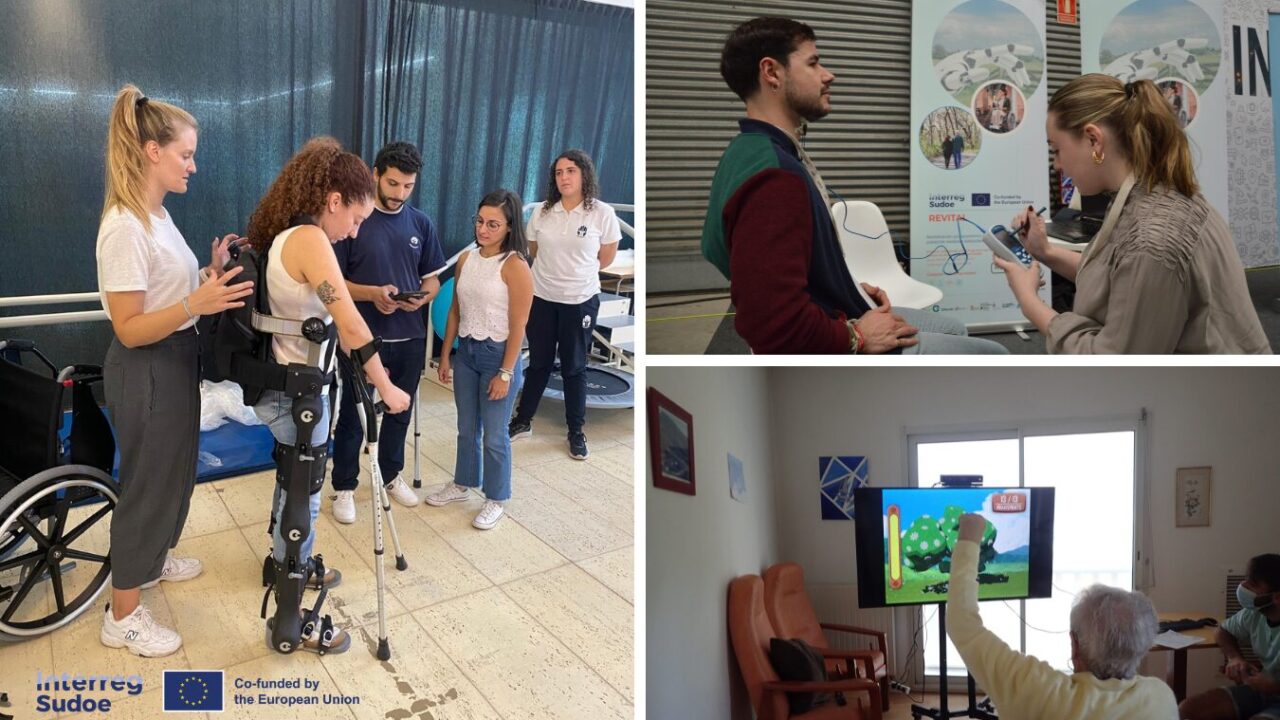
The REVITAL – Interreg SUDOE project has completed its pilot phase, bringing physical and neurological rehabilitation closer to people living in rural areas. The main objective of this initiative has been (and continues to be) to respond to the growing need for specialized healthcare and rehabilitation services, especially for the elderly and those with disabilities, using telehealth and telerehabilitation technologies. In addition to improving access to these services, REVITAL aims to contribute to the creation of skilled jobs and encourage people to remain in rural areas.
The pilot phase of the project was carried out in the three participating countries during 2025 and 2026. The pilot was conducted by the San Cebrián Foundation (Spain), the Polytechnic Institute of Castelo Branco (Portugal), and the Public Health Establishment of Garazi (France), achieving very positive results in terms of both participation and the number of interventions performed.
Pilot Phase: 92 Participants and 888 Rehabilitation Sessions
The pilot phase has provided care to 92 people, 33 men and 59 women, with an average age of 73.4 years.
In total, the following were carried out:
- 818 individual sessions
- 70 group sessions
- 888 rehabilitation sessions
These results highlight the potential of technological solutions to complement healthcare and bring specialized services to rural areas where access to these types of resources is more limited.
Spain: Technological Rehabilitation Directly in Homes
The San Cebrián Foundation has developed the pilot program, opting for an intervention model in the participants’ own homes, thus facilitating personalized care without the need for travel.
A total of 20 people participated (9 men and 11 women), with an average age of 66.5 years, completing 261 rehabilitation sessions.
The interventions took place in the homes of residents in the following towns:
- Villamuriel de Cerrato
- Venta de Baños
- Valle de Cerrato
- Vertavillo
- Mazuecos de Valdeginate
- Magaz de Cerrato
- Grijota
- Villalobón
- Villada
- Fuentes de Valdepero
Different technologies adapted to the needs of each user were used for the sessions:
- Rehametrics: 9 people
- Thera Trainer Mobi: 5 people
- Pablo System: 5 people
- Tymo: 5 people
- VitalStim Plus: 4 people
- Hank: 3 people
- Fesia Walk: 1 person
- Belk: 1 person
France: care was provided from hospitals, nursing homes, and specialized clinics
The Garazi Public Health Center conducted the pilot study with 52 participants (13 men and 39 women). with an average age of 77.6 years.
During the study, the following sessions were conducted:
- 348 individual sessions
- 70 group sessions
- 418 sessions in total
The interventions took place in different healthcare and social care centers:
- In Ispoure, at the Garazi Public Health Center, including the Luro, Adindunen Egoitza, and Toki Eder EHPADs (Home-Based Care Centers), as well as the hospital.
- In Irissarry, at a private speech therapy clinic.
- In Larceveau-Arros-Cibits, also at a private speech therapy clinic.
The technologies used were:
- MediMoov: 39 people
- Fonctionsexecutives.com: 8 people
- Hank: 3 people
- Cérébro: 3 people
- VitalStim Plus: 3 people
- Belk: 1 person
Portugal: intervention from healthcare centers and community spaces
The Polytechnic Institute of Castelo Branco conducted the pilot study with 20 participants (11 men and 9 women), with an average age of 69.25 years, carrying out 209 sessions.
The activities took place in:
- The Pedagogical Clinic of the Dr. Lopes Dias Higher School of Health at the Polytechnic Institute of Castelo Branco.
- A space provided by the Parish Council of Aldeia de São Miguel de Acha, as well as another community space supporting older adults.
The technologies used were:
- Rehametrics: 17 people
- Pablo System: 9 people
- Hank: 2 people
- Belk: 1 person
The professionals’ opinions will allow for the improvement of future telerehabilitation services.
In addition to the pilot program, the project conducted a questionnaire for participating healthcare professionals, focused on identifying new needs and defining protocols and technological tools.
The questionnaire, completed by 17 professionals from partner organizations in Spain, Portugal, and France, allowed for the evaluation of the user experience with the different technological solutions used during the pilot program, analyzing their usefulness, functionality, and contribution to the processes of patient assessment, intervention, and follow-up.
Furthermore, the responses collected helped identify the main limitations detected during the pilot program, new healthcare needs, and proposals for improvement related to the incorporation of new services, the optimization of clinical follow-up, and the development of innovative technologies that better meet the needs of users.
The contributions made by professionals will also help define future protocols and establish the necessary conditions to guarantee the sustainability, continuity, and potential expansion of these services once the project concludes, consolidating more accessible, efficient, and person-centered care models.
REVITAL Project Consortium
The Innovative Solutions for Independent Living Cluster (SIVI) coordinates this project, funded by Interreg-Sudoe, which includes the participation of the Social Services Management of Castile and León, the San Cebrián Foundation, GOGOA Mobility Robots, the École Supérieure des Technologies Industrielles Avancées (ESTIA), the University of Deusto, the Garazi Public Health Establishment, the Beira Baixa Business Association (AEBB), and the Polytechnic Institute of Castelo Branco (IPCB), which together form the complete consortium.