
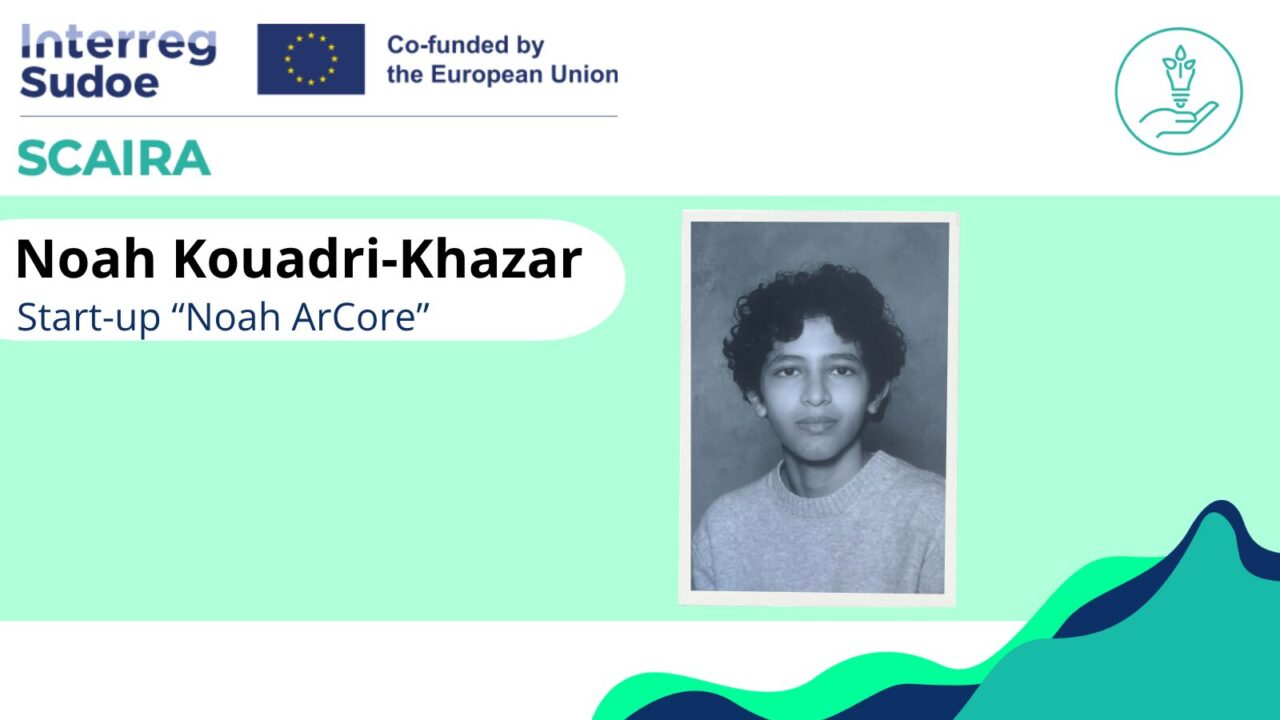
Meet Noah Kouadri-Khazar, selected in the third call with his project Noah ArCore.
Tell us briefly about yourself and your background!
My name is Noah Kouadri-Khazar. I am 14 years old and I live in Castres, in the Tarn department (France), where I study at Collège Jean Monnet. Despite my young age, I am currently in my second year at the University of Texas in a Technology programme delivered entirely online. I grew up in a family deeply connected to innovation: my father is an engineer in the automotive sector and my mother is a specialist in new technologies. This environment sparked my interest in science, engineering and entrepreneurship from a very early age. Naturally, this led me to launch Noah ArCore—my quantum propulsion engine project—driven by the conviction that energy technology requires a radical breakthrough.
How did you find out about SCAIRA?
I discovered SCAIRA through LinkedIn, where I came across the programme announcement. What immediately caught my attention was SCAIRA’s focus on deep-tech and disruptive innovation projects. As a young entrepreneur working on an innovative energy technology, I saw in SCAIRA the ideal environment to structure my project, access specialised mentoring, and connect with a network of investors and innovators from across Europe.
What stage is your start-up currently at?
Noah ArCore is currently at the MVP (Minimum Viable Product) stage. I have developed an initial functional prototype of the quantum propulsion engine concept, together with a dedicated web platform to present and document the project. The main technical architecture has been validated at proof-of-concept level, and I am now working on refining the prototype and preparing the next phase of development and testing.
What is the nature of your project, and what problem does it aim to solve?
Noah ArCore is an industrial deep-tech project focused on the development of a quantum propulsion engine, a disruptive energy technology with the potential to revolutionise the way we generate and use energy. The project combines principles of quantum propulsion, AI-based modelling (led by Adam Kouadri), and ecodesign (led by Sarah Kouadri) within a coherent industrial vision.
The problem we aim to address is fundamental: current energy technologies are polluting, inefficient, or dependent on limited resources. Noah ArCore proposes a breakthrough approach: harnessing quantum-level phenomena to create a propulsion and energy generation system that is radically more efficient and sustainable.
In terms of intellectual property, we have already registered an Enveloppe Soleau to establish the date of our core invention and are currently preparing the formal patent application. Within a few years, I envision Noah ArCore as a recognised deep-tech start-up, with a granted patent, active industrial research collaborations, and a first operational industrial prototype, making a concrete contribution to the global energy transition.
Which SCAIRA services have you chosen?
I am particularly interested in mentoring and support services, access to specialised technical and scientific knowledge, connections with investors, advice on intellectual property matters, and support for internationalisation.
What are your short-term objectives during the acceleration programme?
During the SCAIRA acceleration programme, my main objectives are to strengthen the technical foundations of the Noah ArCore prototype with the support of scientific mentors; structure the project as a viable start-up, including the business model, intellectual property strategy, and development roadmap; establish strategic connections with investors and research institutions; and gain visibility within the European deep-tech ecosystem in order to position Noah ArCore as a credible and disruptive energy project.
Who is your target market and what customer need are you addressing?
The main target markets for Noah ArCore are the aerospace and advanced mobility sectors, as well as the clean energy industry more broadly. Our technology addresses the critical need for highly efficient, zero-emission propulsion and energy generation systems. Secondary markets include defence, space exploration, and industrial applications requiring compact, powerful, and sustainable energy sources. The key customer need we address is the demand for a transformative energy solution that goes beyond incremental improvements: a genuine technological breakthrough.
What challenges do you identify today?
Our main challenge at this stage is technical development: advancing the prototype from the proof-of-concept phase to a more robust and verifiable system requires specialised expertise in quantum physics, materials science, and engineering. We have already taken key steps to protect our intellectual property: an Enveloppe Soleau has been officially registered and we are currently preparing the full patent application. Beyond the technical dimension, we are also working on securing initial funding and establishing strategic partnerships to help accelerate the project’s development.
Do you already have a team?
Yes, Noah ArCore is a family team made up of three people: I, as the founder and project lead, am responsible for the overall vision, technical direction, and strategic development of the quantum propulsion engine; Adam Kouadri (an Artificial Intelligence specialist and recognised Young Leader), my brother, oversees the integration of AI and the project’s data modelling activities, contributing advanced machine learning approaches to optimise the propulsion system; and Sarah Kouadri (a designer and environmental activist), my sister, leads the visual identity and UX design and ensures that the project maintains strong alignment with ecological and sustainability values, a central pillar of Noah ArCore’s mission.
Together, we form a complementary and highly motivated team that brings together expertise in deep-tech, artificial intelligence, and design, united by a shared vision of a cleaner and more efficient energy future.