
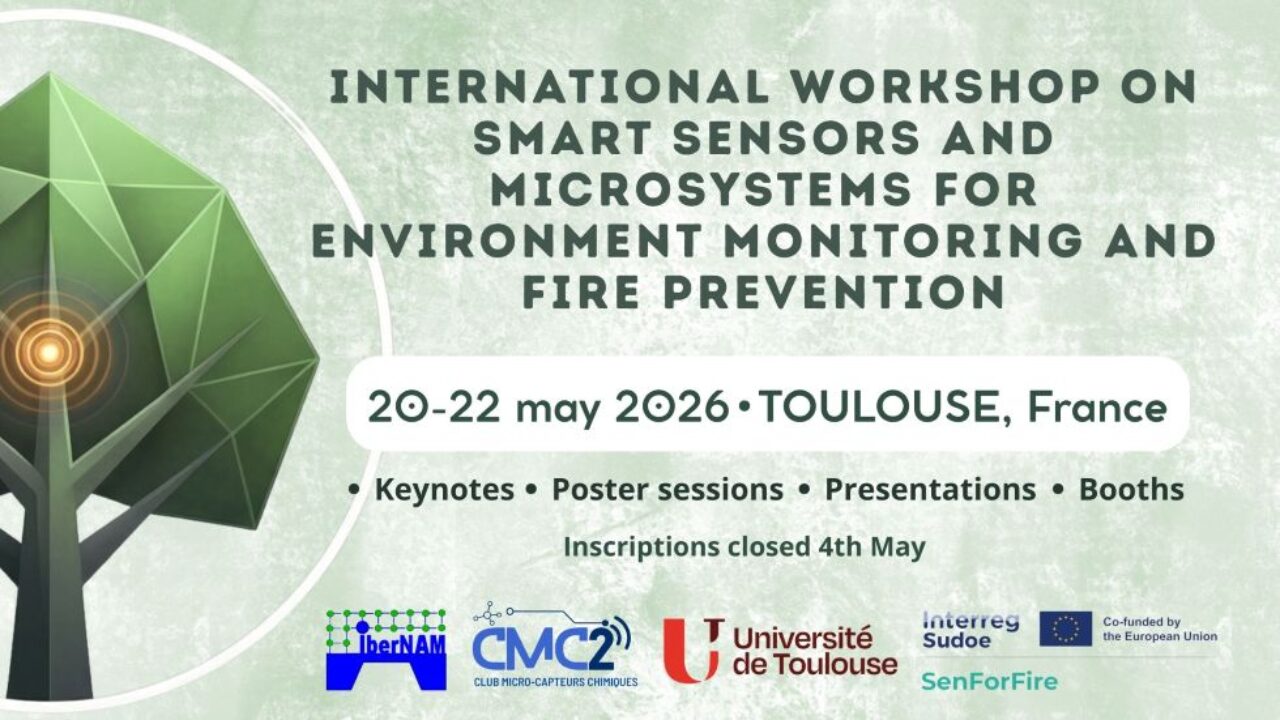
The scientific and technological gathering, driven by the European project SenForFire under the Interreg Sudoe 2021–2027 framework, will take place from May 20 to 22 at the IRIT institute of the University of Toulouse, bringing together researchers, universities, technology centres, and specialised companies from Spain, France, and Portugal.
The European project SenForFire today inaugurates in Toulouse the international workshop “Smart Sensors and Microsystems for Environment Monitoring and Fire Prevention.” The event, running until Friday, May 22, is being held at the Jacques Herbrand auditorium of the Toulouse Computer Science Research Institute (IRIT), on the University of Toulouse campus.
Over three days, the workshop will bring together researchers, technology centres, universities, public administrations, and companies specialising in electronics, sensing, and risk management, with the aim of presenting recent scientific advances, sharing field deployment experiences, and fostering international cooperation in a field of strategic importance for southern Europe.
The programme includes sessions on the design and validation of miniaturised sensors for measuring key environmental variables — temperature, humidity, gases, particles, and wind — as well as the development of low-cost wireless networks for the early detection of fire outbreaks. Also on the agenda are intelligent data processing solutions, risk modelling, and digital platforms for real-time visualisation and fire spread simulation. The opening day will feature presentations by researchers from CSIC, the University of Coimbra, and the French company ELLONA, among others, along with a keynote lecture by Cyrielle Denjean, researcher at CNRM of Météo France and coordinator of the EUBURN project.
A transnational consortium serving the SUDOE territory
SenForFire is funded by the European Interreg Sudoe 2021–2027 programme and brings together a transnational consortium of scientific and technological organisations from Spain, France, and Portugal. Its partners include leading institutions such as the Spanish National Research Council (CSIC), alongside universities and companies specialising in environmental monitoring and advanced electronic systems.
The project aims to develop and deploy smart wireless sensor networks to improve risk anticipation, reduce detection times, and support decision-making by authorities and emergency services. The technological solutions are currently undergoing experimental trials and pilot testing under real conditions in forest environments across the SUDOE area, one of the European regions most exposed to wildfires exacerbated by climate change.
In-person and online attendance
The workshop also offers the option to follow sessions and submit presentations remotely for those unable to travel to Toulouse. Full information, the detailed programme, and remote access are available on the official event website: https://senforfire.sciencesconf.org/