
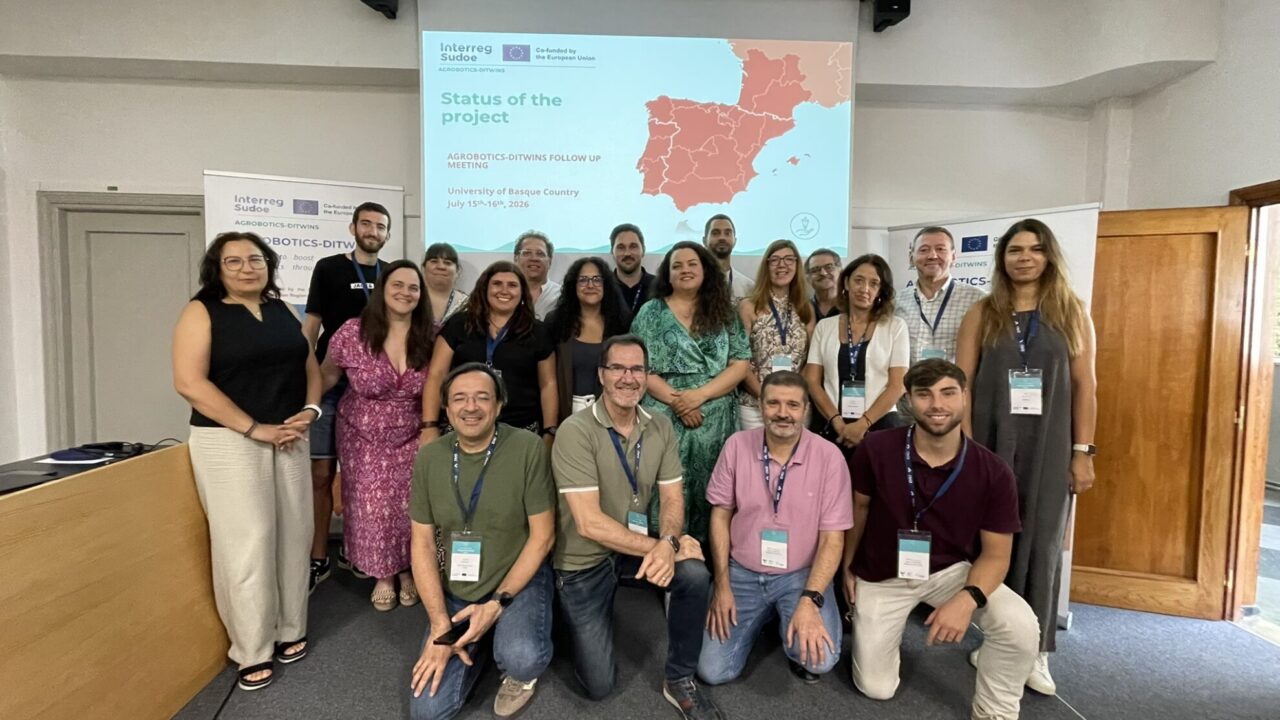
The 13 partners of the European Agrobotics-DiTwins project met in Bilbao on 15 and 16 July 2026 to review the progress achieved so far, coordinate the next phase of work and prepare the activation of the project’s transnational network of Living Labs.
The partnership is led by the University of Málaga as the coordinating entity, together with the University of the Basque Country (EHU/UPV), Miguel Hernández University of Elche, University of Huelva, University of Algarve, Université de Limoges, Málaga TechPark, Data CoLab, NERA – Associação Empresarial da Região do Algarve, Aquitaine Robotics, OSFARM, FI Group and ELATEC.
Co-funded by the Interreg Sudoe Programme, Agrobotics-DiTwins aims to support the transition towards Agriculture 5.0 by facilitating the uptake of robotics, artificial intelligence and digital twins among agricultural and technology SMEs.
The project is developing a transnational network of Living Labs where companies, agricultural professionals, research organisations and technology providers can work together to design, simulate and validate solutions adapted to real operational needs. This approach seeks to reduce the risks associated with technological adoption and promote more efficient, sustainable and competitive agricultural production models.
The meeting was held at the Bilbao School of Engineering of the University of the Basque Country (UPV/EHU), following the completion of the project’s initial phase. This first stage focused on identifying agricultural processes with significant environmental impact, analysing the technological needs of the sector, and defining the specifications required for the project’s digital twins, agricultural simulations and Living Labs.
Over the two-day meeting, partners reviewed the overall status of the project, discussed the results achieved to date and coordinated the transition towards the pilot co-creation programme. The agenda combined steering and coordination sessions, technical discussions, presentations by the participating Living Labs and a visit to the UPV/EHU Living Lab facilities.
The meeting provided an opportunity to compare the capabilities, facilities and service portfolios of the different Living Labs. Partners also discussed the common methodology that will be used to identify business needs, select relevant use cases and support participating organisations throughout the co-creation process.
This joint work is essential to ensure that the services offered across the three participating countries are coherent, complementary and aligned with the real needs of agricultural and technology SMEs.
A dedicated session was also held to review the project’s communication strategy and the campaign supporting the promotion of the Living Labs and the pilot programme.
Málaga TechPark, as the project’s communication lead, presented the main actions planned to raise awareness of the opportunities available, mobilise potential participants and support the recruitment of agricultural SMEs, service providers, cooperatives, business associations and other relevant organisations.
Next steps: from planning to co-creation
Following the Bilbao meeting, the consortium will move forward with the identification and selection of participating companies, the definition of specific use cases and the preparation of the pilot programme.
Selected organisations will work with the technical teams of the Living Labs to analyse their challenges, explore possible robotics-based solutions and assess their feasibility through digital twins and simulation tools before implementation under real-world conditions.
The meeting strengthened coordination among the 13 partners and established a shared roadmap for moving from technical preparation to experimentation and co-creation with companies. Agrobotics-DiTwins is therefore entering a key implementation phase that will bring advanced technologies closer to the practical needs of the agricultural sector and contribute to the consolidation of a transnational Agriculture 5.0 ecosystem across the Sudoe area.