
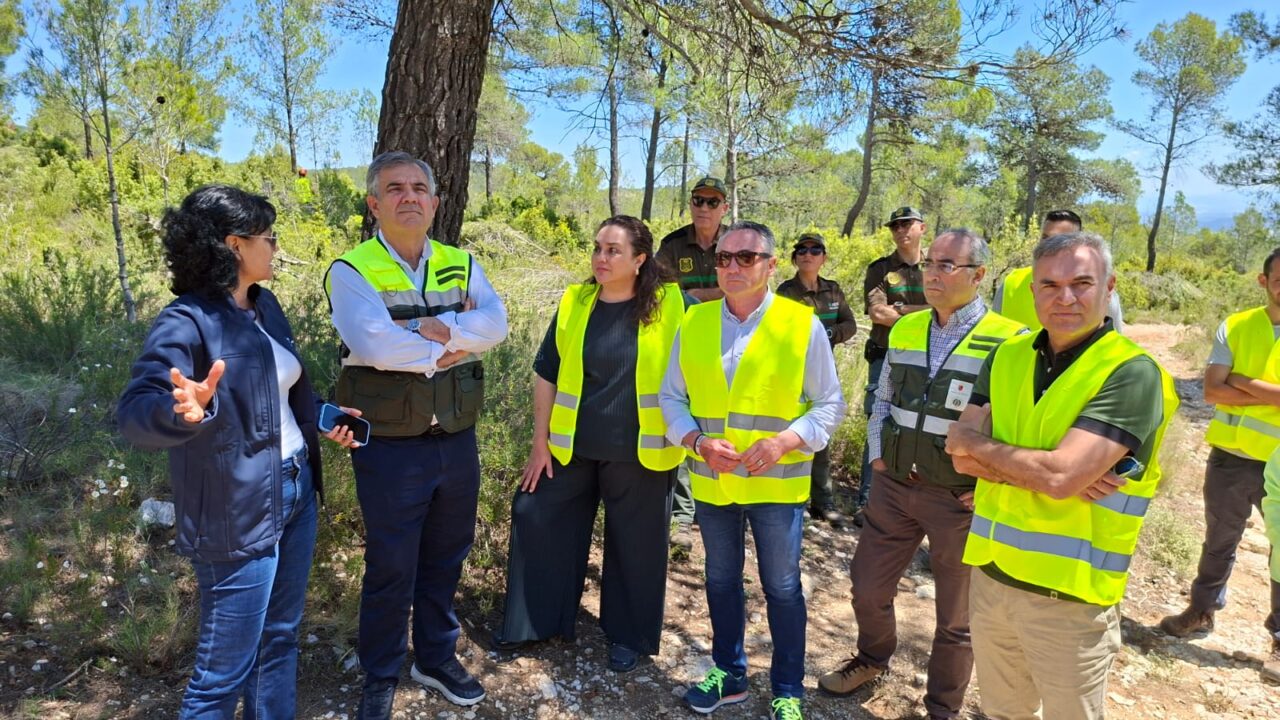
The Regional Minister for Environment, Universities, Research and the Mar Menor of Murcia, Juan María Vázquez, and the Regional Secretary for Energy, Sustainability and Climate Action, María Cruz Ferreira Costa, visited this week one of the pilot sites launched by the Region of Murcia through the SocialForest project, part of the Interreg Sudoe 2021–2027 programme.
This institutional visit to the experimental site served to promote the work being carried out by the regional government in the field of adaptive forest management and, through it, to reduce the vulnerability of forest stands to climate change and generate technical knowledge applicable to other territories in south-west Europe. The meeting also brought together local public authorities, technical staff from the Regional Ministry and members of the media, highlighting the growing social interest in this type of forestry initiative.

The forest area where the intervention is taking place is directly linked to the great Moratalla wildfire of 1994, one of the most serious forest fire events suffered by the Region of Murcia, affecting more than 28,000 hectares. As a result of that fire, a large proportion of the mature trees disappeared, and the current forest largely stems from the subsequent natural regeneration. Three decades later, this abundant regeneration has resulted in an excessively dense and highly homogeneous young pine forest, with intense competition between trees, compromising its development, increasing its sensitivity to drought and raising the risk of future wildfires.
The pilot action covers an area of approximately 15 hectares, distributed across four stands with different silvicultural characteristics. The planned work includes thinning and regulation thinning of regenerated trees, crown lifting and pruning, branch removal, cutting and topping, as well as the management of the resulting plant debris. The aim is to select the trees with the best prospects, reduce competition for water, light and nutrients, decrease fuel continuity and guide the forest towards a more stable, diverse and functional structure.
From an ecological perspective, the intervention seeks to improve the vigour of the new forest stand, support its consolidation, reduce wildfire risk and increase the forest’s capacity to continue providing essential ecosystem services, such as soil protection against erosion, water regulation, carbon sequestration and biodiversity conservation. The project also has a strong demonstrative component, as it will allow comparison between the evolution of a treated area and another without intervention, producing measurable and transferable results for other territories within the SUDOE area facing similar challenges.
In this regard, the Moratalla experience will also have significant strategic value, as the Region of Murcia is considered within the SUDOE area to be especially vulnerable to the impacts of climate change on Mediterranean forest ecosystems. More severe droughts, increased wildfire risk and the difficulty of consolidating forest stands after major disturbances make this project a real-life laboratory for testing forest adaptation solutions that can be transferred to other regions in southern Europe.
The investment amounts to €43,250 and is co-financed at 75% by the European Regional Development Fund (ERDF) through the Interreg Sudoe programme, while the remaining 25% is provided by the Autonomous Community of the Region of Murcia. The project also includes the environmental prevention and monitoring measures required to ensure rigorous implementation fully compatible with the natural values of the area.
Through this intervention, the Autonomous Community is reinforcing its commitment to evidence-based forest management, aimed not only at restoring and improving a forest stand that emerged after a major disturbance, but also at anticipating the effects of climate change on Mediterranean forests. The Moratalla pilot action will therefore serve to validate replicable solutions for future restoration, adaptation and prevention actions in other pine forests across south-west Europe.
Instagram (@socialforest_sudoe)