
The Viseu Dão Lafões region presents climatic conditions that are particularly sensitive to cold air accumulation due to its landscape. This leads to spring frost episodes that severely affect strategic crops such as vineyards (Dão) and apples (Bravo de Esmolfe).
These frosts coincide with critical phases of the vegetative cycle:
Within the framework of the An-Gel project, a high-precision spraying system using microsprinklers has been implemented as an active adaptation and mitigation measure against frost. This system continuously sprays water during cold episodes; as it freezes on the plant, latent heat is released, keeping the tissues at 0 ºC and forming a layer of ice that acts as thermal insulation, preventing damage.
Advantages:
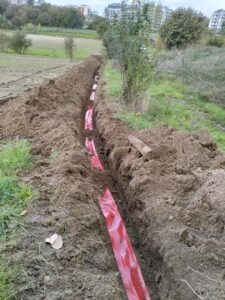
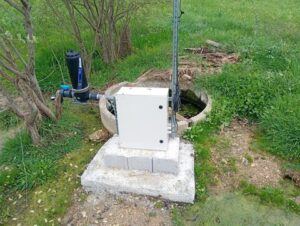

Various actions have been carried out in the pilot plot, including the installation of the water distribution system (pipes and fittings), the implementation of microsprinklers in the vineyard, the commissioning of the pumping and automation system, as well as necessary construction works such as trench excavation and infrastructure assembly.
This experience will allow the effectiveness of the system to be evaluated under real field conditions, contributing to the reduction of economic losses caused by frost. Furthermore, it will facilitate the generation of transferable knowledge to other regions of the Sudoe area and promote the development of sustainable solutions for climate change adaptation.