
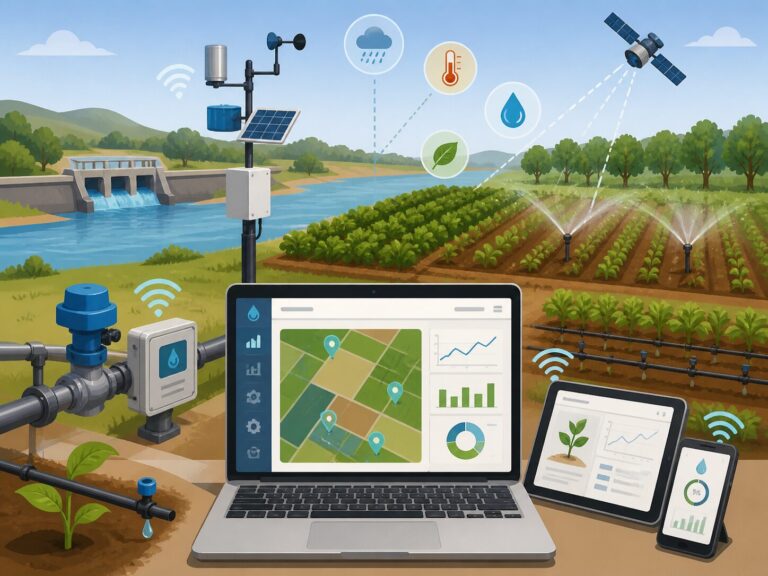
Digitalizing water management in irrigation is no longer a future option, but a necessity for managing a resource that is increasingly scarce. This Smart Green Water project report stresses that technology is only useful if it adapts to the reality of those working in the field and within irrigation communities. In this sense, the key is not to collect more data, but to turn it into practical and understandable decisions.
In agriculture, water is a strategic and limited resource. That is why improving its efficiency is essential both for the economic sustainability of the sector and for food security. The document emphasizes that digitalization makes it possible to better measure, organize, and use information on water abstraction, transport, distribution, and application, enabling a more rational and precise use of water.
One of the report’s main messages is that digital solutions should not be designed solely from a technical perspective, but from the real needs of their users. Farmers who irrigate and advisory technicians have different routines, capabilities, and priorities, so they need different interfaces that are intuitive and easy to use. In addition, the final development of these tools should be carried out together with users to ensure that they meet expectations and support long-term adoption.
The report also recommends organizing information within a Geographic Information System, since most irrigation data are linked to a specific location. This structure makes it possible to work at different management levels, from the general community to the individual plot or even smaller management units. In this way, collective water management can be combined with the private management of each irrigator.
Another key aspect is data policy. The document reminds readers that agricultural information must be collected and used with explicit permission, for specific purposes and only for as long as strictly necessary. It also highlights that data owners should be able to access their data easily and move it to other platforms without unnecessary barriers. This is complemented by the need to establish clear access profiles, such as irrigator, collective manager, and administrator, with permissions adapted to each role.
Cost is another decisive factor. According to the report, it depends not only on technology, but also on the business model, the level of service, and the degree of commitment assumed by the provider. Costs may be linked to physical equipment, digital platform subscriptions, and personalized services such as training, technical support, or consulting. For this reason, a digital solution must offer a real balance between investment and benefit.
Finally, the report places strong emphasis on interoperability. Irrigation data change at different frequencies and must be exchangeable between different systems for digitalization to work effectively. At this point, technical standards are mentioned that help ensure equipment, sensors, and platforms from different manufacturers can communicate with one another.
Access the report here: RECOMENDACIONES A LOS CREADORES DE SOLUCIONES (EN)