
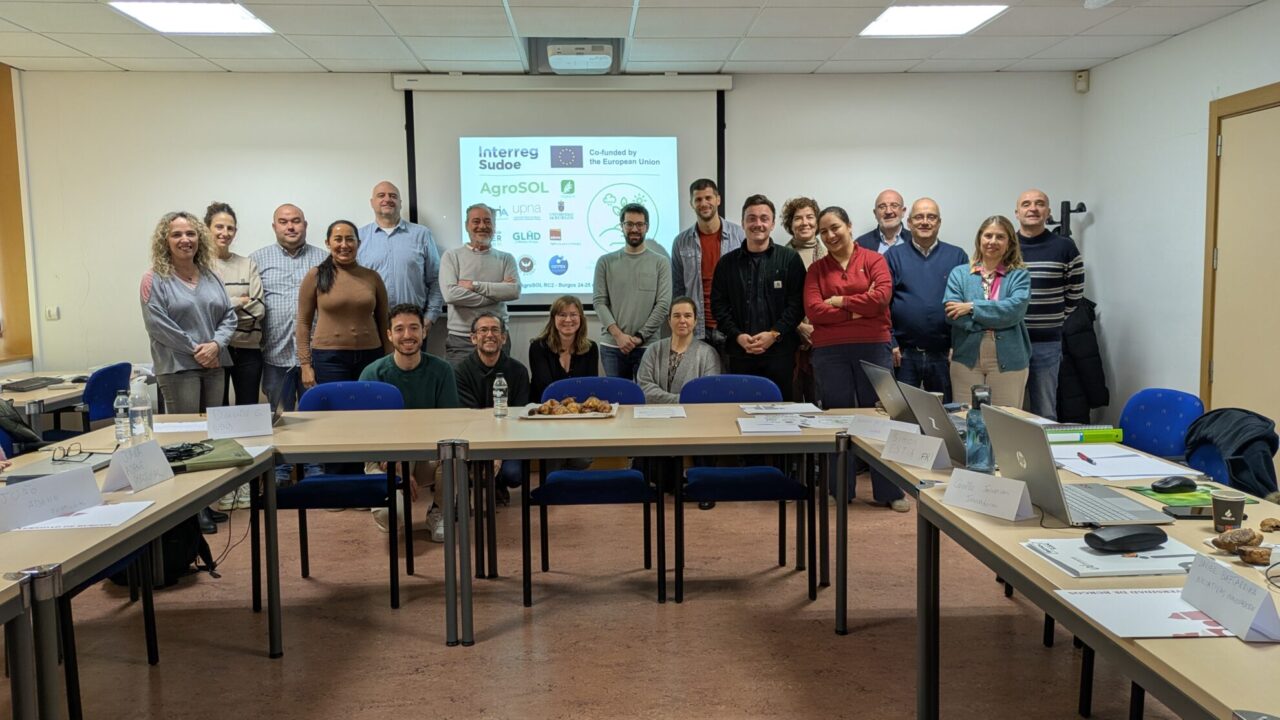
The European project, co-funded by Interreg SUDOE, is launching five pilots in Spain, France and Portugal to develop agrovoltaic models adapted to small and medium-sized rural farms
Mont-de-Marsan, 3 June 2026. Can solar energy strengthen agriculture instead of competing with it? This is the question posed by AgroSOL, a European project working on the development of sustainable agrovoltaic models for small and medium-sized rural farms. Through five pilots in Spain, France and Portugal, the project will analyse how to combine agricultural production and photovoltaic generation in the same space, assessing their effects on crops, the microclimate, biodiversity, farm management and the economic viability of farms.
From 3 to 5 June 2026, the participating organisations are meeting in Mont-de-Marsan, Nouvelle-Aquitaine, at the premises of GIP Agrolandes Développement, to hold the third consortium meeting of the project. The meeting will make it possible to review the progress made, coordinate the next activities and visit the French pilot, where the agrovoltaic installation will be presented and testimonies will be gathered from farmers involved in this type of initiative.
AgroSOL addresses a shared challenge in the SUDOE territory: moving towards greater energy sovereignty while adapting agriculture to climate change without compromising food production or the future of rural farms. Agrovoltaics offer an opportunity in this context, but also pose risks if not properly designed, such as speculation on agricultural land, possible impacts on biodiversity, or unwanted changes in farmers’ working practices.
For this reason, the project does not present agrovoltaics as a single or automatic solution. Its objective is to generate evidence, methodologies and tools to help determine under what conditions this technology can be useful for farmers, public authorities, and stakeholders in the energy and agricultural sectors.
The five AgroSOL pilots operate on real farms, generating data under the same conditions in which farmers work on a daily basis.
Pilot 1: ES (Navarra) – Led by Consorcio EDER with technical support from UPNA and UBU, it will carry out the project in woody crops (almond trees), alternating rows of almond trees with rows of solar infrastructure.
Pilot 2: PT (Alentejo) – Implemented by the University of Évora in collaboration with ADENE, a pilot agrovoltaic system in a greenhouse on the University of Évora campus.
Pilot 3: FR (Nouvelle Aquitaine) – Carried out jointly by GLHD and ESTIA, the project will include different trials aimed at deepening the study of crop growth in agrovoltaic systems, including both horticultural and field crops.
Pilot 4: ES (Castile and Leon) – Led by ITAGRA, it will focus on agrovoltaics with mushroom production combined with the production of aromatic and medicinal plants, with technical support from UPNA and UBU and support from EREN for the dissemination of results.
Pilot 5: ES (Extremadura) – Coordinated by CICYTEX, it will analyse the impact of solar panels on winter cereal crops.
Based on these pilots, AgroSOL will collect data on agricultural production, electricity generation, radiation, temperature, humidity and other microclimatic parameters. The results will be used to develop a common strategy, action plans, design guides, good practice manuals and training activities to facilitate the responsible implementation of agrovoltaic models in SUDOE rural areas.
All information about the project, its activities and progress will be available on the official AgroSOL website: https://interreg-sudoe.eu/en/proyecto-interreg/agrosol/
About AgroSOL
AgroSOL – Agrovoltaics and resilience in rural areas of the SUDOE territory is a transnational cooperation project co-funded by the Interreg SUDOE 2021-2027 Programme through the European Regional Development Fund (ERDF). It will run for 36 months, from 1 June 2025 to 31 May 2028, and has ERDF support of €1,681,159.52 against a total eligible cost of €2,241,546.00.
The project brings together 10 partners from Spain, France and Portugal, representing complementary areas of research, agricultural innovation, energy and territorial development, with the aim of developing sustainable agrovoltaic models adapted to small and medium-sized rural farms in the SUDOE area.
Media contact:
Consorcio EDER
eder@consorcioeder.es
Project co-funded by the European Regional Development Fund (ERDF) through the Interreg Sudoe 2021-2027 Programme