
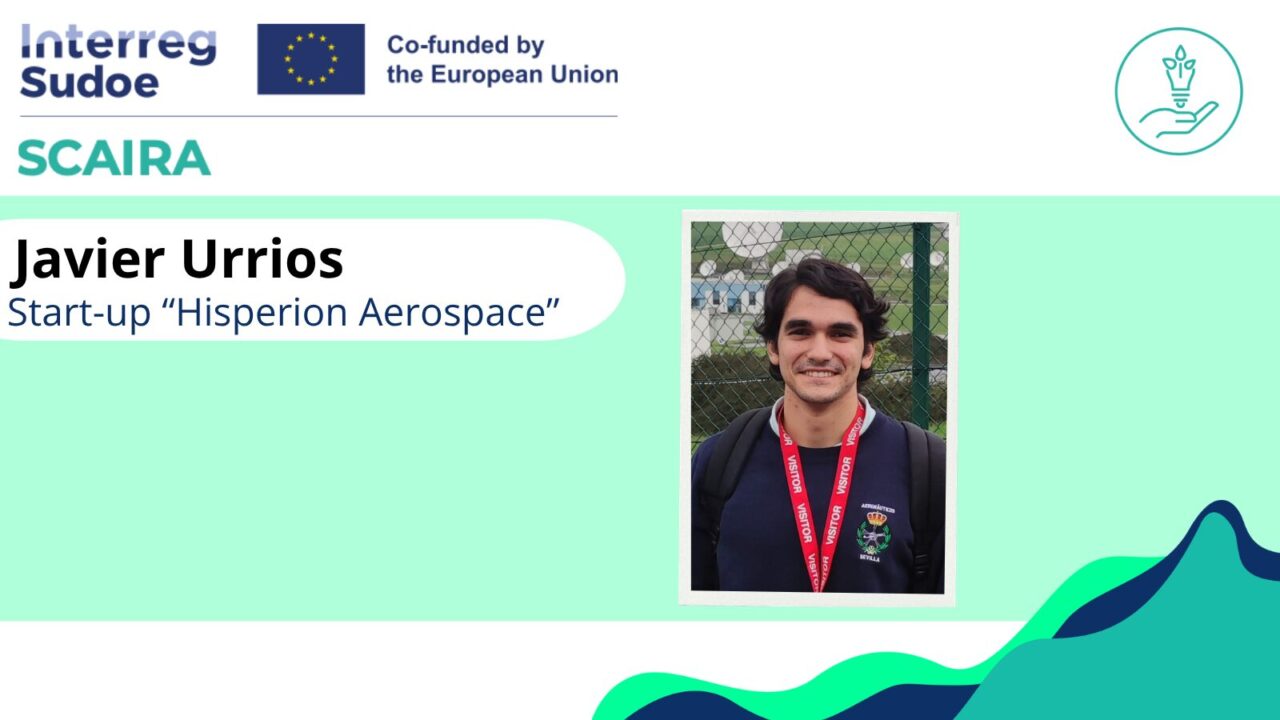
Meet Javier Urrios, selected in the third call with his project Hisperion Aerospace.
Tell us briefly about yourself and your background!
My name is Javier Urrios. I am an aerospace engineer and I focus my professional career on the space sector. I studied for my degree in Seville and later had the opportunity to move to Milan to complete a dual master’s degree. During my studies, I carried out research work with both the University of Seville and the Polytechnic University of Milan, mainly focused on the optimisation of spacecraft trajectories using new propulsion technologies.
How did you find out about SCAIRA?
I had the opportunity to meet Silvia de los Santos, Head of the Aerospace Sector at CTA, at NISE 2025 in Seville. We made our initial contact there, and she later informed us about this programme, which I greatly appreciate.
What stage is your start-up currently at?
We currently have early traction. We developed the MVP less than a year ago and, since then, have been improving our software to reach a commercially ready and easily scalable version. During this development period, we have already secured two paying customers, which we consider a clear sign of market validation.

What is the nature of your project, and what problem does it aim to solve?
Our ultimate goal is to democratise access to space through the development of Orbita, a European high-fidelity space simulation platform designed specifically for the New Space sector. Orbita covers the entire satellite lifecycle, from the conceptual phase to in-orbit operations and end-of-life. It models dynamics, sensors and actuators, and uniquely incorporates onboard satellite camera simulation to validate control systems based on artificial intelligence and computer vision.
Problem: Traditionally, space simulation has relied on two main approaches: established commercial solutions with high costs and limited adaptability for SMEs, or the development of ad hoc code from scratch, which is costly and prone to errors. Moreover, current tools do not adequately integrate emerging requirements such as artificial intelligence and machine learning (AI/ML), nor the most advanced Guidance, Navigation and Control (GNC) techniques. Orbita removes this limitation by providing an accessible graphical user interface (GUI), based on C++, together with a block-diagram workflow that significantly reduces the need for intensive programming. It also directly addresses space sustainability by enabling eco-design approaches and validating collision avoidance manoeuvres (CAM), thereby helping to prevent the proliferation of space debris.
Objectives and future vision: In the short term, our objective is to complete Orbita 1.0, secure between 10 and 20 European SMEs as pilot customers, and validate our pricing model. In the coming years, we aim to lead the European New Space software revolution by becoming the reference mission simulator in the EU. Looking ahead to 2029, we plan to expand across the EU, the United States and Asia, scaling through individual and institutional licensing in order to achieve several million euros in Annual Recurring Revenue (ARR).
Which SCAIRA services have you chosen?
We have selected the following services:
What are your short-term objectives during the acceleration programme?
We view the SCAIRA programme as a practical support mechanism to strengthen key business areas while continuing to focus on product development. Through our participation, we expect to gain actionable guidance on intellectual property strategies needed to protect our software and algorithms before scaling; prepare effectively for our upcoming seed funding round through targeted training and seminars; and benefit from access to the programme’s network of investors and potential industrial partners. In the short term, this support will help us address non-technical knowledge gaps and validate our business model and pricing strategy with professional guidance. In addition, we intend to make full use of the organised B2B meetings to establish structured connections with other aerospace SMEs and potential clients.
Who is your target market and what customer need are you addressing?
Our target market consists of SMEs in the New Space sector and, in the future, also space agencies. In the short term, we expect to secure between 10 and 20 SMEs in Spain and across the European Union as pilot customers. In the longer term, we plan to expand across the EU, the United States and Asia, scaling through individual and institutional bulk licences and pursuing integrations with operators and major industry players.
In terms of customer needs, simulation is a fundamental component of space projects, as physical corrections cannot be carried out once systems are in orbit. This positions our product as a key solution in the early stages of the space sector value chain. At present, New Space actors either develop costly, time-consuming and error-prone ad hoc code or rely on established commercial software suites with high costs and limited adaptability.
Moreover, existing tools do not fully incorporate capabilities required by a rapidly evolving sector, such as seamless integration of artificial intelligence and machine learning (AI/ML), high-fidelity satellite camera vision simulation, or the ability to model and validate advanced Guidance, Navigation and Control (GNC) techniques.
Our solution, Orbita, removes this limitation by providing an easy-to-use graphical user interface, a block-diagram-based workflow, and scripting tools for the simulation of spacecraft dynamics and operations without the need for extensive programming effort.
What challenges do you identify today?
Although our technical solution aims to address the sectoral challenge of “Circular economy in the aerospace and automotive industries” (SCAIRA Challenge 5), our internal challenges as a start-up currently relate mainly to non-technical knowledge gaps:
- We need to establish intellectual property strategies to protect our software and algorithms before scaling.
- We are working to validate our business model and pricing strategy.
- We are preparing for our upcoming seed funding round and need to connect with investors and industry partners.
- We need to strengthen brand awareness and expand our network beyond our local ecosystem in order to initiate discussions that could lead to commercial relationships or pilot projects outside Spain and, potentially, beyond Europe.
Do you already have a team?
Yes, Hisperion Aerospace S.L. was founded by three aerospace engineers. In my case, as CEO, I am responsible for leading the strategy and coordination of the project, contributing an entrepreneurial vision and strong communication skills. José Antonio Rebollo, our CTO, is responsible for software development and high-performance systems engineering, supported by a strong research background. Meanwhile, Joaquín González López-Cepero, the company’s COO, oversees operational organisation and the execution of activities.