
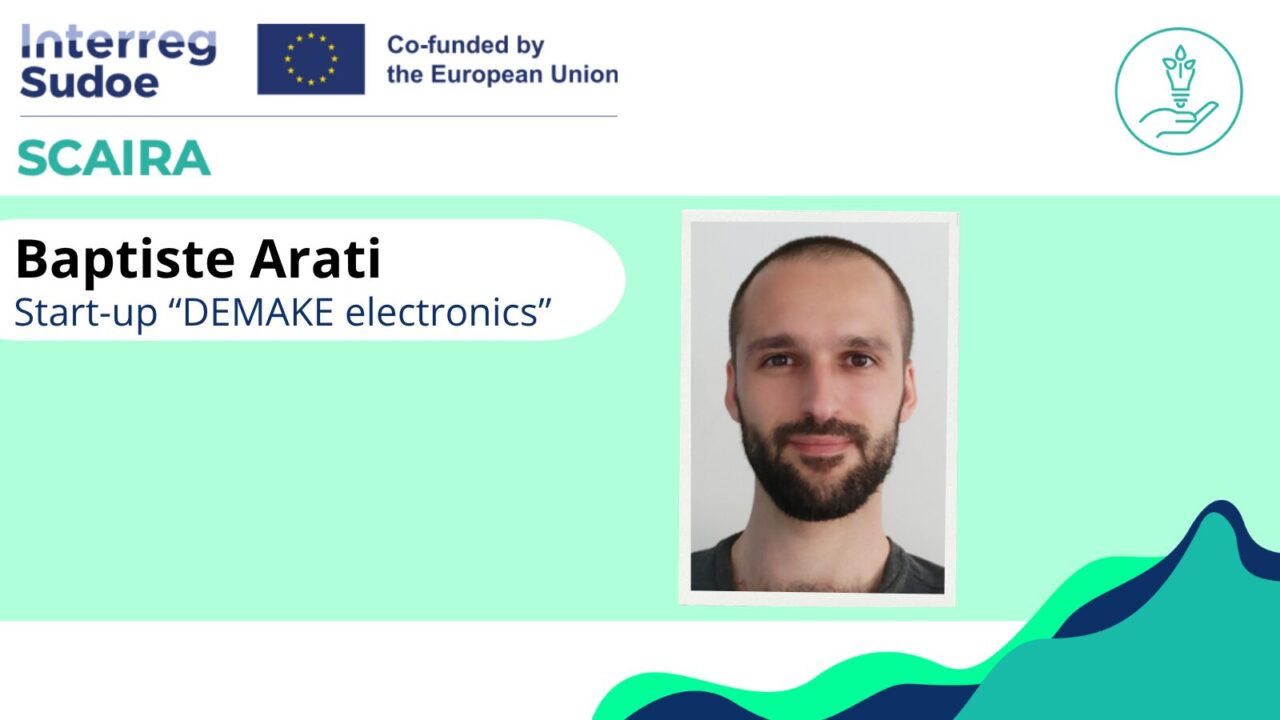
Meet Baptiste Arati, selected in the third call with his project DEMAKE electronics.
Tell us briefly about yourself and your background!
How did you find out about SCAIRA?
I first heard about the SCAIRA project from my former PhD supervisor, Gilbert Teyssedre, Research Director at the CNRS, as I had been manifesting a lot of interest for sustainable engineering. The project attracted my interest for two main reasons. On the one hand, the consortium has a strong industrial presence, particularly from partners in sectors with which I had already been in contact or that operate in areas I know well. I considered the challenges addressed to be ambitious and reflective of a shift in the needs and technological direction of major end users. This was a key factor, as the DEMAKE initiative requires solid support from industry in order to be relevant.
On the other hand, the acceleration programme was relatively short in duration, focused on the geographical area in which I live, and offered appropriate support for early-stage start-ups. This meant that the launch of my company could happen rapidly, allowing to begin generating recurring cash flow. Overall, the conditions matched my needs well.
What stage is your start-up currently at?
From the perspective of its structuring, this start-up is at the ideation phase and will be developed over the next few months. My intention is to use the programme to ensure the best possible launch. From a thematic and positioning perspective, the project is becoming increasingly well-defined and is attracting growing interest. The general approach appears to stand up well to technical constraints and the need is clearly identified within the community.
What is the nature of your project, and what problem does it aim to solve?
The DEMAKE project aims to promote the circularity of electronic products by establishing a structured roadmap towards a genuinely circular economy. The core principle is to develop a value chain capable of dismantling and reassembling electronic devices, supported by the development of key technologies for the recycling of electronic packaging materials. The solution proposed by DEMAKE focuses on the development of recoverable high-performance electrical insulation, lifting several technological locks that currently limit the circularity of electronics.
The main expected benefits of this approach are as follows:
- Repairability of encapsulated/embedded electronics, reducing the need for replacement
- Controlled dismantling for the recovery of critical materials and components, strengthening technological sovereignty and supply chain resilience
- Support for the development of new sustainable electronic architectures
Which SCAIRA services have you chosen?
Service 1: Legal and administrative training for the creation of start-ups.
Service 2: Intellectual property training.
Services 3 and 4: National public funding opportunities for start-ups and green innovations.
Service 13: Preparation of the project for presentation to industry and investors, including registration on LOOM.
Service 11: Preparation of the business plan and the Business Model Canvas.
Service 10: Marketing and corporate communication.
Service 14: B2B meetings between start-ups and industrial companies, and B2F meetings between start-ups and investors.
What are your short-term objectives during the acceleration programme?
In the very short term, I expect the acceleration programme to help me better structure the project. I also particularly value the support provided in the form of expert guidance in these areas. The involvement of industrial partners, especially from the aerospace and automotive sectors, is equally valuable for analysing the project from a critical perspective and providing direction on the most appropriate courses of action. By the end of the programme, the objective is to have a solid legal structure in place, together with clearly defined strategies in terms of patents and funding.
Who is your target market and what customer need are you addressing?
From a general perspective, DEMAKE is aimed at customers who require greater control over electronic packaging technologies and materials. This places the project within the field of high-value electronics, particularly among end-users concerned with the procurement and management of costly devices.
One of the most relevant target sectors is the automotive industry, which will progressively assume greater responsibility for managing its products at the end of their service life. Manufacturers are already required to have end-of-life vehicle treatment plans, and the electrification of the sector is reinforcing this need year after year. Another sector that may be more accessible in an initial phase is the aerospace and defence market. Although experiencing lower regulatory pressure as of now, this sector presents other important drivers, such as strengthening supply resilience and sovereignty or increasing repair capabilities on high-value electronics.
What challenges do you identify today?
At this stage, the main challenge is to launch the project, define the most appropriate start-up strategy and develop a plan to reach the various planned milestones. Part of this work is already underway through several initiatives and within the framework of this acceleration programme, but much remains to be done, particularly with regard to the transition between the different development phases. Next, the challenge will be to establish strong partnerships with companies willing to explore new ways of manufacturing electronic products. To achieve this, DEMAKE needs to demonstrate its value and consolidate its presence in the electronics market.
On the one hand, DEMAKE must secure a strong technological proposition, developing original research and securing IP for specific technologies. Funding for innovation and patent generation will be a key factor in the company’s viability. On the other hand, DEMAKE must position itself in a context in which many companies claim to implement circular or sustainable practices. Being well represented in the appropriate forums and having the capacity to engage effectively with stakeholders will be essential to promote actions with real impacts. Through suitable collaborative environment, the provision of technical advisory services can help companies understand how they can benefit from these changes and how DEMAKE can support them in this process.
Subsequently, DEMAKE may evolve from consultancy activities towards development and eventually production, driving this transformation together with them.
Do you already have a team?
The first milestone of this project is to establish myself as an independent actor in this field and to assess the level of involvement that partners and investors may be willing to commit.
From there, the acquisition of dedicated equipment and the creation of a working team can be considered. This will be a key moment in the transition from consultancy activities towards the development of in-house operational capabilities for research and development. The final milestone will be about scaling up the developed technology towards a larger industrial scale, thus requiring a broader team and capabilities.