
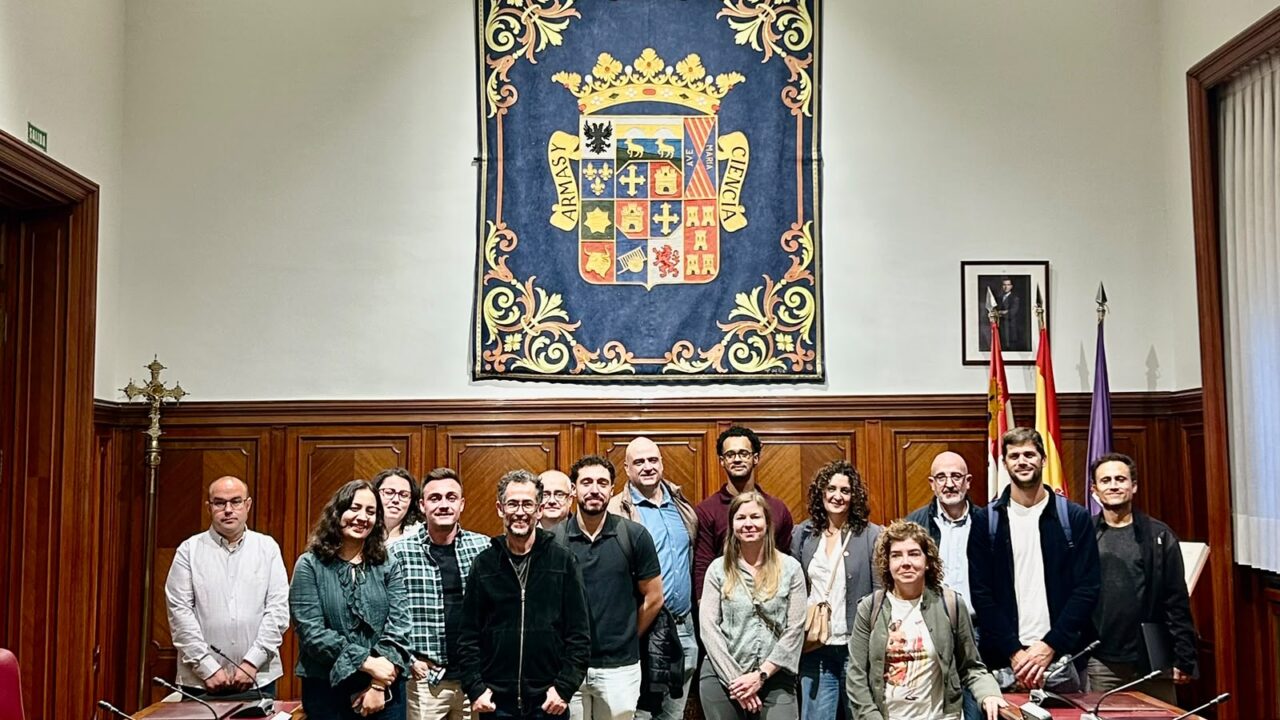
The European project, co-funded by Interreg Sudoe, has brought its partners together in Palencia to review progress across five pilot initiatives in Spain, France and Portugal and visit a facility combining mushroom cultivation with solar energy production.
Can solar panels do more than generate electricity? AgroSOL is investigating how these installations can contribute to agricultural production by studying their interaction with different crops and the environmental conditions they create. The aim is to identify models that enable food and renewable energy to be produced on the same land without compromising agricultural activities.
From 28 to 30 October, the project partners held their fourth consortium meeting in Palencia, where they reviewed activities carried out over the previous six months and coordinated the next stages of the project. Discussions focused on identifying areas with agrivoltaic potential, designing and monitoring five experimental installations, and collecting data on agricultural production, electricity generation and microclimatic conditions.
From farming to experimentation: solutions tailored to each region
AgroSOL works with different crops and agricultural systems, ranging from almond trees and cereals to vegetables, mushrooms and aromatic plants. Through its five pilots in Spain, France and Portugal, the project aims to understand the conditions under which integrating photovoltaic panels can benefit rural farms.
“One of the main challenges of agrivoltaics is ensuring that agricultural activities remain viable and profitable. To achieve this, it is essential to understand the needs of each crop and take them into account from the design stage of the installations, seeking solutions that respond to the real conditions of the agricultural sector,” explains Julio Martín Margüello from Itagra.ct.
The knowledge gained will contribute to the development of an agrivoltaic installation design guide, a good practice manual and a protocol to support the continuity and transfer of the solutions developed to other regions.
One of the highlights of the meeting was a visit to the pilot site at IES Alonso Berruguete in Palencia. Led by Itagra.ct, this initiative investigates the cultivation of three edible mushroom species (Pleurotus ostreatus, Pleurotus eryngii and Lentinula edodes), making use of the space beneath photovoltaic panels to build mini-greenhouses and exploring new opportunities for agricultural land use and production diversification.
Palencia: a meeting point for agrivoltaic cooperation
The meeting concluded on 30 October with an event open to the public at the Provincial Council of Palencia, where AgroSOL presented its initial work on agrivoltaic potential maps, experimental installations and upcoming training activities.
The event also provided an opportunity to exchange experiences with other initiatives, including the Interreg Europe EAGER project, the agrivoltaic initiative at Escuela de Tablares and the OVINIA project, which focuses on photovoltaic grazing. The Spanish Agrivoltaic Association also took part.
Cooperation between projects, institutions and professionals aims to facilitate knowledge exchange and contribute to the development of agrivoltaic solutions tailored to the needs of farms in rural areas.
About AgroSOL
AgroSOL – Agrivoltaics and Resilience in Rural Areas of the SUDOE Territory is a transnational cooperation project co-funded by the Interreg Sudoe Programme 2021–2027 through the European Regional Development Fund (ERDF). The project runs for 36 months, from 1 June 2025 to 31 May 2028, and receives €1,681,159.52 in ERDF funding, out of a total eligible budget of €2,241,546.00.
The project brings together 10 partners from Spain, France and Portugal, representing complementary fields of research, agricultural innovation, energy and territorial development, with the aim of developing sustainable agrivoltaic models adapted to small and medium-sized farms in rural areas of the SUDOE territory.
Further information about the project, its activities and progress is available on the official AgroSOL website: https://interreg-sudoe.eu/en/proyecto-interreg/agrosol/
Media contact:
Consorcio EDER
Project co-funded by the European Regional Development Fund (ERDF) through the Interreg Sudoe Programme 2021–2027.