
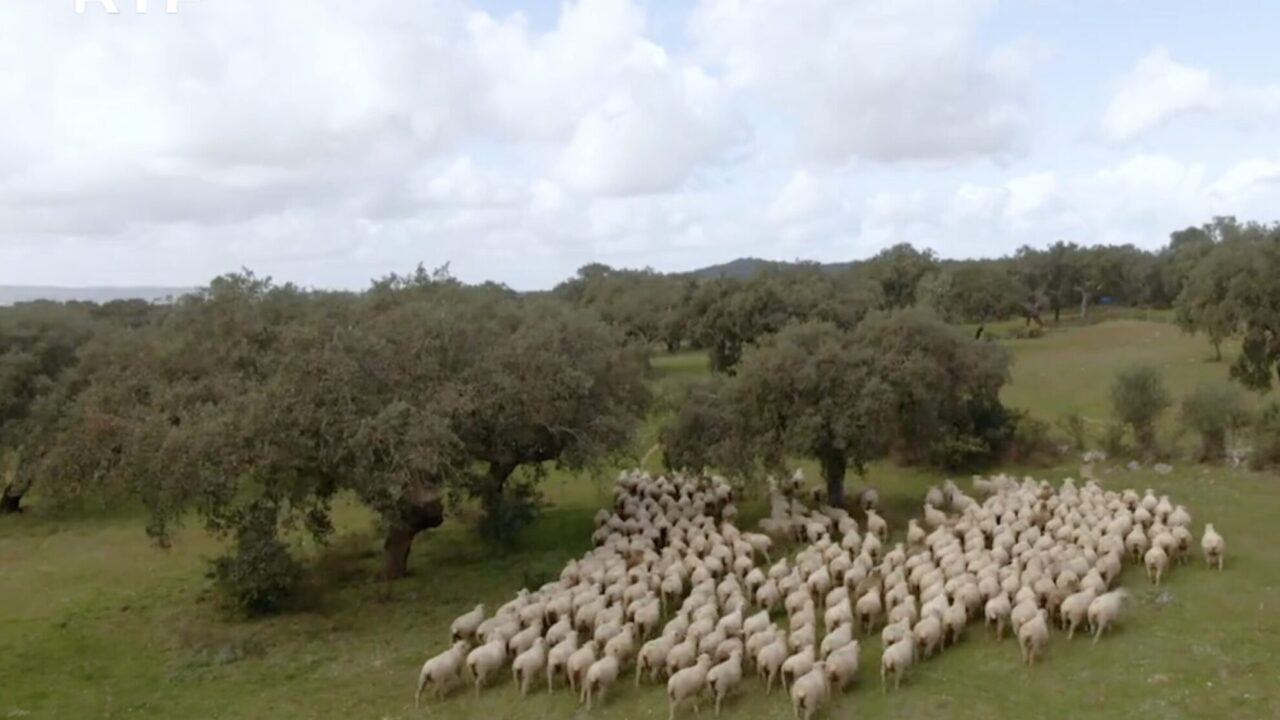
Extensive grazing in various regions of Portugal was the focus of a report broadcast on Saturday 4 July on the programme Biosfera, on RTP2 (a public television channel). The report travelled across the country to shed light on the reality faced by Portuguese shepherds, the main challenges facing the sector, and the contribution this activity makes to nature conservation, the preservation of biodiversity and the sustainable management of the land.
Throughout the report, the importance of extensive grazing in maintaining landscapes of high natural value and the ecosystem services they provide is highlighted. Among the testimonies featured is that of María Bastidas, a specialist at ADPM (Associação de Defesa do Património de Mértola), one of the partners in the PASTONATUR project, who explains how this practice contributes to the ecological balance of the land.
According to María Bastidas, “extensive grazing allows for the use of the land and the control of the shrub layer, ensuring the predominance of a diverse herbaceous layer adapted to climatic variations”. She adds that “the trampling by animals helps to incorporate manure into the soil, and their movement promotes the dispersal of seeds”, processes that are fundamental to increasing soil fertility and the natural regeneration of vegetation.
The ADPM expert also emphasises that “grazing is inherent to the formation of these landscapes”, noting that “the presence of domestic animals is crucial for the maintenance of many habitats and species of high conservation interest”.
This perspective reinforces one of the central principles of the PASTONATUR project, which will be demonstrated through pilot projects to be carried out on actual livestock and arable farms, selected in protected areas in Spain, France and Portugal. The aim is therefore to underpin, with technical and scientific knowledge, the close relationship between extensive grazing, biodiversity conservation, its role in mitigating climate change, and the sustainability of areas of high natural value.
“Without this interaction between human activity and nature, these landscapes would lose much of their ecological character and biodiversity,” adds María Bastidas.
The programme also highlighted the contribution of extensive grazing to fire prevention in Portugal. By highlighting the environmental, social and economic benefits of this activity, it raises public awareness of the role that herders play in the management and preservation of natural landscapes.
Claudino Matos from ACOS (Associação de Agricultores do Sul), another of PASTONATUR’s partners, was also interviewed, representing the Centre of Excellence for Extensive Grazing.
His account highlighted the historical and cultural significance of extensive livestock farming in the Alentejo region, which has shaped the landscape for several centuries, recalling the transhumance route that was once used not only by Spanish herders but also by Portuguese herders coming from other regions further north.
The ‘Biosfera’ episode ‘Pastoral Ecosystems’ is available via this link: https://www.rtp.pt/play/p16211/e940495/biosfera


