
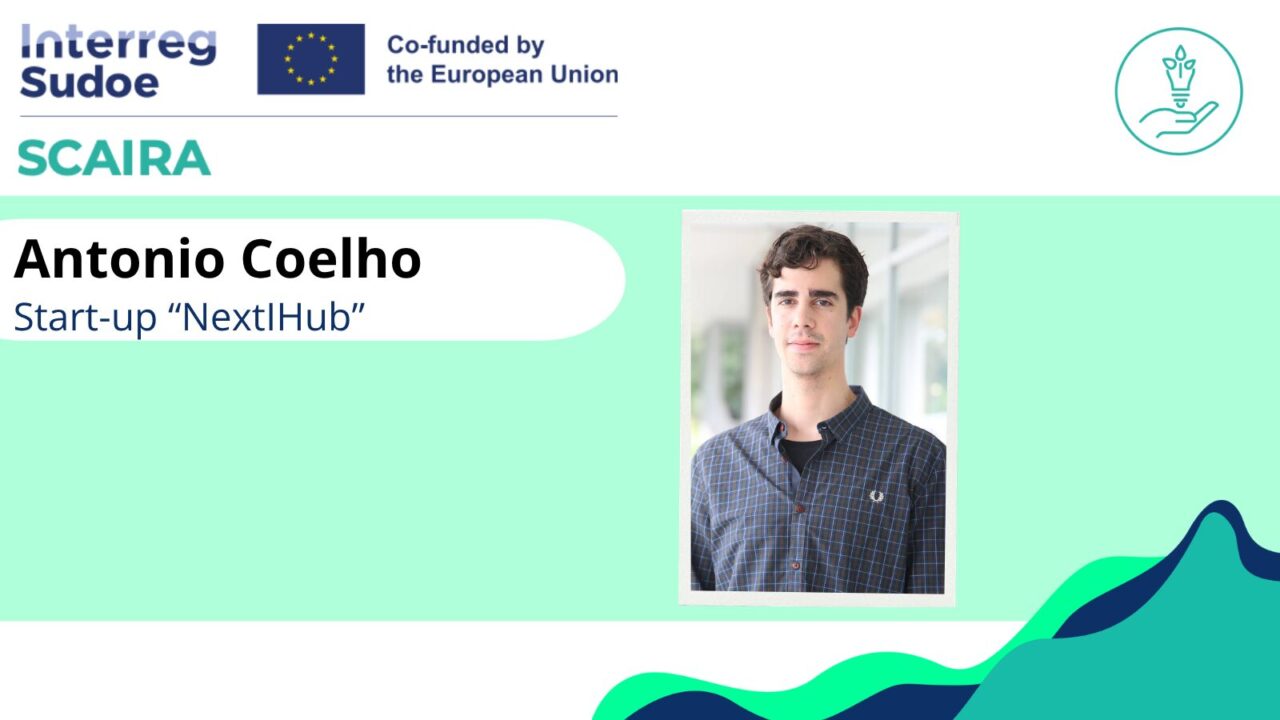
Meet António Coelho, selected in the third call with his project NextIHub.
Tell us briefly about yourself and your background!
I am a researcher and engineer specialising in sustainable energy systems, energy optimisation and data science, with a strong academic and professional background at the intersection of energy, software and applied industrial innovation. I hold a PhD in Sustainable Energy Systems from FEUP, completed within the MIT Portugal Program, where my research focused on the optimisation and market participation of multi-energy systems integrating electricity, gas, hydrogen and carbon markets.
Throughout my career, I have worked in academia, international research environments and industry. At INESC TEC, I contributed to several European and national R&D projects related to multi-energy systems, optimisation, forecasting and industrial energy management. I also had the opportunity to work at Lawrence Berkeley National Laboratory (USA), where I developed optimisation tools for multi-energy microgrids. Subsequently, I worked as a Software Engineer at Critical TechWorks, contributing to the development of cloud-based solutions for the BMW Group, which allowed me to gain valuable experience in software development, DevOps practices and the creation of industry-oriented digital solutions.
My profile combines advanced energy modelling, optimisation, machine learning and software development, supported by practical experience with Python, SQL, Pyomo, cloud technologies and industrial applications. Over the years, I have developed tools and methodologies for energy operation, planning, forecasting and market participation, and I have published scientific work in leading journals in the field. My work has also been recognised with several distinctions, including the Best PhD Thesis Award from APREN.
What led me to start this project was the strong potential I see in this type of tool, together with my longstanding personal and professional interest in energy optimisation and software development. Over the years, through my doctoral research and my involvement in R&D projects, I developed tools with clear practical value for industry. This enabled me to identify a real opportunity to translate this knowledge into a solution capable of helping companies reduce costs, improve efficiency and advance their decarbonisation efforts. NextIHub stems from that motivation: combining my technical expertise with the ambition to develop a practical and scalable software solution for industrial energy management.
How did you find out about SCAIRA?
I learned about the SCAIRA programme while presenting an energy optimisation tool I had developed at a conference at FEUP in Portugal. During the event, Tânia Estevão, from MOBINOV, who is also involved in the SCAIRA project, approached me and asked whether I would be interested in creating a start-up based on the tool. She then explained the objectives of the programme and how it could support the development of the project.
What stage is your start-up currently at?
What is the nature of your project, and what problem does it aim to solve?
NextIHub is an industrial energy decision-support software platform designed to help manufacturing companies manage increasingly complex energy systems in a smarter, more flexible and more sustainable way. The project addresses a growing challenge in industrial environments: energy management is no longer limited to electricity alone, but now involves multiple energy carriers such as electricity, heat, gas, hydrogen, storage and electrified equipment, all operating under volatile market conditions and increasing decarbonisation pressure.
Our objective is to enable industrial companies to optimise their energy operations in real time, reducing costs, lowering CO₂ emissions, improving operational reliability and creating additional value through flexibility and participation in energy markets. In practical terms, NextIHub helps users decide how and when to operate assets such as storage systems, charging infrastructure, cogeneration units and renewable generation, while taking into account production constraints, tariff structures and sustainability targets.
The project is particularly relevant for energy-intensive industrial environments, including the automotive sector and green industrial applications, where electrification and energy resilience are becoming strategic priorities. Our ambition is to transform industrial energy systems from static cost centres into flexible and intelligent assets that support both competitiveness and decarbonisation.
Over the coming years, our goal is to evolve NextIHub from a technically validated solution into a scalable, market-ready SaaS company, converting pilot projects into long-term commercial partnerships. We see ourselves working with industrial plants, industrial parks and manufacturing groups in Portugal and Spain within the MIBEL market, as well as in other European markets, supporting the transition towards a low-carbon and digitally optimised industry.
Which SCAIRA services have you chosen?
We have selected a set of SCAIRA services that reflect a phased roadmap for the development of NextIHub, from business structuring to product validation and market access.
Months 1–2
Service 1: Legal and administrative training for the creation of the start-up.
Service 11: Business plan development with the start-ups + Business Model Canvas.
Months 3–4
Service 6: Development of the proof of concept (PoC).
Service 7: Training on MVP development and prototyping.
Service 4: National public funding opportunities for start-ups and green innovations.
Service 3: Financial strategy oriented towards innovation and sustainable manufacturing.
Months 4–6
Service 10: Marketing and communication.
Service 13: Pitch preparation for presentation to industry and investors, including registration on LOOM.
Service 14: Organisation of B2B meetings between start-ups and industrial companies, and B2F meetings between start-ups and investors.
These services have been selected to strengthen the legal and business foundations of the company, structure a robust financial and funding strategy, progress from the proof of concept to a market-oriented MVP, and improve our communication, pitching and industrial partnership capabilities. Taken together, they provide a coherent roadmap to support the transition of NextIHub from a technically solid project into a start-up ready for commercialisation.
What are your short-term objectives during the acceleration programme?
During the acceleration programme, our short-term objectives focus on defining more clearly what NextIHub will become and what steps are needed to make it a reality, both from a technical and an administrative perspective.
First, and as a priority, we aim to build a solid understanding of the market. By the end of the programme, we expect to have a basic documented market analysis, identify between three and five potential OEMs as initial targets, map the main competitors and compare their products, pricing and positioning. This will help us better understand the competitive landscape, identify entry barriers, clarify the differentiating elements of our solution and estimate the market size within our initial target geography.
Second, we aim to strengthen the product itself and clarify the value proposition. Our objective is to finalise the tool, complete an initial bench test and translate the technical capabilities of NextIHub into a clear and concise one-page value proposition. We also want to define the main product benefits in business terms and structure the offer in a credible and easy-to-understand way for industrial customers and potential partners.
Third, we want to improve our commercial readiness and visibility. During the programme, we plan to prepare a simple 10-slide pitch deck, define a clear two-minute elevator pitch, launch a LinkedIn presence and a basic website or landing page, and hold at least one meeting with a potential partner. These steps are important for increasing the project’s visibility and starting direct engagement with the market.
Finally, we aim to establish the financial and legal foundations of the start-up. Our short-term objective is to prepare a simple three-year financial projection, define the revenue model and pricing assumptions, identify the main cost structure, estimate the funding needs for the next development phase and submit at least one public funding application.
Overall, our goal during the acceleration programme is to reach a more mature stage of project development: legally structured, commercially clearer, technically stronger and better prepared to launch pilot projects, establish partnerships and move towards subsequent growth phases.
Who is your target market and what customer need are you addressing?
Our main target market is industrial companies operating in the MIBEL electricity market, particularly in Portugal and Spain, where we have strong knowledge of market structures, price dynamics, regulatory conditions and industrial energy management practices. This enables us to deliver clear value from the early stages.
This is also a particularly attractive market due to the high penetration of renewable energy, especially solar and wind, which increases both the opportunities and the challenges for industrial energy management. In this context, electrification, battery storage and flexible consumption strategies can help companies adapt to generation variability, reduce energy costs and improve the use of local renewable resources.
The main need we address is the lack of integrated and practical solutions for managing increasingly complex energy systems. Industrial companies must coordinate electricity consumption, storage, charging infrastructure and other flexible assets in a context of volatile markets and growing decarbonisation requirements. Existing tools are often fragmented or limited to monitoring, without supporting operational decision-making.
NextIHub responds to this need by providing a decision-support platform that helps industrial users optimise when and how to operate electrified assets and battery storage systems, reduce electricity costs, lower emissions and improve operational reliability. In this way, we help companies in the MIBEL market turn electrification and storage into strategic opportunities rather than operational challenges.
What challenges do you identify today?
The main challenges I face at the moment are primarily related to time availability, entrepreneurial experience and market knowledge. Currently, my main professional role is at INESC TEC, so the development of this project is, for now, a parallel initiative. This means that one of the main challenges is finding enough time to dedicate to the project and to move it forward with the speed and continuity I would like.
Another important challenge is that, although I have a strong technical background and research experience, my experience in entrepreneurship and in setting up a start-up is still limited. Areas such as business structuring, go-to-market strategy, pricing models, legal incorporation, fundraising and commercial development are still relatively new to me, and these are areas where I need further support and learning.
Finally, I need to deepen my understanding of the market. It is necessary to gather more information about target customers, competitors, entry barriers, pricing approaches and the most attractive market segments for an initial deployment. Strengthening this knowledge is essential to position the project correctly and define a credible path towards commercialisation.