
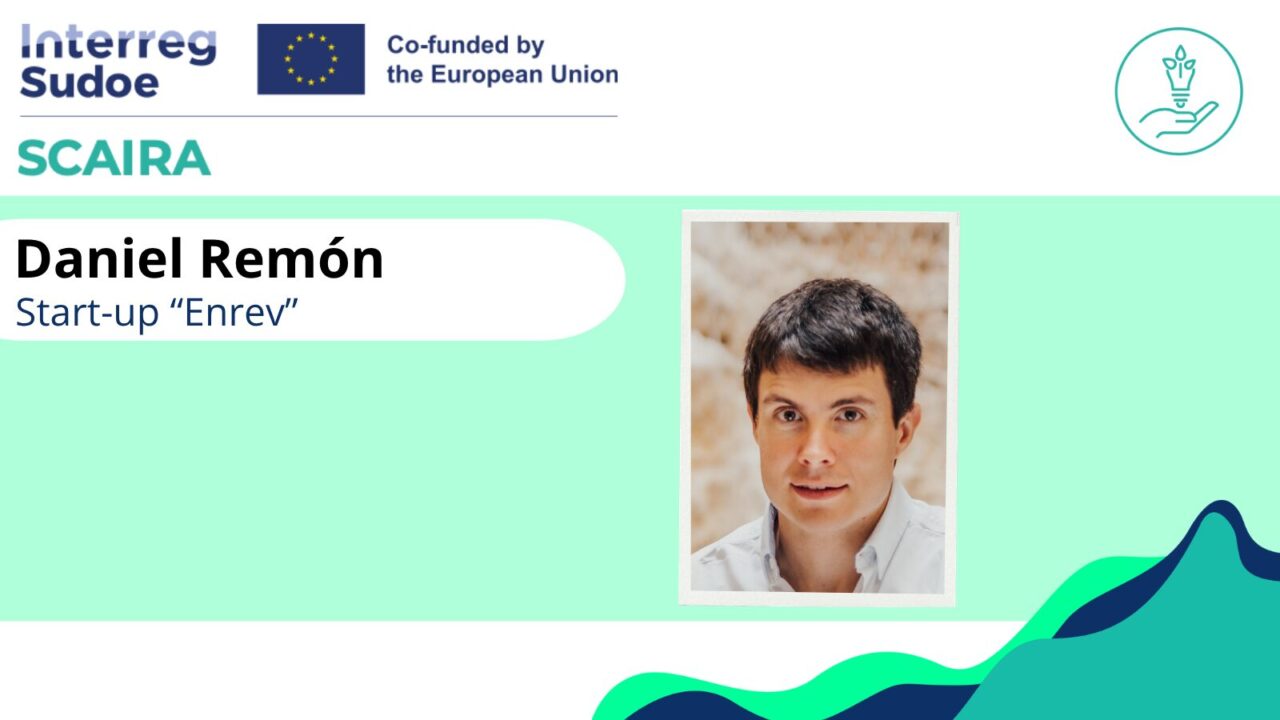
Meet Daniel Remón, selected in the third call with his project Enrev.
Tell us briefly about yourself and your background!
I hold a degree in Mathematics and Industrial Engineering from the Universitat Politècnica de Catalunya (UPC). During the final years of my studies, I specialised in power electronics as a key tool for integrating renewable energy into the electricity grid, and I continued along this path by undertaking an industrial PhD at Abengoa in Seville, focusing on the impact of photovoltaic generation on grid stability. I was ultimately awarded a PhD in Electrical Energy Systems by the UPC in 2017.

Following this stage, I began exploring solutions to make electric cars a viable option for the mass market, ensuring that their development would integrate positively with the electricity grid and support the deployment of clean energy sources. This led to the concept that gave rise to Enrev. As a result of this initial work, and driven by my intention to contribute to the development of electric mobility from Asturias, I joined guppy in 2019, where I served as Chief Technical Officer until 2024.
At that point, we decided to formally establish Enrev in order to bring our electric vehicle concept to the industry, at a time when major European manufacturers were beginning to see their position threatened—and with it the stability of many jobs across Europe—by the emergence of new competitors, primarily Chinese, who currently hold a significant competitive advantage in the electric vehicle sector, which is set to become dominant in the increasingly near future.
How did you find out about SCAIRA?
Through an email from CEEI Asturias.
What stage is your start-up currently at?
We are finalising a prototype with which we expect to reach TRL 6 following the validation phase, and to attract the interest of car manufacturers and their suppliers in order to carry out a pilot project.
What is the nature of your project, and what problem does it aim to solve?
We carry out research and development to promote the electrification of road transport and the reliable integration of renewable energy into the electricity grid. This drive towards electrification takes shape in the development of a technology that makes electric vehicles affordable and practical for everyone, so that they become the first choice in terms of price and performance, rather than a last-resort solution driven by environmental restrictions.
Specifically, this technology is based on a modular battery swapping system that enables vehicles to be designed with a battery suited to everyday use, reducing total manufacturing costs by 20% without permanently limiting their range. On the contrary, it effectively removes range as a concern, as it can be increased within minutes to accommodate any type of journey.
Moreover, interchangeable batteries can play a highly valuable role when they are not in vehicles, both by providing ancillary services to the electricity grid and by supporting stationary electrical installations.
In the long term, I see Enrev as a company developing a range of solutions to bring electric vehicles closer to the mass market, as well as for energy management in all types of systems and the control of electricity networks, thereby contributing to a clean, sustainable energy system free from geopolitical dependencies.
Which SCAIRA services have you chosen?
Service 11: Development of the business plan and the Business Model Canvas.
Service 12: Market research and identification of the target audience.
Service 3: Funding opportunities for start-ups and green innovations.
Services 6 and 7: Development of the proof of concept (POC) and the minimum viable product (MVP).
Service 9: Measurement and impact of an industrial project.
Service 13: Preparation of the project for presentation to industry and investors, including registration on the LOOM platform.
Service 14: B2B meetings between start-ups and industrial companies, and B2F meetings between start-ups and investors.
What are your short-term objectives during the acceleration programme?
Our objective during the programme is to complete the prototype, establish relationships with key industry stakeholders to jointly advance the development of the technology, and define a scalable business model around this technical collaboration.
Who is your target market and what customer need are you addressing?
Our main customers are traditional car manufacturers, Tier 1 suppliers, and battery manufacturers. We could also consider energy companies across different segments, but particularly those in the electricity sector.
Car manufacturers and their suppliers need a technology that enables them to regain the competitive advantage currently held by their Chinese counterparts, thanks to their speed of innovation and degree of vertical integration. Our technology allows them to offer attractive electric vehicles at low prices.
For battery manufacturers, interchangeable batteries provide a means of bringing their innovations to market more quickly than through the lengthy vehicle design processes.
For users, this technology solves the problem of accessing an affordable electric vehicle that can meet all their mobility needs.
What challenges do you identify today?
At present, the main challenge is to gain access to key players in the automotive industry in order to validate the business model and accelerate technical development. In the medium and long term, challenges may arise in relation to vehicle regulations and the rollout of the battery swapping network, although our technology includes elements that help reduce the cost of the latter.
Do you already have a team?
In addition to me, Enrev benefits from the occasional collaboration of Pablo as a strategy adviser. The team is completed by Miguel, Head of Mechanical Engineering; Álvaro, Head of Electrical Engineering; and Rita and Elena from the Marketing Department.